Retiring teacher, coach urges Colony grads to ‘find their 68’
By Jeremiah Bartz Frontiersman.com A football coach using a hockey reference as the centerpiece for his keynote address may


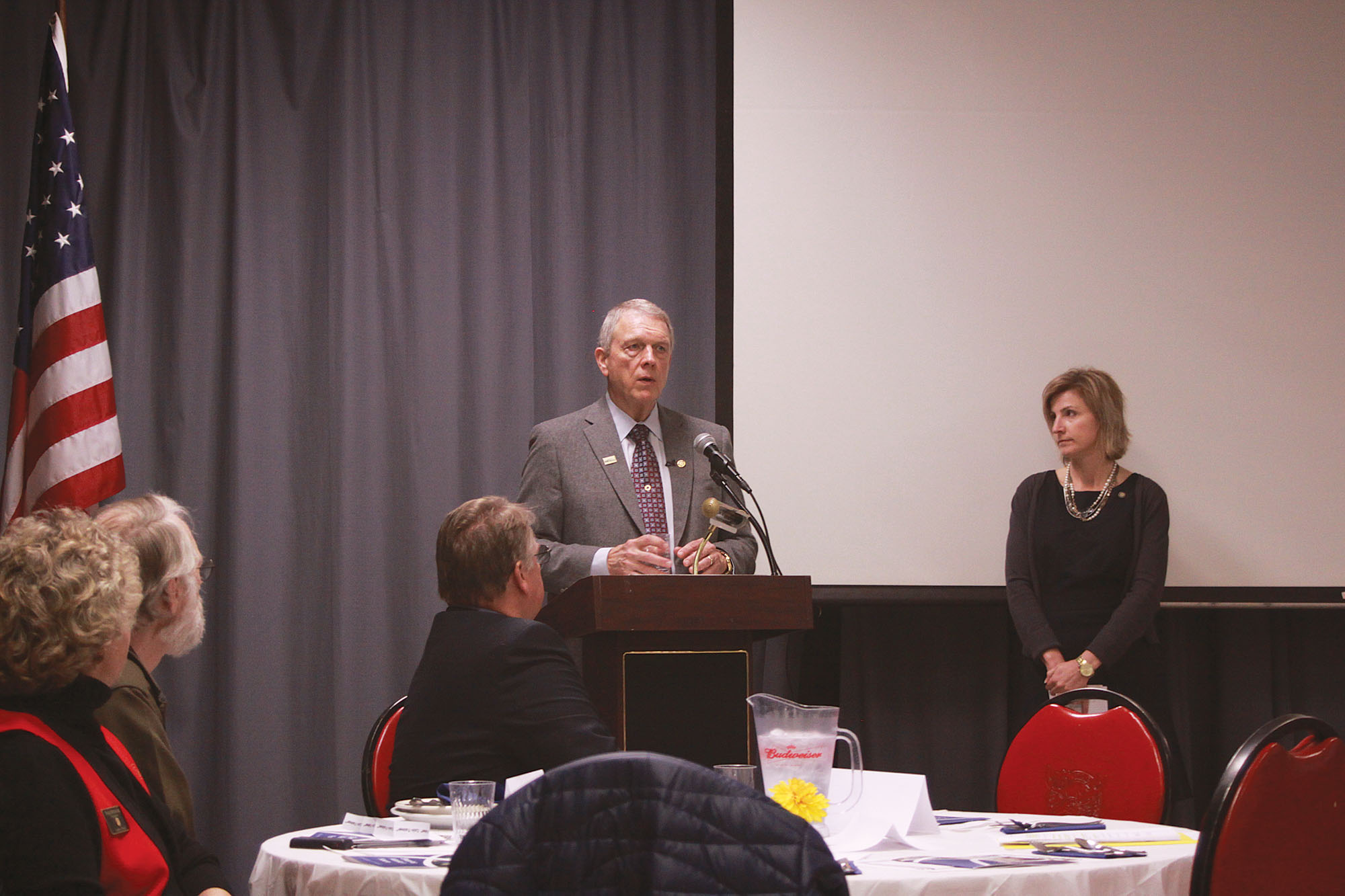
PALMER — University of Alaska president Pat Gamble told a joint Rotary Club luncheon Thursday a “silver bullet” solution to budget cuts in education doesn’t exist.
However, there are ways to circumvent potential program closures, at least for now.
“Four years ago, when I came in, the university had just completed probably the biggest growth spurt in its history, at least in the last 20, 25 years. And that’s what it was all about — it was all about growth, it was all about getting more students to come into the university and more students to stay in Alaska instead of going outside,” Gamble said.
At the time, it worked. Only 40 percent of Alaska’s high school graduates left the state for higher education that year, compared to 60 percent about a decade prior, Gamble said.
But Gamble saw universities in the rest of the country being “cut to the bone” by the economic recession, and that worried him.
“They were going through a transition that at that time was not happening in Alaska, but we usually echo the Lower 48 in many ways when it comes to macroeconomics, and so it was clear that there was gonna be a new phase that was gonna have to be paid attention to,” he said.
Gamble’s anachronistic prophecy was, of course, true.
According to a Thursday article by University of Alaska Fairbanks Sun Star Editor-in-Chief Sam Allen, the university sent an email to its students last week warning of a “special review” of 46 academic programs by the Planning and Budget Committee “based on low enrollment, decreased enrollment and low graduation rates.” That list includes undergraduate and postgraduate degrees, associate’s degrees and occupational certificates.
Nor are core subjects immune, according to the article. The mathematics, physics and chemistry departments are also on the list.
The cuts are not only a threat to the Fairbanks campus, either. Gamble said any student requests to declare a major in programs currently up for review in any UA school could be denied, even if they have already taken classes credited toward those majors.
For those already in the program, he said, there will be a “teach out” of those students to get them graduated before a program potentially ends.
Gamble said he received a phone call from Karen Rayfield of the UAA Office of Management and Budgets recently telling him that the 2015 budget would be $16 million below last year’s baseline budget.
Gamble was unsurprised.
“What’s happening to the economy of Alaska is happening and we’re gonna have to live with it, but we’ve gotta fit inside that,” he said. One part of the solution — or at least a buffer against budget cuts — is increased student retention, Gamble said.
“Keeping a student in (Alaska) is a business proposition, not just an academic proposition,” he said. “You want the student to be successful and graduate to go into the workforce, but at the same time, if the average graduation period is, let’s say rounded off it’s 5 years — 10 semesters — and you lose a student after one semester, you just lost 9 semesters of tuition.”
A good reputation will also go a long way toward bringing in and keeping students, Gamble said. However, if an incoming or potential student wants to major in Philosophy, for example, and the school doesn’t offer a degree in that field, a good reputation won’t matter much, and it won’t retain students primarily interested in philosophy.
Where the ax falls isn’t always up to the school. Gamble said the university needs $50 million to renovate school buildings every year, based on construction company estimates, though it rarely receives that amount in full. Recently, the school was taking in $37.5 million a year just for deferred maintenance costs, which Gamble said in an interview would be lower if the university had received more dollars in the first place. As time goes on and the budget for maintenance and fixed-cost utilities drops, the risk of “mission failure” increases, he said.
Gamble said just last year some pipes burst in the walls of one of the dormitories and students had to be evacuated.
“We had to take from our operating day-to-day budget to make a massive maintenance repair,” he said in an interview. “It’s like robbing Peter to pay Paul, you know — we should never have to arm wrestle for those dollars.”
Yet Gamble remains optimistic, perhaps with good reason. Bachelor’s degree completion is at an “all-time high” of almost 32 percent across the UA system — the national average is 31 percent — he said. That marks a 15 percent increase over four years, according to Gamble. However, UAF bachelor degree completion hovers around 42 percent, which has “never been seen before at the university,” he said.
There has also been a 25 percent increase in engineering degrees coming out of UA.
“Our goal is to graduate 200 engineers a year — we’re gonna do it this year,” Gamble said.
His “first ever/best ever” list continues:
The number of health care-related degrees is up 20 percent, and ACT scores of incoming freshman are up 32 percent. Forty-one percent more students indicated a UA school as their first choice in the last five years. Grant aid has increased $9.4 million in 4 years.
The number of “transfer issues” has been significantly reduced, and the “handling period” for those issues of two to three days is down from 45 days, according to Gamble.
Finally, UA graduates were awarded the highest number of degrees and certificates to date in fiscal year 2014.
“These are ‘best evers’ and ‘first evers’ that we’re seeing at exactly the same time we’re reducing the budget,” Gamble said. “So (if) anybody tell(s) you that ‘oh, if you cut the budget you’re gonna cut quality,’ that’s nonsense. It’s not gonna be easy, but that’s not axiomatic.”
Online classes aren’t a foolproof way to cut costs, either, Gamble said. While 30 percent of UA students take one or more online classes during their college career, they cannot replace “butts in seats” in the classroom in front of teachers, he said.
More than that, both the teachers and the students have to invest.
“In the old days we just sort of threw up our hands and said ‘well, some of you guys will survive ’cause you’ve got survival skills…and the ones that don’t, well that’s tough, they’ll just have to learn the hard way,” Gamble said. “That is not the way it works today.”
Contact Caitlin Skvorc at 352-2266 or caitlin.skvorc@frontiersman.com.


By Jeremiah Bartz Frontiersman.com A football coach using a hockey reference as the centerpiece for his keynote address may

Frontiersman.com With its headquarters in Wasilla, the Frontiersman has been a primary source of news for the Matanuska-Susitna

By Katie Stavick Frontiersman.com The next generation of leaders took flight this week as the Houston High School Class

By Kyle Wilkinson For the Frontiersman Keynote speaker and Carry the Cure President Bill Pagaran’s words boomed through the