Retiring teacher, coach urges Colony grads to ‘find their 68’
By Jeremiah Bartz Frontiersman.com A football coach using a hockey reference as the centerpiece for his keynote address may


MAT-SU — The most recent avalanche data available makes it clear that now is not the time to be playing in the backcountry.
“The hazard is increasing,” said Jed Workman with the nascent Hatcher Pass Avalanche Center.
A warning posted to the center’s website Thursday tells visitors to “expect the hazard to increase to high tonight and into Friday as winds continue to blow 30-40 mph.”
Workman said that wind can push snow and set up wind slabs that come down all in one chunk when the weaker snow underneath them lets loose.
“While these slabs are very strong and will be able to hold a lot of added stress, we are now seeing conditions that approach the tipping point. If these slabs fail, they will be large and destructive,” the avalanche warning states.
Workman said he expects that the avalanche danger will continue to build up over the next couple days and take just as long to subside. Not to spoil your weekend, but he thinks it’ll unsafe on the slopes until probably next week.
His center is funded through donations and doesn’t have nearly the income it would need to become a full-fledged avalanche-monitoring center. That’s the goal.
Dorothy Adler, education director with the North American Outdoor Institute in Palmer, agreed that now is a bad time to be out on the snowy slopes, especially slopes of a specific steepness.
“Thirty to 45 degrees is the slope angle that generally has enough of an incline to slide. It doesn’t mean that lesser slopes won’t slide,” Adler said.
There are slopes like that in Hatcher Pass and the Talkeetna Mountains, but also the Chugach Range. People should stay off of those slopes and keep out of areas underneath them.
She said terrain traps are also something to watch out for. The usual traps are things like gullies and bowls or flat run-out zones — anywhere that snow can collect. But there are also things like cliffs and trees.
“It’s actually any places where the consequences could be high,” Adler said.
Adler said that 75 percent of avalanche fatalities are due to asphyxiation — getting buried — and 25 percent from trauma — getting thrown into a tree or off a cliff.
Her organization, NAOI, has put on a series of avalanche trainings throughout the Valley with more to come.
Next up on the calendar is the Iron Dog Safety Expo at the Curtis D. Menard Memorial Sports Center in Wasilla.
Further out, there is an avalanche awareness field training in Willow on Feb. 25, and various classes including wilderness first aid in Meadow Lakes in March.
The institute is actually staging classes all across the state, from Sitka to Fairbanks to the Arctic Man event in Paxon. It’s all thanks to a grant the institute got from the state Department of Public Safety.
The goal of training, she said, is to reduce the numbers of avalanche injuries and fatalities.
“We always tell people that the best tool people can have is your brain,” Adler said. “If you put yourself in the wrong place at the wrong time that avalanche beacon won’t do you much good.”
Contact reporter Andrew Wellner at Andrew.wellner@frontiersman.com or 352-2270.
For more than a decade Alaska has topped the rankings nationwidefor avalanche and snowmobile-related injuries and deaths. TheAlaska Department of Public Safety and Alaska Division of Parks aresupporting the effort to change this fact with free avalanche andsnowmobile safety awareness training for the general public.
From Ketchikan to Fairbanks, Talkeetna to Seward, Anchorage toSutton, you are sure to find a training program available in yourcommunity this winter provided by the professionals with the NorthAmerica Outdoor Institute and partners from the Alaska AvalancheInformation Center and the Southeast Avalanche InformationCenter.
“We know people are going to recreate in areas that put them atrisk,” said NAOI Education Director Dorothy Adler. “We just want toprovide them with information and skills to help them make gooddecisions about the way and places they recreate so they avoidinjury or know what to do if everything goes wrong.”
According to Adler, the Be Snow Smart program is designed as afun, interactive experience that gives participants an opportunityto learn and practice skills, including identifying avalancheterrain, snowmobile safety, incident avoidance techniques andcompanion rescue in the event of a worst case scenario.
“We have something for everyone,” Adler said. “Whether you’rejust getting started or a longtime veteran that wants to bechallenged, we are here to help you find it.”
Courses include school, community awareness and full-day fieldtraining. View the schedule online at besnowsmart.org.
Classes fill up quickly and registration for all field programsis required. To schedule a program for your school or community,contact Debra McGhan at 376-2898 or 982-0332. These programs madepossible with financial support from the Alaska Department ofPublic Safety, Division State Troopers and the Alaska Division ofParks, SnowTrack.
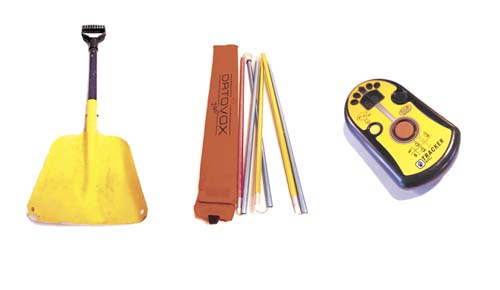
A shovel, probe and avalanche beacon are essential gear when traveling into the backcountry.
ROBERT DeBERRY/Frontiersman

By Kyle Wilkinson Kyle in the outside Our spring bear hunt was bittersweet this year. We’re heading home without

Frontiersman.com Valley athletes earned titles during the Region III Championships track and field meet last week at Colony High

Leila Petersen Palmer Moose Leila Petersen, a member of the Palmer track and field team, has been named a Frontiersman

By Jeremiah Bartz J’s World August would have been the start of my 25th year as an editor at