Retiring teacher, coach urges Colony grads to ‘find their 68’
By Jeremiah Bartz Frontiersman.com A football coach using a hockey reference as the centerpiece for his keynote address may


PALMER — It is not often you get to see the dirty work of a democracy actually include dirt.
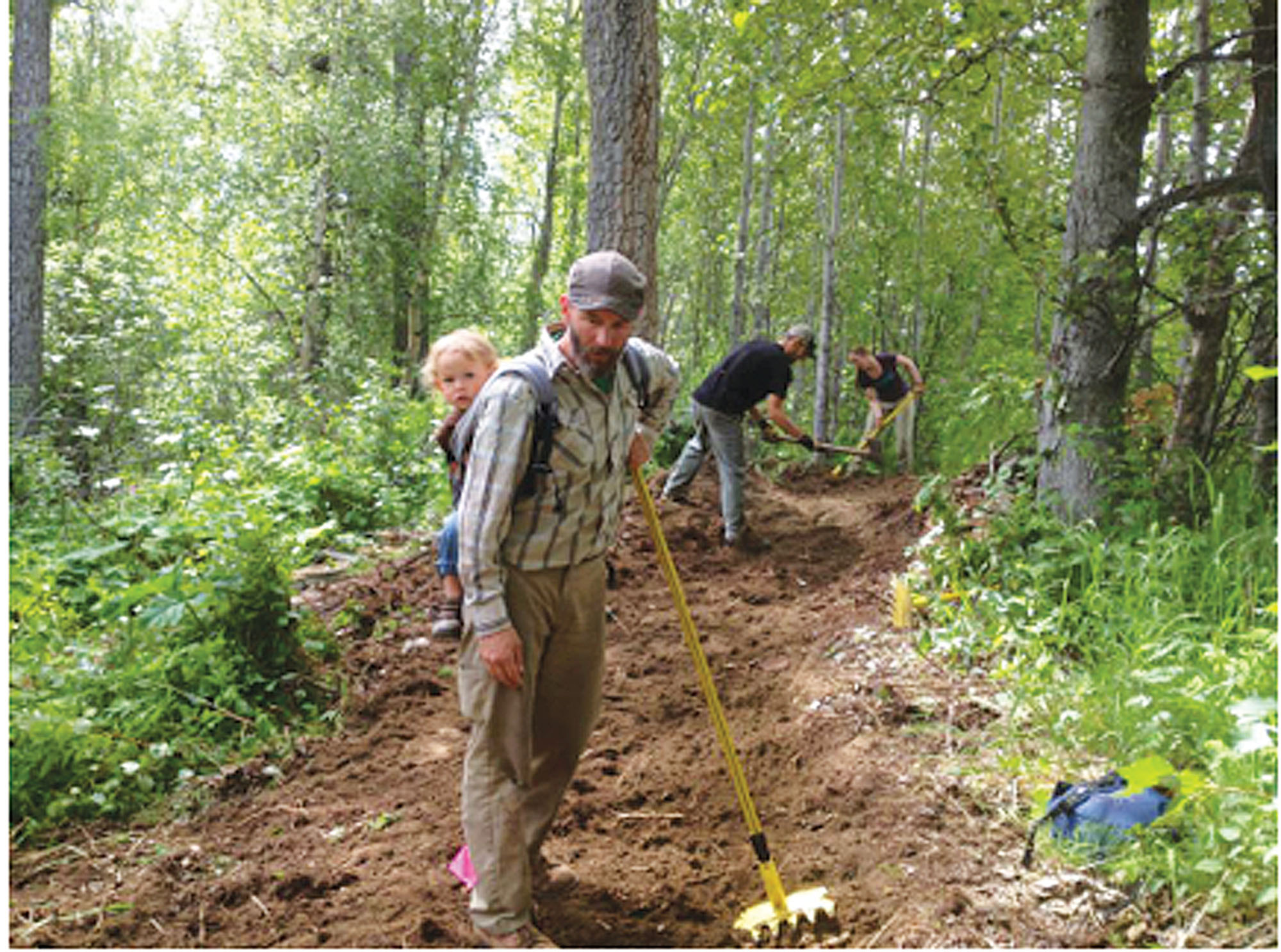
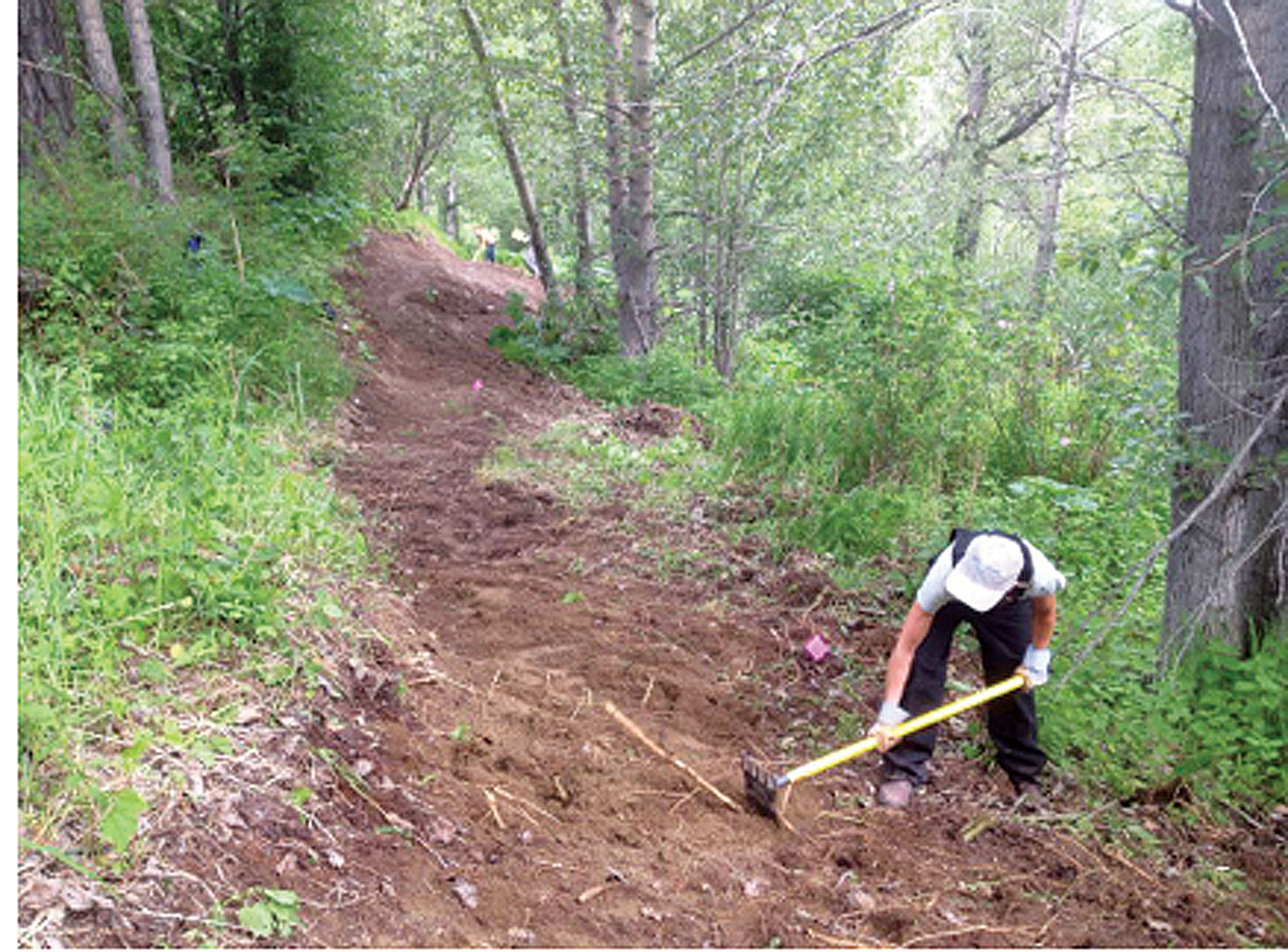
But that is exactly what you can see happening at the end of the Mat-Su River Park in Palmer. It includes more than 1,000 cubic yards of dirt, enough equipment to move it all, two trail crews, and plenty of shovels and rakes, all being used to build the Palmer Bike Park.
By the end of the Bike Park’s construction, three styles of sustainable bike trails will connect three different schools, two parks, and the Butte-to-Palmer bike path. It’s all part of a shared vision that has non-profit, private enterprise, and local government working side by side to make the Mat-Su a destination spot for healthy, active recreation.
The Palmer Bike Park is part of the Borough’s Matanuska River Park Master Plan approved by the Assembly on June 3. That plan is one of three plans providing for a continuing network of quality trails across the Borough. The other plans include the Crevasse-Moraine Master Plan and the Lazy Mountain Master Plan.
Hugh Leslie, the borough’s Recreation and Library Services Manager, said that the three master plans are in response to the 2011 community values survey. Trail users were the most popular group according to the survey.
“We are making a significant investment in outdoor recreation,” Leslie said.
Borough collaboration
In addition to matching funds from the borough, the Alaska State Parks Recreation and Trails Program provided a $50,000 grant to the Valley Mountain Bikers and Hikers Association to help create the bike park. The project also received two years of community assistance support from the National Park service Rivers, Trails, and Conservation Assistance program.
“In the planning process we had a lot of input from citizen groups throughout 2012 and 2013,” Leslie said.
Leslie added that it’s not unusual to have citizen groups come forward and work with the borough. They help with the push for increased healthy active recreation opportunities. He mentioned groups like the Aurora Dog Mushers Association, the Mat-Su Ski Club, and the Matanuska Greenbelt Trails Association as examples of involved non-profits.
“These non-profits help with the heavy lifting. We’re very fortunate to have these groups step forward to help the borough. Ultimately it saves that cost burden being passed on to the taxpayer,” Leslie said.
VMBAH has been specifically involved in the increased and improved trail building around the borough.
Leslie said, “VMBAH worked in agreement with the borough to update existing trails and build new ones, including building the single track bike trail at the Palmer Bike Park.” VMBAH is also connected with the bike trail work planned for the Government Peak Recreational Area.
VMBAH Executive Director Nate Nicholls said the group’s philosophy is to increase the quality and quantity of sustainable trails throughout the Matanuska-Susitna Valley.
“We work in concert with the mission and goals of the borough to become a destination for healthy, active recreation,” Nicholls said.
When the borough’s population was smaller, user-made trails were adequate for the amount of use they saw. But now, with an estimated 95,000 people in the borough, Nicholls said that it is important to have trails built that stand the test of time since, once trails are built, people tend to follow. “And 99 percent of a trail’s cost is upkeep,” he said.
That is why VMBAH now hires specialized trail contractors to design and build the trails’ foundations.
“Volunteers are used to help more with the finish work,” Nicholls said. “We can use more volunteers that way and everyone is more successful.”
The borough also is beginning to use specifically designed crews for trail work. Leslie said, the borough has added “additional money to fund a full-time outdoor recreation trail specialist, with two seasonal crews with crew leaders. They work to make trails and maintain trails so that the borough can be more aggressive on the creation and maintenance of our trails.”
Professional trail building companies work alongside VMBAH and the borough trail crews to help serve the growing recreation demand in the Valley. Small businesses working on the Borough’s recreation investment include professional trail builders Happy Trails, Inc., out of Fairbanks, and the Palmer based Ptarmigan Ptrails LLC. USKH worked on the Mat River Park Plan but is not a member of the Professional Trail Builders Association.
Eddie Kessler, co-owner of Ptarmigan Ptrails, said, “for people to enjoy the trails you don’t want them to know that they’re on a trail. You want the trail to be part of the landscape.”
“Right now the Valley is severely lacking in recreational outlets for kids other than organized team sports. Kids take ownership in the trails around them because they can get to them. To market the Valley as the home of the State Fair goes only so far with kids. But a plethora of trails gives lots of opportunity to be involved personally with the area. It is a pride of ownership then,” said Kessler.
Mat-Su Borough Assemblyman Matthew Beck observed, “The best government is a government that serves. When you see people have a vested interest you want to support it. I like the fact that so many people actually came to speak up about these trails. That means it is important to them.”
“You help them or get out of the way. When you have someone like Eddie Kessler or the folks out at Jordan Lake, you want to support them. It saves money in the long run,” Beck said.
Cost of trail building
The cost of building a world-class trail is hard to estimate, Kessler said. He said a rough estimate might be around $30,000 a mile.
For instance, the new 1.2 Mile, Fox Trail single track planned in the Mat-Su Greenbelt Mat Lake Trail system is estimated to cost $34,000. But, through a grant from the Alaska Division of Parks and Recreational Trail Program, it will only cost the borough $8,000.
“To ask what a trail costs is like asking how much a car costs,” Leslie said. “It all depends on the car you want.”
“A trail is a trail is a trail” is not necessarily true for today’s bikers. New trail construction is geared for today’s specialized biking demands.
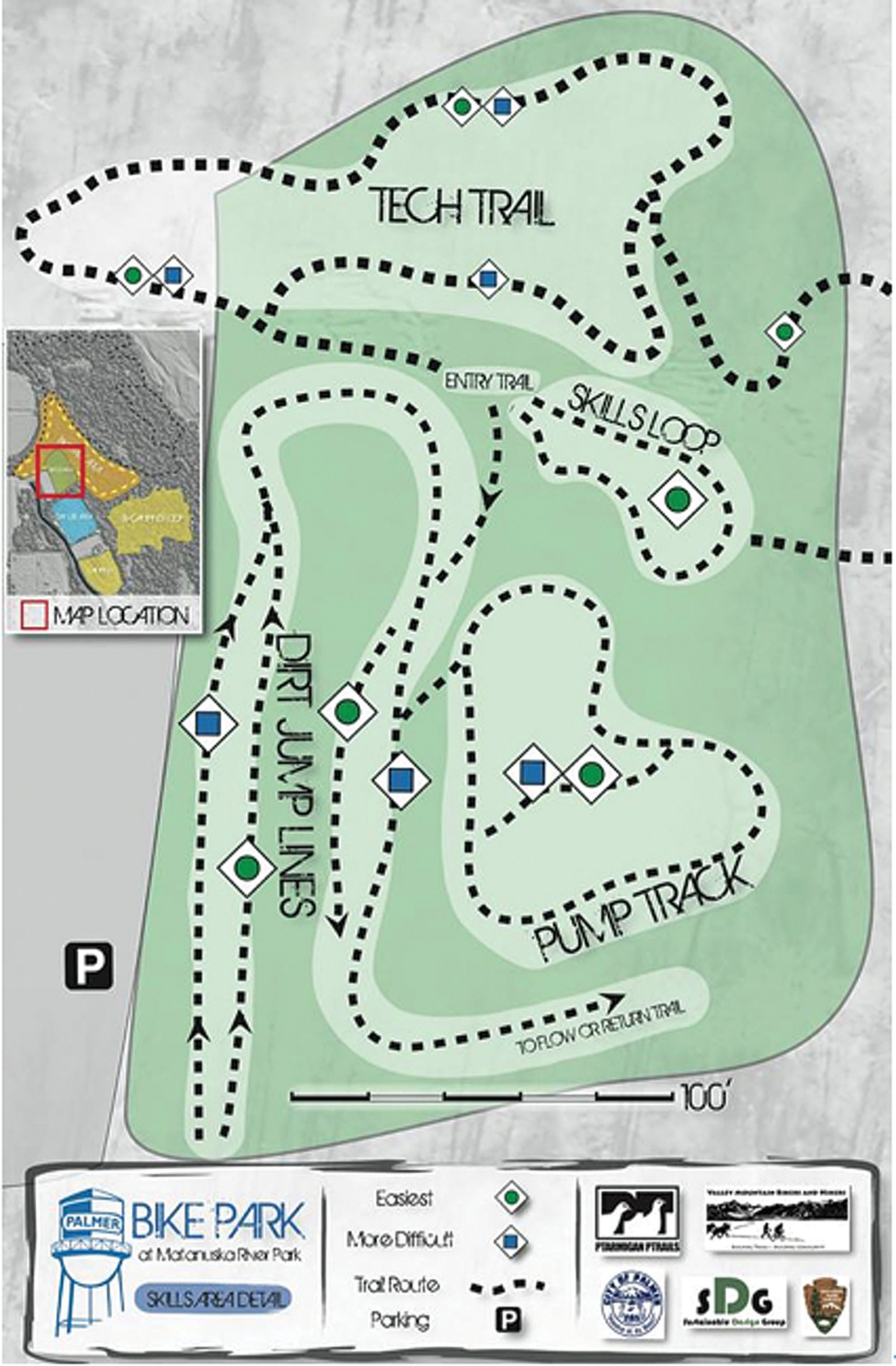
In response to the varying biking needs, Ptarmigan Ptrails, designed the Palmer Bike Park with three types of trails: technical, flow, and pump.
“A technical trail will be built for both intermediate and beginner mountain bike riders. Right now the Valley doesn’t have much in the way of beginning mountain bike trails. The Bike Park will help with that demand,” said Kessler.
A flow trail is similar to a technical trail except it is built to have the bike travel more on its own momentum. “A flow trail is kind of like water. It gives the bike minimal resistance and the rider uses the pedal minimally. The trail has corners that allow the bike to flow more than ride. It can be really fun,” Kessler said.
In addition to both of these trails, the Bike Park also will have a pump track and dirt jumps. Kessler described the pump track as a carefully designed series of bumps and dips for a pared down BMX-bike feel or experience.
“It’s like a motocross course for BMX bikes even though you can use any bike you want on a pump track. It isn’t strictly for a certain type of bike,” said Kessler. It’s a kid bike experience that grown-ups love, too.
Future of trails
in the Mat-Su
Right now there are eight bike trail systems for the human powered activities envisioned by Beck established or in the works throughout the core area. They include: Palmer Bike Park, the Mat-Lake Trail System, the Mat-Su Greenbelt trails in the Crevasse Moraine area, Wilson Park Pump Track, Morgan Horse Trail, the Butte-to-Palmer Bike Path, and the Palmer-Moose Creek Railroad Trail. Other trails include the 16 Mile Downhill Trail built cooperatively with Alaska State Parks, Happy Trails Inc., and Ptarmigan Ptrails, and the soon-to-be-built Government Peak Recreation Area Bike Trails, to be built by Happy Trails Inc., with the help of VMBAH and initial layout by Ptarmigan Ptrails.
Overall, there are 27 trails throughout the Valley totaling more than 113 miles.
“I think we have arguably have one of the best trail systems out there,” Leslie said. “I think we are a destination point for people who want a trail experience close to Anchorage but with a wilderness experience. The benefit of our trail system is that everything is within 15 to 20 minutes. Just think, the difficult Pioneer Ridge-Austin Helmers Trail is just 20 minutes away to the more beginner(-level) West Butte Trail.”
“Good green activities will have the same effect that the Friday Flings have had. They stop and shop and eat. People will come here. If they aren’t here, they can’t spend money,” said Beck.
“I would hope we continue to grow to become a destination for people when they come to Alaska. The Mat-Su can be a regular highlight destination like Denali is or the Kenai.”
“Recreation has to be viewed as an industry,” said Kessler. Activities such as extending the Palmer Bike Park bike trails and the other trails around the Valley makes it a nice destination point for visitors.
In the end, the dirt work being done throughout the Valley for bike trails and at the Palmer Bike Park might do more than lure visitors. They also help build community.
Brandon Thielke, a recent arrival from Lander, Wyoming, and employee of Backcountry Bikes and Ski, said that the Mat-Su Trails Master Plan was key in the decision for his wife and he to relocate to Palmer instead of Eagle River or Anchorage.
“I saw it as a recognition of the benefits a trail system offers. It’s impressive. Plus, there is just tons of space to make it happen compared to Anchorage,” he said. “It was the type of place we wanted to be a part of.”

By Kyle Wilkinson Kyle in the outside Our spring bear hunt was bittersweet this year. We’re heading home without

Frontiersman.com Valley athletes earned titles during the Region III Championships track and field meet last week at Colony High

Leila Petersen Palmer Moose Leila Petersen, a member of the Palmer track and field team, has been named a Frontiersman

By Jeremiah Bartz J’s World August would have been the start of my 25th year as an editor at