Retiring teacher, coach urges Colony grads to ‘find their 68’
By Jeremiah Bartz Frontiersman.com A football coach using a hockey reference as the centerpiece for his keynote address may


Ken Andreyo/Carnegie Mellon University
WASILLA — Without a pair of Palmer innovators, the world would still be a much bigger place.
In the early 1990s, Dr. Alex Hills was part of the team that developed the first wi-fi network, paving the way for the always-on wireless access that connects people around the world. At about the same time, bicycle shop owner Mark Gronewald was helping to usher in an era of fat tire bicycles, opening up vast amounts of new terrain that cyclists had never dreamed of riding.
For their achievements, the two Palmer residents will be among 20 Alaskans inducted into the initial class of the Alaska Innovators Hall of Fame during a ceremony to be held Wednesday, Oct. 7 at the Bear Tooth Theatre in Anchorage.
“It is an honor,” said Gronewald, who now works as a trails consultant at his company, Trailwerx.
The Hall of Fame was created by the State Committee on Research and is supported by the Anchorage Economic Development Corporation and the University of Alaska. Other Alaska innovators being inducted at the ceremony include Ed Clinton, Elden Johnson, Lynn Johnson, Erv Long, Tim Meyers, Skip Nelson, Dennis Nottingham, Jim Seccombe, Pat Simpson, Gene Strid and Sheri Tingey. They’ll join nine others – Clarence Berry, Cathy Cahill, Keith Echelmeyer, Jack Hebert, Gwen Holdmann, Bernie Karl, Hank Statschewich, Greg Walker and Tom Weingartner – who were inducted last December.
Those Alaskans written about in “Northern Innovators,” a 2014 book by Ned Rozell that contains short profiles about each of the innovators’ work. Rozell’s book was used as a precursor to the Hall of Fame the duo will be inducted into next week.
Dr. Hills is a distinguished service professor at Carnegie Mellon University in Pittsburgh, Pennsylvania. Back in the early 1990s, he and several other researchers were trying to fingure out how to use radio waves to create a campus-wide network that could be used for research. Through trial and error, the group worked out how to bounce signals across campus wirelessly.
“In the beginning we had early-version laptop computers and then we had this external radio thing we stuck on the lid of the laptop,” he said.
The system was crude at first, but it was a start.
“It kinda worked,” he said.
The researchers soon upgraded the network, and in 1993 all of Carnegie Mellon’s 140-acre campus was covered by the world’s first campus-wide Wi-Fi network – which Hills and his colleagues dubbed “Wireless Andrew” after university founders Andrew Carnegie and Andrew Mellon.
As Hills and the other researchers tinkered with the system, they started to see the vast potential of Wi-Fi communication. Although the network was supposed to be used only by researchers, it wasn’t long before students started to hear about the innovation.
“Engineering students are smart,” he said.
Hills protected the newly-created network with a password, but those same students quickly found ways to use the network to get online.
“They hacked their way in,” he said.
Soon, more students than researchers were using the network.
“That’s when the light bulb went on,” he said.
The fact that students took to the new form so quickly told Hills that Wi-Fi was going to be a big deal.
“If you want to see the future, just look at what young people are doing,” he said.
At about the same time, a different kind of revolution was taking place in the world of off-road cycling. In the 1970s and 80s, mountain bikes had begun to make their appearance, with slightly wider tires and stouter frames than conventional bikes.
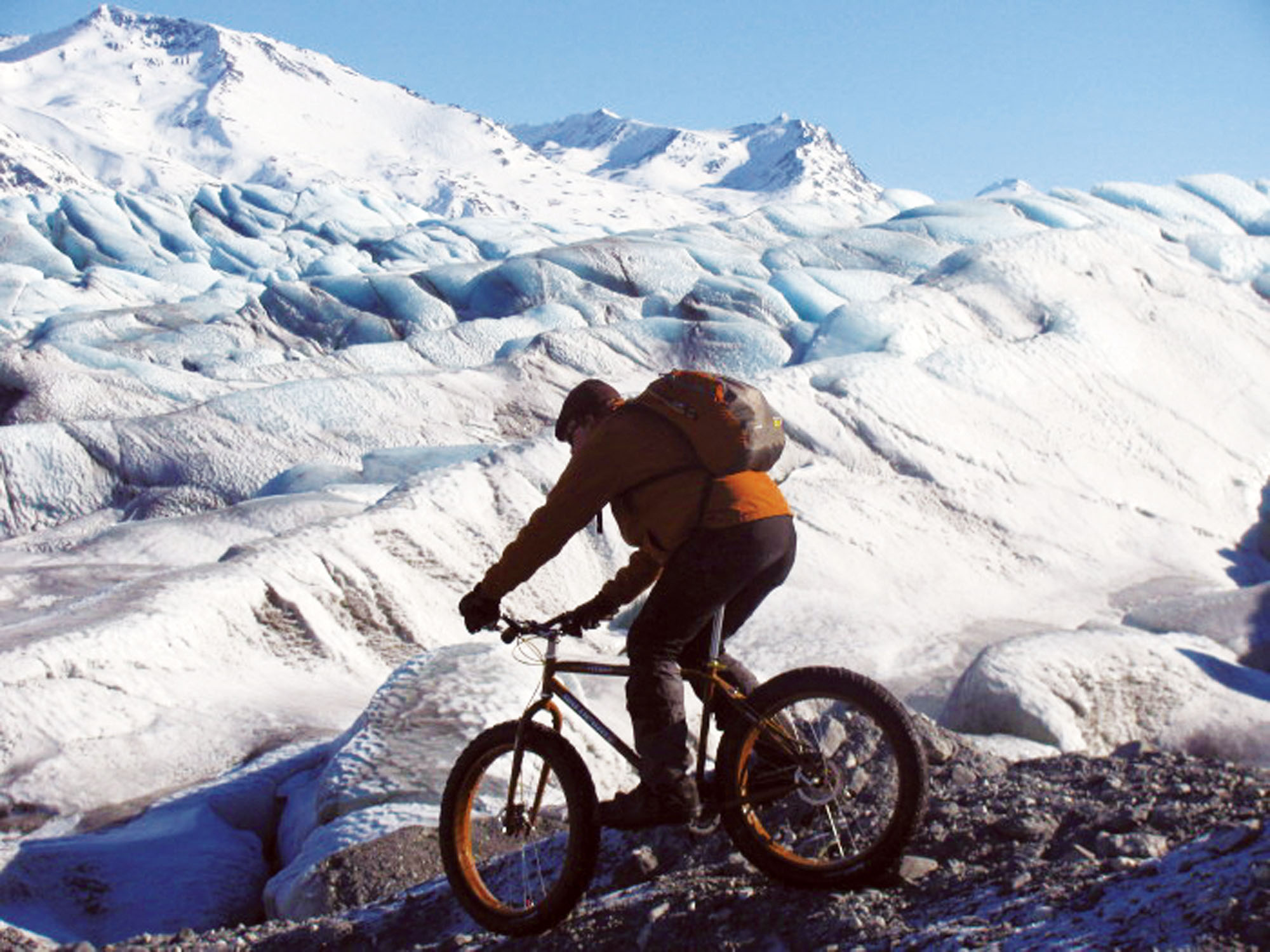
By the 1990s, bike builders and riders were pushing the limits of their bikes and wondering what kinds of terrain could be conquered. One of those bike builders was Gronewald, who owned Wildfire Designs in Palmer. Gronewald had started using studded mountain bike tires to ride in the winter, which worked – sort of.
“The limitation was when you got on snow you knifed right through,” he said.
In the early part of the decade, Gronewald said Simon Rakower in Fairbanks started using even wider tires to get some “floation” on snow.
“It was obvious wider tires, more air volume equated to a lot more flotation,” Gronewald said.
But the bicycles were still limited by the size of the frames, which were still lagging behind the wide tire technology. Then Gronewald met Ray Molina – who was using wide tires made in Mexico mounted on a special frame to ride on sand dunes in New Mexico – at a trade show in Las Vegas.
“I was like, ‘Gosh, this is what I’ve been waiting for,’” Gronewald said.
With the larger frames and tires, Gronewald started making his own bikes, combining the new technology with whatever was available for the older bikes. His designs were among the most innovative of the day, and he was the first to figure out how to off-set the bike’s chain to accommodate the larger tires.
“I think my contribution was putting all the stuff together, using off-the-shelf parts,” he said.
In the beginning, the bikes were a tough sell.
“People looked at it like it was kind of a gimmicky thing,” he said.
But after perfecting the fatbike design over the next few years, Gronewald’s bikes were used by Mike Estes and Andy Heading to win the Iditasport (now called the Iditarod Invitational) in 2001. The men’s dominance in the 1,000-mile wintertime race from Knik to Nome helped spur a boom in fatbikes that continues to this day.
“Who knows where it’ll end,” Gronewald said.
Both Hills and Gronewald are quick to give credit for their innovations to others.
“There were lots of people involved,” Dr. Hills said of his early Wi-Fi advances.
He credited his time in the Alaska Bush in the 1970s for giving him the perspective needed to help advance radio frequency technology two decades later. While working to bring better communications to rural Alaska, he said he learned a lot of tricks about how radio waves work. He recalled one endeavor where he and his team bounced a radio signal from Little Diomede Island in Alaska off Big Diomede in Russia to reach Wales back on the Alaska mainland.
“After working with it for a while you get a hang of what these radio waves are doing,” he said.
But despite his contributions, Hills said the work to create the Wi-Fi networks of today was pushed forward by many scientists.
“The days of someone sitting in their garage and coming up with something are over,” he said. “These days, everything is a collaboration.”
Gronewald agreed. He said the gradual change from mountain bike tires to the ultra-fat tires used to float on snow today was a slow process moved forward by many innovators.
“Like anything else, it was an evolution,” he said.
Contact editor Matt Tunseth at 352-2268 or matt.tunseth@frontiersman.com

By Jeremiah Bartz Frontiersman.com A football coach using a hockey reference as the centerpiece for his keynote address may

Frontiersman.com With its headquarters in Wasilla, the Frontiersman has been a primary source of news for the Matanuska-Susitna

By Katie Stavick Frontiersman.com The next generation of leaders took flight this week as the Houston High School Class

By Kyle Wilkinson For the Frontiersman Keynote speaker and Carry the Cure President Bill Pagaran’s words boomed through the