Retiring teacher, coach urges Colony grads to ‘find their 68’
By Jeremiah Bartz Frontiersman.com A football coach using a hockey reference as the centerpiece for his keynote address may


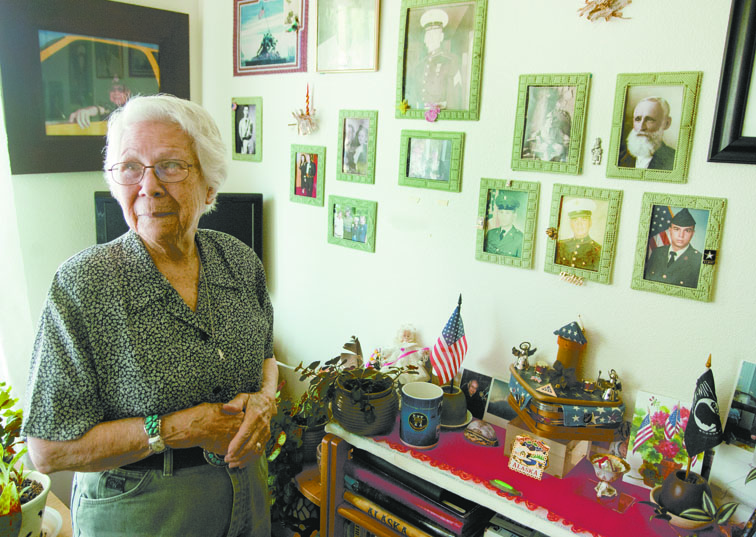
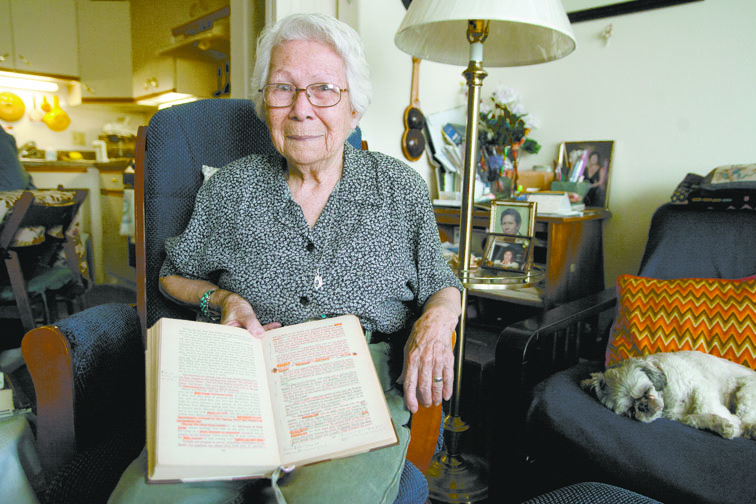
PALMER — Rachel Block’s life has been a lesson in how forgiveness is easier to preach than to practice.
As a girl growing up in the Philippines, Block has vivid memories of a young life interrupted by war, humiliation and torture. She recalls the day her childhood came to an abrupt end — April 9, 1942. That’s the day Japanese soldiers raided her home in Momungan, a town in the Lanao province of the Philippine island of Mindanao.
It was also the last day for nearly three years the 13-year-old would see any of her family. Block and three of her 10 siblings were captured, and because her father was a wanted man, she became a target for torture.
“They pulled out all my fingernails and my toenails,” recalled Block, now a spritely 85-year-old resident of Cottonwood Estates in Palmer. “I was tied down to a chair. They beat me up first, they questioned me: ‘Where’s your dad?’ I said, ‘I don’t know,’ and I didn’t. They didn’t care.”
Beaten and bloody, with a broken jaw, arm and thigh bone, Block was then dragged outside and staked to an anthill, the same ant colony she would later learn her three captured siblings were also subjected to. She vividly remembers that the soldier tasked with her interrogation appeared uncomfortable torturing a 13-year-old girl, but his commanding officer seemed to enjoy it.
“I think the man that tortured me did not want to do it, because when I cried out when I felt the pain in my first three fingers, when I cried out to God to help me, then all of the sudden the pain was gone,” she said. “He couldn’t do it any more, because I was bleeding all over my face, my body, my bones were fractured and broken. The guy took a stool and he threw it down and marched out, he was disgusted. But the colonel sitting behind the desk? He was just smiling away like he was enjoying it.”
That’s when she was taken to the anthill and left for three days and nights. During that time, she was never bothered by ants, something she attributes to her faith and a promise from God that she and her family would survive the war.
“I believe in his promises,” she said.
That faith was ingrained in Block as one of 11 children born to an American soldier from Michigan and a Spanish mother. Her father, Marion Lee Kelley, was a corporal in the Spanish-American War. He fought in Cuba, Puerto Rico and the Philippines, where he met Block’s mother and settled down.
By the time World War II broke out, Marion Kelley owned and operated three lumber mills and was the only lumber supplier to the gold mines on the islands. As an American and someone with inside knowledge about the mines, he was highly prized by the Japanese when they invaded, Block said.
“The Japanese wanted that gold,” she said. “They knew my father knew where (the mines) were.”
Instead of helping the Japanese, Kelley would instead aid the American forces. When asked where would be a good hiding place for the gold, he suggested putting it on a ship and sinking it.
“My father sank that ship in the Pacific where he knew nobody could get it,” Block said.
That was after he learned four of his children were captives. In fact, Block said, he actually tried to turn himself in, but the soldier he contacted didn’t believe he was in very good physical condition and wasn’t aware of who he was and let him go.
Shortly after their capture, Block recalls she and her siblings were separated, but not before they learned who had betrayed her family to the Japanese.
“Well, the first thing in the morning the next day after we were captured, we were separated, my brother and two sisters were separated from me,” she said. “And let me tell you who captured, who was sitting on the desk who ordered the capture of us children. It was our storekeeper. He was Japanese. I was very surprised. His children go to the same school I went, the same church we went to worship. He was already a military man and I think he was just playing along. We trusted him.”
Later that day, Block would be beaten and interrogated, the only time during her nearly four years as a Japanese prisoner of war that she was subjected to torture. But that doesn’t mean the rest of her time interred with hundreds of other Americans, missionaries and prisoners was pleasant.
The living conditions “were just terrible,” she said. Prisoners were moved from province to province and crowded into small bungalows, sometimes with as many as 50 families in each one. They weren’t allowed outside, weren’t put to work and weren’t allowed to exercise.
In fact, the camp she was in had a reputation, Block said. “In that camp, nobody comes out alive. We were the first ones.”
There, she was subjected to treatment and images no teenage girl should endure, Block said. She’s emotional recalling one graphic incident.
“I seen with my own two eyes a woman — a pregnant woman — and an old woman with a little girl were killed,” she said. “They just happened to pass our camp and a Japanese soldier stopped the old lady, stabbed her, and then when the old lady fell, he stabbed the pregnant lady right in the stomach. He cut her stomach open and throw that baby up in the air, then bayoneted the little girl, too.”
As much as Block remembers April 2, 1942, as one of the turning points in her life, so is Feb. 3, 1945. That’s the day her camp was liberated by American forces. She recalls an excited buzz in the air among the prisoners, along with fear. They were excited about the prospect of finding freedom, yet scared the Japanese would kill them before U.S. soldiers could get there.
“The Japanese were already telling us not to come near the windows or we would get shot,” she said. “We knew (help was coming) and we were so happy, and the Japanese were nervous we might do something, but what could we do? We knew they were going to kill us, because they told us so.”
As the U.S. forces drew near, Block said she could hear the sounds of the tanks from the 44th Tank Battalion rumbling closer.
“First, they pushed the (outer) wall down and the tanks just rolled over the 12-foot-high wall of concrete,” Block said. “We were housed on the other side of the main building, so we couldn’t see it, but we heard the rumbling all day. We knew they were coming.”
That was also when she learned her other three siblings had survived their captivity, something Block said she felt in her soul.
“All of us survived,” she said. “I just knew my father, my family, had lived. I felt it. The Lord promised me that everybody in our family would be fine.”
Feb. 3 is also the day 13 years later in 1958 when Block’s father passed away, making the date bittersweet.
Block has lived a full life since her experience as a prisoner of war during World War II. She came to the United States in 1960 and spent 18 years driving 18-wheel trucks for the government. Eventually in 2000, she and her husband, Charles Block, moved to Alaska, fulfilling a lifelong dream that began when she was a little girl and saw pictures of the Last Frontier in a National Geographic magazine.
Retired and living in California, “My husband wants to go to the Philippines and retire there,” Block said. “I said, ‘No way. I’ll come visit you there.’ I wanted to come to Alaska.”
Alaska is also where her faith came to a crossroads with her capture and torture. While attending a Bible study group at Real Life Church in Palmer several years ago, the subject of forgiveness came up. Until then, Block said that for a long time she never talked about her experience as a prisoner of war. She said she learned a life-changing lesson in that group.
“I learned that it’s important (to forgive) because it releases your anxiety to be able to speak about it,” she said. “In our church ladies group, we were talking about faith and forgiveness. That’s where I got to realize that this problem, the things you have gone through, will not go away until you forgive.”
But it wasn’t easy. At first, she refused.
“I said no, why should I?” she said. “But then you look at the cross, you look at Jesus. What did he do for you? He died for you, for me, for everybody. That made me do it.”
Block said she’s willing to relive her childhood pain and share her story partly with hope that it helps others, especially veterans, who struggle with the same emotional pain. She’s also very concerned about the high suicide rate among veterans, a situation that hits close to home.
“My boy, my oldest boy (Charles Jr.), he wanted to commit suicide,” she said. “He came home from Vietnam, and when I found out I went up to him and told him, ‘Is this what God has prepared you for? You can cast the devil out when he brings you these thoughts.’ And he did.”
Block may have forgiven her Japanese captors, but she admits she carries some emotional scars that may never heal. It’s most notable when she sees Japanese people, especially older Japanese.
“Every time I see a group of Japanese, like last Friday at the Friday Fling, it just gives me the creeps,” she said. “It gives me the feeling like I’m back to that place again. It’s not personal against them, but it triggers it. Even now that I have forgiven them, still when I see an older Japanese person it makes my blood boil, the hair stand up on the back of my neck. I’m still dealing with that.”
Contact reporter Greg Johnson at greg.johnson@frontiersman.com or 352-2269.

By Barbara Hunt Palmer Buzz It was 6:43 on Friday morning and the Plant Owner was sound asleep when

By Kyle Wilkinson Frontiersman Memorial Day Weekend was filled with a variety of events in Willow. From live music to

By Kyle Wilkinson For the Frontiersman The Susitna Valley Emergency Preparedness Fair will be held at the Willow Community Center

By Barbara Hunt Palmer Buzz Green-Up happened at exactly 9:34 am on Saturday morning in Palmer. This was