Retiring teacher, coach urges Colony grads to ‘find their 68’
By Jeremiah Bartz Frontiersman.com A football coach using a hockey reference as the centerpiece for his keynote address may


WASILLA — When it comes to infrastructure projects, these days it’s the Parks Highway upgrade that’s drawing the crowds.
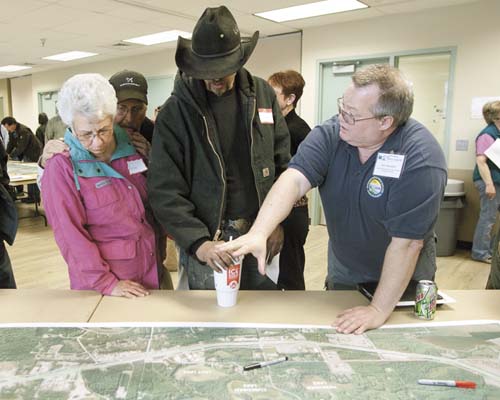
Dozens of residents turned out Monday to a project open house at the Curtis D. Menard Memorial Sports Center.
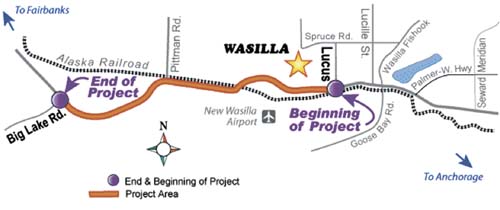
The project area runs from Lucus Road to Big Lake Road, and includes upgrading that stretch of road from two lanes to four with a center median. The intent is to bring down the number of serious and fatal accidents on what is often described without hyperbole as the state’s most dangerous stretch of road.
Project manager Jim Amundsen with the state Department of Transportation said he has heard concerns about the project that were more-or-less across the board. Some of the most interesting that he hadn’t heard before concerned whether large trucks will be able to use the access points the state has planned.
“Most cars are going to be able to make that turn,” he said.
But fully loaded trucks? Right turns might be fine, but left turns could require some help, perhaps a stoplight or an acceleration lane.
One resident who arrived Monday with just that concern was Jim Page, who cuts logs into firewood to sell as bundles at grocery and convenience stores. Page said that with the way people drive through that stretch of the Parks Highway, he doubts it’s going to be safe making a left turn.
“I think more people are going to get hurt and killed,” he said about the plan to widen the road. But a solution is elusive. “They should’ve built a bypass 20 years ago like they wanted to.”
After talking to Page, Amundsen said the plan definitely needs some tweaks and he intends to make them. As for the bypass idea — building a road around this problematic stretch — Amundsen said it’s not timely enough.
“It’s going to be 15 years before we get it built. That’s what’s wrong with a bypass,” he said.
Other concerns expressed around the maps included property owners worried about how much land the project is going to take, neighbors actually hoping the project would clear out some problem areas like the cabins at Mile 49, and at least one man concerned about what the highway work will mean for the movement of moose in the area.
Controversy around the project seems to have been loudest where it concerns that center median and controlled access. Not everyone is going to be able to turn left onto the highway.
Some folks in Wasilla — including the city’s mayor, Verne Rupright, but not the city council — want a five-lane road with a center turn lane.
This camp tends to cite business impacts as a reason to go with five lanes and expresses skepticism about how safe a four-lane divided road would be.
Numerous organizations in Big Lake, meanwhile, have sided with the four-lane divided proposal, mostly citing safety statistics as reasons for their support.
Amundsen told visitors to his table that DOT remains convinced that four lanes is the way to go. He has said previously that five lanes just wouldn’t improve safety enough.
As for when flaggers and construction delays will arrive, Amundsen said he’ll be back to hear more comments in the fall, then come back this time next year with a design that is 65 percent complete. Then the state will start buying land. That takes three years.
“I expect four years from now we’ll be starting construction,” he said.
Contact reporter Andrew Wellner at andrew.wellner@frontiersman.com or 352-2270.

By Jeremiah Bartz Frontiersman.com A football coach using a hockey reference as the centerpiece for his keynote address may

Frontiersman.com With its headquarters in Wasilla, the Frontiersman has been a primary source of news for the Matanuska-Susitna

By Katie Stavick Frontiersman.com The next generation of leaders took flight this week as the Houston High School Class

By Kyle Wilkinson For the Frontiersman Keynote speaker and Carry the Cure President Bill Pagaran’s words boomed through the