Retiring teacher, coach urges Colony grads to ‘find their 68’
By Jeremiah Bartz Frontiersman.com A football coach using a hockey reference as the centerpiece for his keynote address may


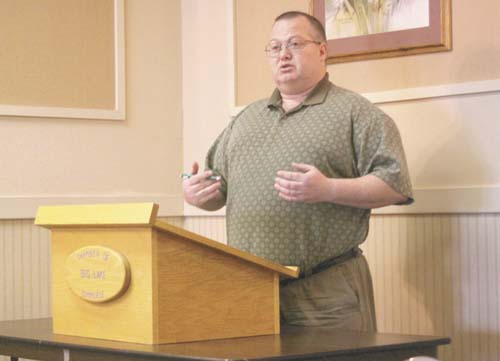
BIG LAKE — In front of a mostly sympathetic crowd Monday, Jim Amundsen with the state’s Department of Transportation answered questions about changes planned for the Parks Highway between Wasilla and Big Lake.
The packet of information he handed out beforehand contained two alternatives — either a four-lane, divided highway or a five-lane highway with a center turn lane.
Essentially, Amundsen said, there are a couple of choices:
• a four-lane, road with exits like the Parks Highway is from the Glenn Highway to Seward Meridian Parkway,
• or, a five-lane road with a designated center turning lane, like the Parks Highway is from Wal-Mart to Lucus Road in Wasilla.
Amundsen was speaking to the Big Lake Chamber of Commerce, which, along with the Big Lake Community Council, has already voiced support for the four-lane, raised road plan.
Overall, Amundsen said, the public seems to stand with Big Lake on that score. But the four-lane idea is less popular in Houston, where Amundsen was set Monday night to address the city’s planning commission, and in Wasilla, where politicians, including Wasilla Mayor Verne Rupright, have spoken out against it.
Amundsen said the four-lane option is simply safer than a five-lane highway. In fact, national design standards strongly discourage the construction of a center turn lane on a highway that will be rated for traffic moving 55 mph or faster.
Safety is really the whole reason the state wants to change the highway in the first place, Amundsen said. It’s the most dangerous stretch of road for head-on crashes in Alaska, even worse than the much-lamented and dangerous Seward Highway, he said.
“We’re killing way too many people,” Amundsen said. “We’re putting way too many people in the hospital.”
Asked when Big Lake could see the long-awaited stoplight at Parks Highway and Big Lake Road, he said that unless something drastic happens — like every third car on the road just disappears — that intersection will get a stoplight as part of this project.
“Currently, all of the numbers indicate that that intersection needs a traffic light,” he said.
But the state is building the project in three chunks. First will be Lucus Road to Church Road, which will start turning dirt in summer 2014. The next summer the state will do Church Road to Pittman Road, and summer of either 2016 or 2017, the Pittman Road to Big Lake Road section will be built.
Other roads like Stanley Road will get a stoplight. Amundsen said the plan is to synchronize the lights in the expanded portion of the road so that someone driving the speed limit will get green lights all the way into Wasilla.
“It would really be nice if you could drive through it like it was the highway it was meant to be,” Amundsen said.
So what about land? What is DOT going to do for people who are in the way of the road project?
Amundsen said the state will pay fair market value and only take what it needs. And that doesn’t mean it will take a critical piece of your land, pay for just that chunk and put you out of business.
“We will be asking, ‘Will your business be able to continue to function as it is today?’ And if that answer is ‘no,’ then not only am I buying your lot I am buying your business,” Amundsen said.
Tom Stoelting, with Alpine Septic, said he worries about moving to a new lot. Currently, when someone complains to the state about the smell coming from his pumpers, the reply they often get is that since Alpine was there first, the complainant should have been aware of that when he or she moved there. But if he has to move to a new lot, that might change.
Amundsen said the Department of Transportation would do its utmost to accommodate him.
“I guarantee you aren’t the first person to have those types of issues,” Amundsen said. “It’s your life and livelihood, we understand that.”
In the case of the Mile 49 Cabins, Amundsen said DOT will find a contractor to remove them. Anyone interested in buying one should wait to see who that contractor is. Amundsen said they’re desirable as cabins since many are very portable.
“On some occasions we actually make money on a relocation and this is probably one of those ones where we will,” he said.
But even though those cabins have no water or septic, the people who live in them can’t be moved to a place similarly lacking in amenities, he said. Federal rules prohibit it.
Contact reporter Andrew Wellner at andrew.wellner@frontiersman.com or 352-2270.

By Jeremiah Bartz Frontiersman.com A football coach using a hockey reference as the centerpiece for his keynote address may

Frontiersman.com With its headquarters in Wasilla, the Frontiersman has been a primary source of news for the Matanuska-Susitna

By Katie Stavick Frontiersman.com The next generation of leaders took flight this week as the Houston High School Class

By Kyle Wilkinson For the Frontiersman Keynote speaker and Carry the Cure President Bill Pagaran’s words boomed through the