Retiring teacher, coach urges Colony grads to ‘find their 68’
By Jeremiah Bartz Frontiersman.com A football coach using a hockey reference as the centerpiece for his keynote address may


WASILLA — Revving up in the back parking lot of Wasilla High School, dozens of bikers, hot rodders and other auto enthusiasts gathered to ride together for the annual Freedom Flag Run event. The event is hosted by the 49th State Street Rodders and gathers car and motorcycles clubs from across the Valley. The event began as a memorial for the Sept. 11, 2001, terror attacks. The first event was just four days after the towers fell and became an annual event to recognize fallen military, police officers and firefighters.
The bikers began the ceremonial ride first with the cars and trucks flowing after. They rode from Wasilla to Alaska Raceway Park in Palmer with their American flags waving in the wind. Some cars honked, saluted and a few bystanders even put hands over their hearts as they passed.
Once at the racetrack, the Rodders served up hundreds of free hot dogs, burgers, chips, soda and desserts to a booming audience. There were several speeches on the importance of Sept. 11, American values, military, police and firefighter sacrifices and other American anthems throughout the day. People moseyed around the shiny cars, trucks and bikes, swapping stories.
“Most of us are vets as well so it’s a dual ride,” said Ken Barkley, president of Alaska Wind and Fire riding club.
The Wind and Fire group is a national riding club with more than 60 chapters across the country. Its Alaska headquarters moved from Haines to Wasilla two months ago. The Wind and Fire club’s mission is to support fire victims, both firefighters and civilians. After the event they also headed to Anchorage for a fallen firefighter memorial at midnight.
Community event and collaboration with other clubs is what drives a lot of the drivers at events like the Freedom Flag Run. Barkley said that unlike the Lower 48, the biker clubs in Alaska do not fight with each other. All the bikers present wore the unifying patch of the Alaska Coalition of Motorcycle Clubs, a statewide program. Under the coalition, the clubs participate in charity events and ensure bikers are following the rules.
“There’s no fighting amongst the groups. We support each other and go to each other’s events,” Barkley said. “There’s nothing better than watching 40 to 50 bikers riding down the road together.”
Paul Williams drove a replica of his father Fran’s military Jeep from WWII. Williams said his dad was a scout at the Battle of the Bulge.
The green Jeep has everything one might expect, right down to the division and serial numbers, giving it an authentic 1940s Army appearance. The Jeep was titled “Last Chance.”
These Jeeps were used by scouts and would go behind enemy lines to report back on what they found. According to Williams, if the enemy spotted them, they had to get out as fast as they could to avoid getting killed. Williams said his father’s Jeep was his last chance of survival.
“You wouldn’t fight out,” he said. “You’d bug out.”
Williams also brought a collection of patches inside a big frame. He is part of the Alaska Territorial Cavalry Club and another member accumulated quite a few patches. He borrows many of them for these types of events. His father was part of the 87th infantry division called the Golden Acorn, which reported back to Gen. George Patton. The golden, yellow patch was there among the others.
Williams said he likes to take the patches to events like these because it’s a conversation starter and he often finds a common thread with the people talks to. He said it could bring new meaning to children and grandchildren who have old military clothes with patches on them. When they learn more about what’s behind the patches, what stories the divisions had, the patches take on a whole new meaning.
“I certainly don’t think it’s a bad thing to know where they came from,” Williams said.
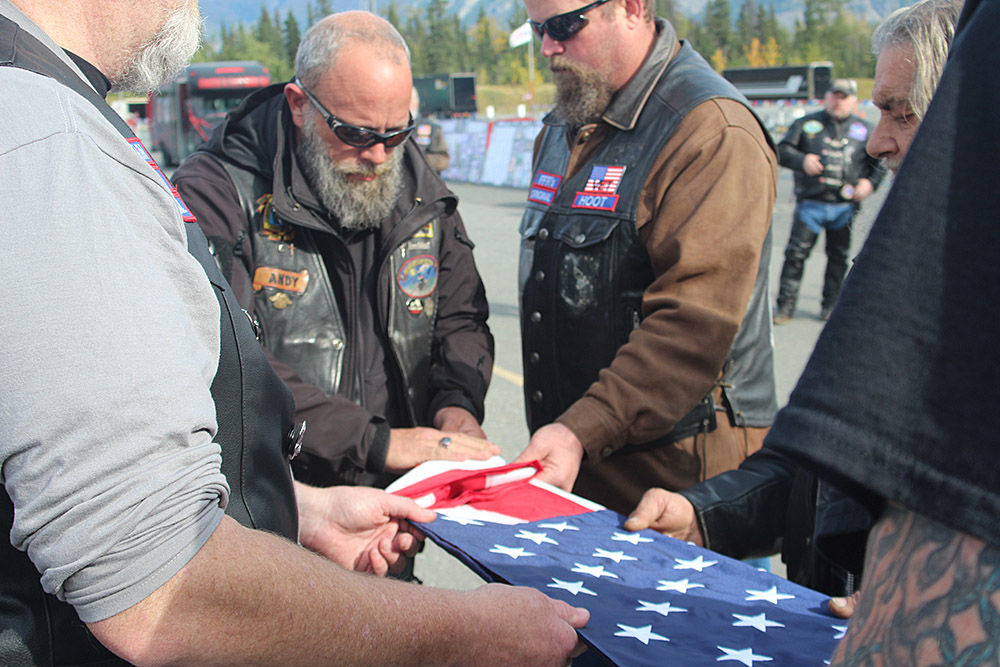
During the flag folding ceremony, the emcee stated that the American flag represents the “same religious principles that the country was founded on.” A handful of burly bikers stood in a rectangle and folded the flag 12 times, flowing the traditional process. Each step of the flag folding had a meaning.
The emcee explained each fold to the audience, “The first fold of our flag is a symbol of life. The second fold is a symbol of our belief in eternal life. The third fold is made in honor and remembrance of the veteran departing our ranks, and who gave a portion of his or her life for the defense of our country to attain peace throughout the world. The fourth fold represents our weaker nature; as American citizens trusting in God, it is to Him we turn in times of peace, as well as in times of war, for His divine guidance. The fifth fold is a tribute to our country, for in the words of Stephen Decatur, ‘Our country, in dealing with other countries, may she always be right, but it is still our country, right or wrong.’”
Richard Hamblen served in the Army in the 1970s. This was his first Freedom Flag Run event. He’d run similar events in the Lower 48 for Memorial Day. He was immediately drawn to Williams’ collection of patches. Hamblen said he served with four of the divisions seen in the frame. It was just what Williams was looking for, a connection under shared symbols.
“It seems like a bunch of good people brought a bunch of good rides,” Hamblen said.
Hamblen rode his chopper with the other bikers. He said he liked riding in big groups so the Harleys could “keep up” with him.
The PA system played sentimental tunes from golden oldies, classic rock and country singers throughout the day — all American patriotism themed. They played audio clips from George W. Bush’s speech after the terror attacks and a scene from the 1970 movie “Patton” starring George C. Scott.
President of the 49th State Street Rodders, John Troutner said the American flag was all about the “red, white and blue- patriotism.” Troutner said it was an all-encompassing symbol of everything leading up to that day.
President of the newly formed Freedom Flag Runners, Mark Schwulst rode at the very first Freedom Flag Run in 2001. Schwulst said the Alaska Coalition of Motorcycle Clubs accepted them as an official club in March. He said the mission of their club is firstly, spreading the message behind the stars and stripes. They go to schools and teach kids about the flag’s history and symbolism. They teach them how to fold it and hand out pocket flags to take with them.
“It stands for what we stand for,” Troutner said. “You look at it and it says it all.”
Contact reporter Jacob Mann at 907-715-8717 or jacob.mann@frontiersman.com

By Jeremiah Bartz Frontiersman.com A football coach using a hockey reference as the centerpiece for his keynote address may

Frontiersman.com With its headquarters in Wasilla, the Frontiersman has been a primary source of news for the Matanuska-Susitna

By Katie Stavick Frontiersman.com The next generation of leaders took flight this week as the Houston High School Class

By Kyle Wilkinson For the Frontiersman Keynote speaker and Carry the Cure President Bill Pagaran’s words boomed through the