Retiring teacher, coach urges Colony grads to ‘find their 68’
By Jeremiah Bartz Frontiersman.com A football coach using a hockey reference as the centerpiece for his keynote address may


PALMER — During the second day of Dominic Johnson’s trial in Palmer Superior Court, District Attorney Roman Kalytiak continued to show the jury photos of evidence stacked against Johnson for his role in the murder of Palmer teen David Grunwald on Nov 13, 2016.
During his opening arguments, Kalytiak made his case that Johnson was a catalyst for the violent crimes, and on Tuesday he called law enforcement officers and forensic experts to the witness stand who processed the evidence during the investigation. The timeline of events that began in 2016 was displayed through photos of the crime scene and locations of the subsequent searches.
The prosecution called Carly Wiehe, Forensic Scientist 3 at the Alaska Scientific Crime Detection Laboratory, to the stand, who photographed the crime scene on Dec. 2, 2016. Wiehe wears a variety of hats for the lab, and responded to the discovery of Grunwald’s body near Mile 7.3 of Knik River Road when Alaska State Troopers called the lab’s crime scene phone and Wiehe responded with two coworkers. Johnson had directed trooper Tony Wegrzyn to the location of the body nearly 100 yards off of the road through the brush on a very faint trail. Wiehe originally helped to document the crime scene, taking hundreds of photographs that were used as evidence presented to the jury. A great emphasis in Wiehe’s work is on the quality of her photographs, helping to accurately display to the jury the evidence that was documented nearly two years ago. Wiehe spent more than three hours taking photographs of Grunwald’s body.
“Normally I am the first one in the scene and the last one out. I take photos before the scene has been altered, and then I am the last one to take photos as you exit so you can see how the scene was left when we left there,” Wiehe said.
Wiehe was the first to photograph placard 58, the marker used by crime scene investigators that stood near the 9mm shell casing that was used to fire the bullet that killed Grunwald.
“We also work really well as a team with our law enforcement, specifically in the Valley I’ve worked a lot with those law enforcement and we have a good teamwork there,” Wiehe said.
Wiehe processed the trailer where Grunwald was brutally beaten and recalled a distinct odor of bleach in the camper where Johnson and the group are accused of destroying the evidence. The trailer processing took place on Dec. 1, 2016. The next day, Wiehe arrived at the crime scene on Knik River Road at 5:45 p.m. and took photos until 9. Wiehe had a large role in evidence processing during the investigation. Wiehe collected finger and palm prints from Austin Barrett, Bradley Renfro, Johnson and Devin Peterson at various scenes related to the crimes.
The prosecution’s next witness was Carrs/Safeway general merchandise manager Kelli Jo Varnes, who supplied Major Crimes Investigator Andrew Adams of the Alaska State Troopers with the surveillance video of David Grunwald. On Nov. 13, Grunwald entered the Palmer Carrs store to fill a water jug at 6:12 p.m. and exited at 6:14, adding evidence to corroborate the testimony of Grunwald’s girlfriend, Victoria Molkelke, on Monday. Varnes supplied Adams with the surveillance footage nine days later on Nov. 22, 2016, which helped to create the timeline of events on Nov. 13.
Just over three hours after his trip to the Palmer Carrs, Grunwald went missing.
During testimony with Grunwald’s mother, Edie, she detailed the events of the day on Sunday, Nov. 13, 2016. Edie Grunwald attended church with her husband, son, and his girlfriend before shopping for furniture with David and Victoria. They took her Jeep rather than David’s 1995 Ford Bronco, which was burned at the base of the Talkeetna mountains early Nov. 14. Edie Grunwald detailed her last communications with her son before he was beaten, kidnapped, and murdered. David had been granted permission for 20 extra minutes beyond his curfew to take his girlfriend to the Butte, and just five minutes after he had missed his curfew at 9:20 p.m., Edie was already working to find her son. She contacted Molkelke and Rodney Almandinger, Erick Almandinger’s father, with no results. The Almandinger home is where David Grunwald went after dropping off Molkelke. Rodney Almandinger failed to provide any information on where the boys were, and so Edie and her husband Ben got in her Jeep and retraced her son’s route to see if his vehicle had been disabled along the way. She began finding parents of her son’s acquaintances online and asked them if they had seen her son.
“During those days between Nov. 13 and Dec. 2, is it fair to say that there was more hope earlier during that time period, that David would be found alive?” Kalytiak asked Grunwald.
“Yes,” Grunwald said softly.
“And, as time passed, there was less hope?” said Kalytiak.
Grunwald concurred.
The prosecution continued to detail the collection of evidence against Johnson. David Grunwald left his home in a hooded sweatshirt, jeans, and moccasin-style slippers. After a dusting of snow, when Wegrzyn tracked through the faint trail that led 77 meters from the roadway to the clearing where David Grunwald’s body was put, he saw the orange hooded sweatshirt peeking out from under the snow. Experts described the location of the body as “remote,” and numerous witnesses admitted that they would not have noticed the body in the snow if they had not arrived on the scene of the investigation already equipped with that knowledge.
Adams deployed state of the art technology to assist in processing and analyzing the crime scene. Adams used a Faro 3D scanner to provide an interactive walkthrough of the crime scene. The Faro uses a laser and a spinning mirror to measure each piece of the landscape surrounding a crime scene. Where traditional tape measures can suffer up to 40 millimeters margin of error, the Faro is accurate up to 4 mm. Trooper Scott Bartlett had to manage his way through the forest to get to the opening where Grunwald was found. Bartlett noted that there were three inches of fresh snow and uncovered key evidence in 10 degrees, and told jurors that on scene, he and his fellow investigators were equipped with heavy coats and snow pants. Kalytiak argued on Monday that David Grunwald’s clothing choice signified that he was not ready to be outside in the Alaskan winter, and suffered consequences he could not have foreseen. Kalytiak juxtaposed the warm weather gear worn by investigators uncovering evidence against the clothing worn by David Grunwald. Bartlett’s role in the investigation helped to begin to put the pieces together. While investigating the crime scene, Bartlett used a metal detector to uncover the shell casing that was marked with Placard 58.
Kalytiak repeatedly mentioned that between Placard 58 around the shell casing and Grunwald’s body, frozen into the ground, were a pair of slippers.
Another item of clothing was discussed as evidence with later witnesses. Trooper Mike Ingram interviewed Rodney Almandinger while Wegrzyn interviewed Erick, and on Dec. 6, 2016, served a search warrant on a house in Big Lake in search of firearms related to the beating and murder of David Grunwald. Ingram contacted Devin Peterson and seized three firearms from Peterson’s backpack. Ingram also distinctly remembered a knitted cap that belonged to Barrett.
“I remember more than anything a knit cap that was like a Ouija cap that was inside the backpack,” Ingram said.
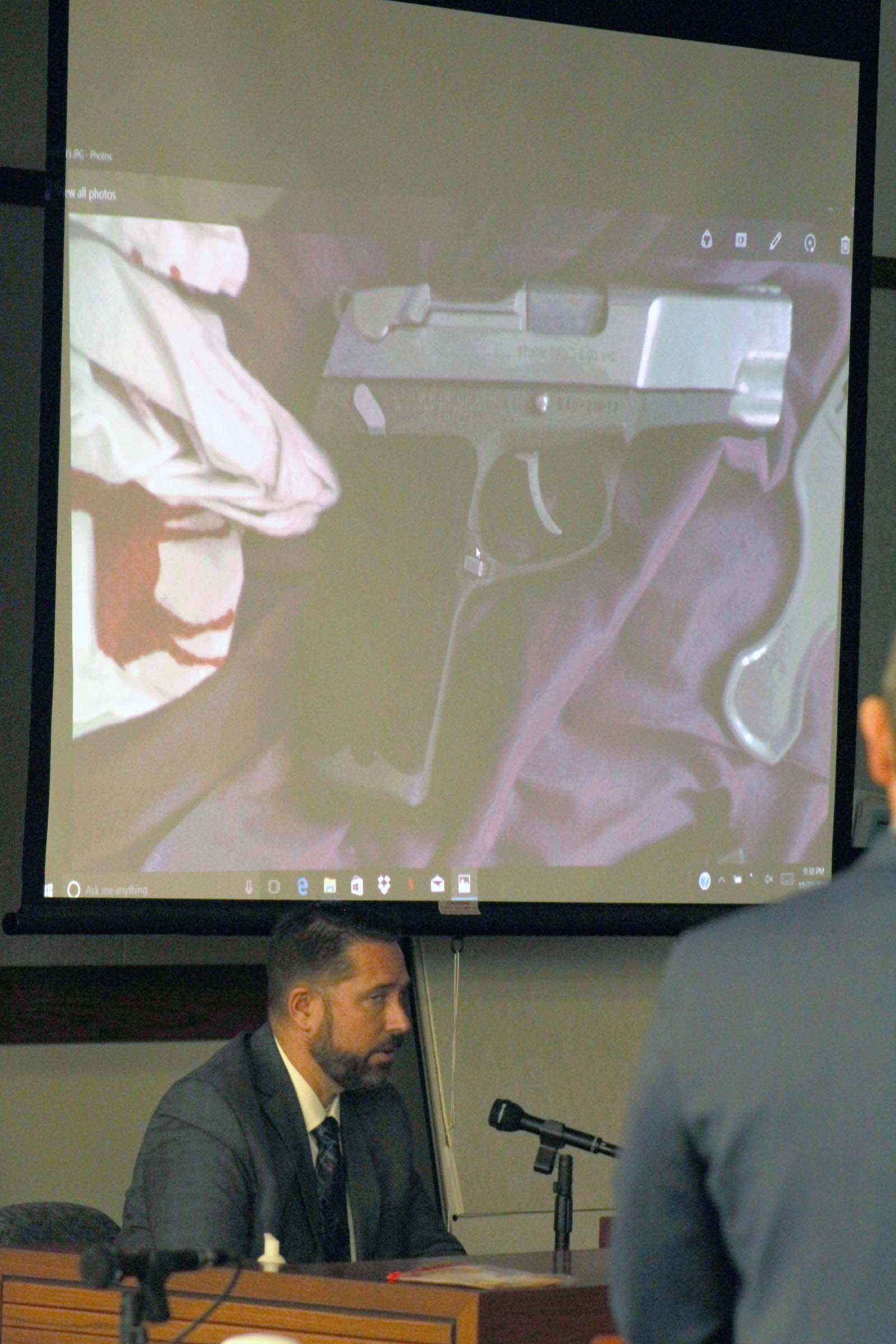
Ingram also located Barrett’s identification card at the house in Big Lake. Ingram examined rounds and weapons seized at the house, confirming the type and style of ammunition used in different guns. While Ingram added expertise on identifying the rounds used in each gun, the Ruger 4.0 used to pistol whip David Grunwald and the Springfield 9mm used to shoot him, the most experienced expert witness thoroughly detailed the correlation between weapon and ammunition. Debra Gillis has worked as a forensic scientist at the Alaska Scientific Crime Detection Laboratory in Anchorage since 2001, and has a wealth of applicable knowledge and education. She claims that her bread and butter is identifying cartridge cases and bullets back to a specific gun, and also specializes in function test of firearms, serial number restoration, distance determination and shot patterns. Gillis detailed the various safety components on the Ruger and the Springfield, and Kalytiak brought to the attention of the jury the difference in construction in the Ruger and Springfield.
“Since this is a polymer frame, this one is I think going to be lighter,” Gillis said.
Kalytiak argued that the difference in the weight and construction were the justification for why each gun was used for each crime. Monday, Kalytiak particularly focused on the lanyard at the bottom of the Ruger, which Johnson requested from Erick Almandinger to beat David Grunwald with. Gillis identified striations in the casing that indicate that it was fired from the Springfield on Knik River Road.
Johnson’s attorney, Lyle Stohler, called into question Gillis’ methods, wondering if she had continued to search for a round that fit the pistol after she had matched the round to the gun. Stohler objected to only five arguments from the prosecution, and consistently questioned the presence of a stream at the crime scene. Multiple bridges are visible near the location of the shooting, and none of the prosecution's witnesses could recall if there was a stream present. Some speculated that due to the frozen ground, even if a stream was present it would not be noticeable. Stohler also repeatedly brought into question the examination of Mile 5 Knik River Road, where Johnson also took Wegrzyn to search for the body of David Grunwald.
The trial continues Wednesday at 9 a.m. at the Palmer Courthouse.
Contact Frontiersman reporter Tim Rockey at tim.rockey@frontiersman.com.

By Jeremiah Bartz Frontiersman.com A football coach using a hockey reference as the centerpiece for his keynote address may

Frontiersman.com With its headquarters in Wasilla, the Frontiersman has been a primary source of news for the Matanuska-Susitna

By Katie Stavick Frontiersman.com The next generation of leaders took flight this week as the Houston High School Class

By Kyle Wilkinson For the Frontiersman Keynote speaker and Carry the Cure President Bill Pagaran’s words boomed through the