Retiring teacher, coach urges Colony grads to ‘find their 68’
By Jeremiah Bartz Frontiersman.com A football coach using a hockey reference as the centerpiece for his keynote address may


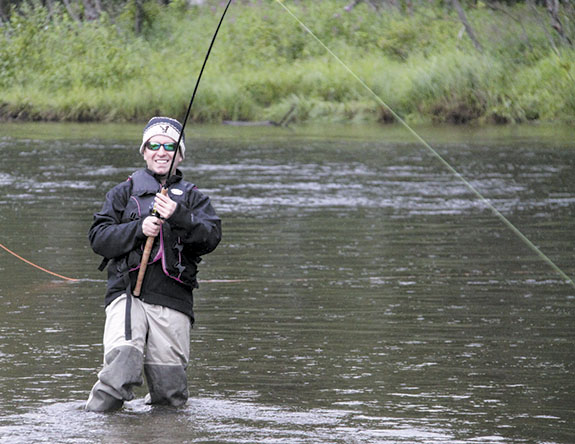
MAT-SU — Some may still feel like a bad day of fishing beats a good day at work. But in a summer stocked full of bad salmon fishing days, some Mat-Su business operators would love to reel in a good day at the office.
With a steady line of restrictions and closures in local salmon fisheries, it’s not only anglers who are feeling skunked. Businesses that cater to sportfishing are suffering.
The complete closure of coho salmon fishing on the Little Susitna River, effective last Friday, is the latest restriction announced by the Alaska Department of Fish and Game that impacts the Mat-Su Valley. Poor returns are again to blame, just as they were for the restrictions and ultimate closure of the local king salmon fisheries earlier this summer. Rival user groups continue to debate the reasons for poor returns in the Northern Cook Inlet. Sportfishing groups question commercial fishing’s impact on salmon returns to local fisheries. Local sportfishing activists say they are concerned with the level of responsible management in some industries. Varying opinion has led to passionate debate, privately and publicly.
Regardless of blame, a number of local businesses continue to feel the pain.
Local fishing guide operators have been forced to cancel scheduled trips with clients, business is rapidly dropping at local stores that sell fishing gear and certain campgrounds that typically stay busy throughout the summer months are unusually quiet this year.
“People up here are dying on the vines. It’s terrible to watch that happen,” state Rep. Mark Neuman said. “We’re not getting the fishing we need up here.”
Neuman said local businesses that bank on the sportfishing industry and local families who depend on sportfishing to put food on their tables are hurting because of the lack of fish returning to Valley waters. Now, Neuman said, more attention needs to be paid to reasons why the fish are not returning.
Howard Delo, a retired fisheries biologist and longtime Frontiersman outdoors columnist, said this will be the fourth year the Little Su will not meet the escapement return total for silver salmon, a mark set by the ADF&G.
“If a run fails to meet the minimum for four or more years it should be classified as a stock of concern,” Delo said. “The Little Su will meet that this year.”
With that, Delo said, three of the five wild salmon species found in the Valley would be classified as stocks of concern. Sockeye salmon in the Yentna River area already is listed as a stock of concern. King salmon was labeled a stock of concern in 2011.
Andy Couch, who owns and operates Fishtale River Guides and is a member of the Mat-Su Borough Fish and Wildlife Commission in addition to writing a weekly column for the Frontiersman, has written multiple petitions to the Alaska Board of Fisheries concerning what many are calling a crisis in the Mat-Su Valley.
Couch’s latest petition targets the Northern District Salmon Management Plan. His petition, submitted three days before ADF&G closed all silver salmon fishing on the Little Su, asked the Board of Fish to close commercial salmon fishing within a one-mile radius of the mouth of the Little Su for the remainder of the 2012 season, or until ADF&G could project that the Little Su silver salmon escapement goal will be met.
ADF&G did issue an emergency order to suspend commercial set gillnetting in the Upper Cook Inlet on Aug. 9 from 7 a.m. to 7 p.m. in reaction to the low number of cohos returning to the Little Su.
“Run timing can be highly variable for coho salmon; however, at this time even based on the record late-run timing model, the sustainable escapement goal (in the Little Susitna River) is projected to not be met. Therefore, it is prudent to close the commercial set gillnet in the general subdistrict of the Northern District to conserve coho salmon bound for the Little Susitna River,” according to a press release issued by the office of the ADF&G area management biologist in Soldotna.
Couch said he was pleased to see the commercial fishery closed for that day, but said that is not enough.
ADF&G publicly released its intent to close the Little Su to salmon fishing on Aug. 8. As of Aug. 8, only 740 fish had passed through the Little Su weir and counted. As of Sunday, more than two days after the waters were closed to silver salmon fishing, 1,817 fish had been counted.
Couch said that historically, at least 5,050 coho must pass through the weir by Aug. 6-13 to meet escapement minimums.
Couch said the explanation for the lack of fish returning to Valley waters is fairly simple. The salmon are being intercepted by the commercial fishery before they’re able to return to this region.
“The commercial fish division seems more than willing to just let those guys fish all the way through the season, no matter what the escapement levels are,” Couch said. “They are no way following responsible management.”
Neuman said ensuring that escapement numbers stop declining and start rising is of highest priority.
“I think one of the most important things, whether you’re a commercial fisherman, a sport fisherman, a subsistence fisherman — we all lose out if we don’t get those spawners,” Neuman said. “We all lose if we don’t get fish.”
Neuman said he sees the importance of the commercial fishing industry, but he’s fighting for the survival of salmon sportfishing in the Valley.
“You look at the economic multiples it has an effect on, it’s huge,” Neuman said.
A study released in 2009 measured the economic impact of sportfishing in Alaska at $1.6 billion. The estimated impact from sales to non-residents was $700 million. According to the report, a total of 15,879 jobs also were created.
But a lot has changed since then, and proponents of sportfishing in the Valley and the Northern Cook Inlet region fear the worst. Neuman said last week he is inviting state officials, such as ADF&G commissioner Cora Campbell to tour the Valley, and personally speak with business owners impacted by the lack of fish.
Mike Hudson, owner of 3 Rivers Fly and Tackle, a popular fishing gear shop based in Wasilla, has lived in Alaska for nearly 30 years and said he’s watched a steady decline in the salmon sportfishing industry for about 15 years. Last Wednesday, just hours after the closure of silver salmon fishing in the Little Su was announced, Hudson called for responsible management in all fishing industries — commercial and sportfishing. He said the sportfishing sector has tried to do the right thing, conserve the industry in the interest of the future.
“The sport fishermen are doing the right thing. What we do is the responsible thing. We don’t let greed get in the way,” Hudson said.
Like many on the sportfishing side, Hudson argues the salmon species are being overfished before a possible return to Cook Inlet waters.
“Greed is overusing the resource, nobody paying attention to how precious the resource is,” Hudson said.
Hudson fears for the future of a unique Northern Cook Inlet sport fishery.
“It’s one of the last places in the world you can fly to an international airport and fish for five species of wild salmon,” Hudson said.
Hudson’s business has catered to local anglers and visitors eager to reel in what the Valley has to offer. Rough seasons have led to tough business for Hudson.
Six years ago, Hudson said, he had nine employees. This year, he has two. His sales in June were down 50 percent from five years ago.
With the lack of fish and abundance of restrictions, select campgrounds have been unusually quiet this summer.
Division of Parks and Outdoor Recreation area superintendent Wayne Biessel said last week that the total number of users of the Little Susitna campground and the campground at the mouth of Willow Creek is far below normal.
The financial impact is different, but there is an impact, Biessel said. The Little Su facility is used as a funding source, he said.
“The funds are reinvested directly back into the facility,” Biessel said.
With fewer campers paying their nightly access fee, fewer dollars will be available to maintain and upgrade the facility, he said.
Delo and Couch both said the annual poor salmon returns are a serious problem that needs to be solved now.
“You need to start managing for the resource first, the user comes second, whether commercial or sport,” Delo said.
Contact Mat-Su Valley Frontiersman sports editor Jeremiah Bartz at sports@frontiersman.com.

By Jeremiah Bartz Frontiersman.com A football coach using a hockey reference as the centerpiece for his keynote address may

Frontiersman.com With its headquarters in Wasilla, the Frontiersman has been a primary source of news for the Matanuska-Susitna

By Katie Stavick Frontiersman.com The next generation of leaders took flight this week as the Houston High School Class

By Kyle Wilkinson For the Frontiersman Keynote speaker and Carry the Cure President Bill Pagaran’s words boomed through the