Retiring teacher, coach urges Colony grads to ‘find their 68’
By Jeremiah Bartz Frontiersman.com A football coach using a hockey reference as the centerpiece for his keynote address may


Anchorage’s port, which serves 85 percent of the state’s population, is falling apart.
Corrosion is eating away at steel piles installed that support the docks at the Port of Anchorage. Unless the piling and docks are rebuilt, and there are 1,423 piles, the port will no longer be structurally safe in 10 years, said Jim Jager, the Port of Anchorage’s external affairs manager.
In fact an earthquake, which can happen at any time, would cause the port to collapse now, cutting off supplies of groceries, fuel and other needed commodities to Southcentral and Interior Alaska communities, Jager told the Resource Development Council, an Anchorage business group, in a Sept. 22 briefing.
It’s not a pretty picture, but the problem can be fixed, Jager said.
A project to reconstruct the port is in the planning stages and work is expected to begin next year but all of the $700 million needed to fund the work is not yet in hand.
“We do have $125 million left from an earlier project to expand the port, which is being used for planning and permitting and is enough to begin the first phase of reconstruction,” Jager said.
Officials at the port and Municipality of Anchorage, which own the port, see ways of covering about half of the total cost, though some of this is still iffy, Jager said. It’s clear, however, that at least $300 million will have to be raised from sources yet to be identified.
Revenue bonds issued by the port or city are possible, or a state-backed bond. Jager argued that is appropriate because the port serves most of Alaska, not just Anchorage. The port has its own revenues from companies that unload freight that could help pay debt service on revenue bonds.
However, this can get tricky if the payments result in a increase of port user fees, Jager said. Some shippers who are price sensitive have the ability, like dry goods shippers, to shift to other marine transporters, barge services for example, which may take a little longer but which have access to barge docks and don’t need the Port of Anchorage. However, shippers of perishables, like grocery firms, don’t have that flexibility and need to move their freight fast.
If the port’s user costs go up and some dry-goods shippers switch to barges there would be less volume moving, which would add to costs on the perishables. It could, in other words, drive up food costs in Southcentral and the Interior.
Meanwhile it will take seven to eight years to reconstruct the Anchorage port, which is uncomfortably close to the 10-year point at which the present pilings will no longer be safe.
The corrosion problem is serious, Jager said. In 1961 the piling was expected to last 35 years. The 24 inch-diameter steel piles installed in 1961, which are hollow, have a steel wall thickness of just under half an inch - 7/16th of an inch to be exact. Bacterial action in Cook Inlet’s silt has corroded three-quarters of the metal at the bottom of the piles, which carry the weight of the docks.
There is nothing that can be done to stop the corrosion process, Jager said.
Beginning in 2004, a process of reinforcing the corroded piles with metal sleeves was started and this continues at a cost of $3 million a year. However, the sleeves are also subject to corrosion, and have a 10 to 15-year estimated life, and once they corrode they cannot be replaced, Jager said.
Given this, the sleeves installed in 2004 and the years immediately after are already approaching the end of their own design life.
Even the reinforcement doesn’t do the whole job, though. With the sleeves the piles are strengthened enough to carry the vertical load of the docks and heavy equipment on them but an earthquake would introduce a sideways motion that the piles cannot stand up to.
In a quake, a collapse of the dock could also trigger a slide of land behind the dock, where fuel tanks and other facilities are built, and all this could slide into Cook Inlet taking the wreckage of the docks and piling with it.
Also, the current piling isn’t grounded on bedrock. Test holes drilled at the port show bedrock at 135 feet at the shallowest point and 190 feet at the deepest. The present files, meanwhile, only go down 60 feet, so it is only silt that supports them.
The reconstructed pilings will be much sturdier. The piles will be driven deeper to bedrock and they will be 48 inches in diameter, twice the size of the current piles, and with twice the thickness of steel, at one inch. They will also be filled with concrete, which will add extra strength.
With this design the reconstructed dock will have an expected life of 75 years, Jager said.
The port covers 125 acres and is hugely important to Southcentral and Interior Alaska, and even western Alaska communities served by barges that transship cargo brought first to Anchorage in large ships. Sixty percent of Alaska’s 740,000 population lives within two hours by truck from the Anchorage port, and 75 percent live on the state’s highway system that carry goods brought north by marine vessels.
Ninety percent of the goods consumed in Southcentral and the Interior come north by ship, with the remaining 10 percent split between air and truck, Jager told the RDC.
About 3.5 million to four million tons of cargo per year is landed in Anchorage, about half of it for consumers in the region and the rest moved to points further north or west. At its peak of freight movement, in 2004, the port handled 4.4 million tons.
The incoming freight is of all types, in perishables or other commodities carried in containers to bulk products like cement or fuel. About 3.4 million barrels of fuel storage capacity is at the port along with 60,000 tons of cement storage capacity, Jager told the RDC.
What’s also important, he said, is the port’s interconnections with other transportation like fuel pipelines that connect it to Joint Base Elemendorf Richardson, the Ted Stevens International Airport, and the Tesoro refinery on the Kenai Peninsula, as well as the Alaska Railroad and the state’s highway system.
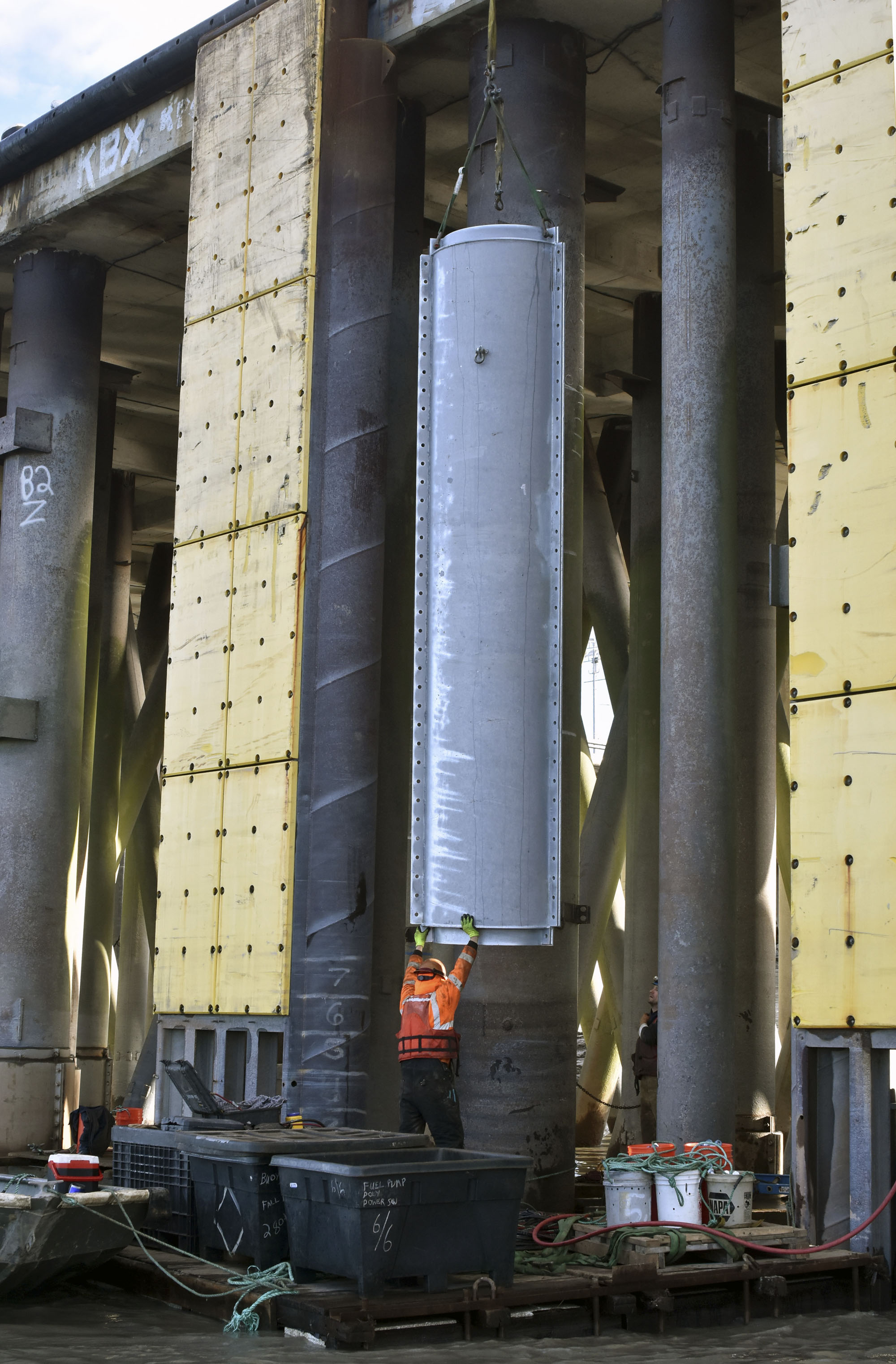
Beginning in 2004, a process of reinforcing the corroded piles with metal sleeves was started and this continues at a cost of $3 million a year. However, the sleeves are also subject to corrosion, and have a 10 to 15-year estimated life, and once they corrode they cannot be replaced.
Submitted photo
By Jeremiah Bartz Frontiersman.com A football coach using a hockey reference as the centerpiece for his keynote address may

Frontiersman.com With its headquarters in Wasilla, the Frontiersman has been a primary source of news for the Matanuska-Susitna

By Katie Stavick Frontiersman.com The next generation of leaders took flight this week as the Houston High School Class

By Kyle Wilkinson For the Frontiersman Keynote speaker and Carry the Cure President Bill Pagaran’s words boomed through the