Retiring teacher, coach urges Colony grads to ‘find their 68’
By Jeremiah Bartz Frontiersman.com A football coach using a hockey reference as the centerpiece for his keynote address may


WASILLA — Alternative routes for high-voltage transmission lines will cost MEA ratepayers somewhere between $10.1 million and $18.2 million, according to figures presented to the Greater Wasilla Chamber of Commerce Tuesday.
Officials still don’t know the final route, spokeswoman Julie Estey told local business owners. What is known is that the lines likely won’t follow the Parks Highway as suggested in August 2013, and that the demand for electricity is increasing in the Wasilla, Knik-Fairview and Point MacKenzie areas. They know homes, businesses, and wetlands likely will be impacted, but don’t know which specific areas.
The capacity of the transmission lines must increase to ensure safe power consumption, Estey told chamber members. Capacity in the existing electric system is growing at about 1 percent per year, while demand is growing at about 6 percent per year, according to MEA.
“The system is at risk here,” she said. “In order to grow and sustain the growth that you have, you need another transmission line.”
Estey said the effort underway now changes the framework for the conversation. This time around, MEA is asking Wasilla officials and residents where the new lines should be built.
“The main reason we’re here is to open up a new candid and transparent conversation with the community in Wasilla about transmission lines,” she said.
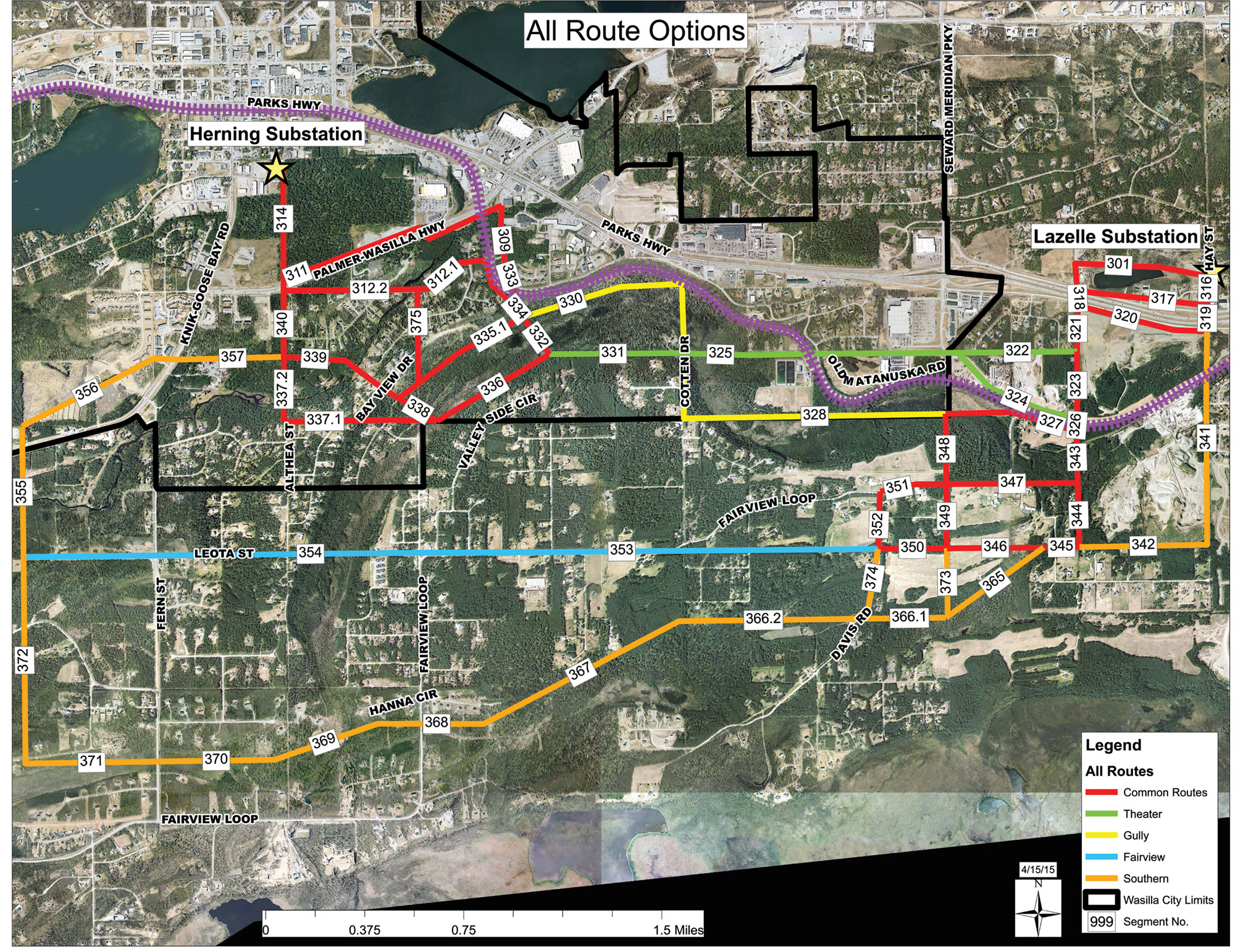
Officials have roughly grouped the alternatives into four potential corridors, including:
• A route along portions of Fairview Loop and Leota Street, estimated to cost between $13.1 million and $18.2 million, and potentially affecting as many as 111 parcels and 51 homes.
• A route that runs near Old Matanuska Road and the rail bed (known as the “Theater” route, because it runs near Valley Cinema and the Wasilla Walmart), estimated to cost between $10.1 million and $11.9 million, and potentially affecting as many as 74 parcels and 27 homes.
• A “Gully” route that runs along Cotton Drive and cuts through a low point near Old Matanuska Road perpendicularly, estimated to cost between $10.2 million and $11.2 million, and potentially affecting as many as 67 parcels and 34 homes. (This is MEA’s preferred route because of low impact to private property owners and cost.)
• An arcing Southern route that runs far to the south of Fairview, then crosses Knik-Goose Bay Road twice before dog-legging back to the Herning substation, estimated to cost between $10.2 million and $11.2 million, potentially affecting as many as 77 parcels and 25 homes.
The overall strategy is to create an encircling loop of transmission lines around the Wasilla area, which would then feed to smaller-scale distribution lines feeding individuals and houses, said MEA Director of Engineering Gary Kuhn. Substations help transition between the transmission voltages and the distribution voltages, he said.
“What we’re trying to do with substations is reduce the vulnerability at the substations by making sure we have the right electrical components in place at the substations,” Kuhn said.
Officials have a starting point in the soon-to-be renovated Lazelle Substation near the hospital. They have an endpoint in the Herning Substation south of the Parks Highway and east of Knik-Goose Bay Road. In between are dozens of segmented lines that run though densely populated neighborhoods in some cases, and unpopulated wetlands in others.
Feedback during meetings in May and June will likely determine the ultimate cost, according to MEA spokeswoman Julie Estey.
“We’ve narrowed it down for these four for people to focus on, but even within these four, there are about three or four different ways it could go,” she said. “In each one of these segments, we have money estimates, and the numbers of lots impacted and businesses and wetlands, all of that is associated with each of these numbers. So, we get a route, we can add those all together and say ‘This would be the impact of those routes.’”
The MEA has already created a redundancy loop around the Palmer metropolitan area, and creating a similar loop around the Wasilla area would improve service and could eventually position MEA to sell extra electricity generated at the new Eklutna Generating Station, active since April 1, to markets in need of greater power, Estey said.
An open house on the project is from 5 to 9 p.m., May 21 at the Curtis D. Menard Memorial Sports Center. A public hearing is scheduled for 6 to 9 p.m., June 11 at the Menard Center.
More information, including maps of each individual route, is available at mea.coop/wasillatline. Feedback may also be submitted via email at WasillaTLine@mea.coop, or by phone at 761-9277.
Public feedback from either meeting would be compiled and forwarded to the Wasilla Planning Commission for consideration, Estey said.
“There’s plenty of opportunity to make your voice heard,” she said. “If you have an opinion on this, there’s no reason not to tell us what it is.”
Contact Brian O’Connor at 352-2269, brian.oconnor@frontiersman.com, or on Twitter @reporterbriano.

By Jeremiah Bartz Frontiersman.com A football coach using a hockey reference as the centerpiece for his keynote address may

Frontiersman.com With its headquarters in Wasilla, the Frontiersman has been a primary source of news for the Matanuska-Susitna

By Katie Stavick Frontiersman.com The next generation of leaders took flight this week as the Houston High School Class

By Kyle Wilkinson For the Frontiersman Keynote speaker and Carry the Cure President Bill Pagaran’s words boomed through the