Retiring teacher, coach urges Colony grads to ‘find their 68’
By Jeremiah Bartz Frontiersman.com A football coach using a hockey reference as the centerpiece for his keynote address may


A California tech startup has developed a system of precision airdrops of small freight packages that could benefit rural Alaska communities and industrial operators at remote sites.
Airdrops are nothing new, of course. The military has been doing it since World War II. What’s different now is the precision with which it can be done even in conditions of poor visibility.
The company, DASH Systems of Hawthorne, Calif., was in Alaska in mid-July demonstrating its system with drops at Toolik, a University of Alaska Fairbanks research site on the North Slope; at two Interior locations, Minto village northwest of Fairbanks and the Poker Flats rocket site near the Interior city, and the HAARP high altitude research site near Glennallen. Poker Flat and HAARP are UAF facilities.
The system involves conventional piloted aircraft – a Cessna 208 was used in the demonstrations – with the cargo loaded into a protected “pod” equipped with fins that is precision-directed to the landing site, said Joel Ifill, CEO and founder of the company.
The payload ejection is now done manually by a “load master” on the plane but the company is developing a treadmill-type system that will eject the pod without aircraft crew being near a partly-open door.
The ejection is done at about 2,000 feet but the decision on that is made by the pilot based on conditions, Ifill said. A few seconds before landing a small parachute deploys to slow the descent.
The parachute deployment is now done at about 200 feet but DASH is working to reduce even lower. “The lower the chute deploys the greater the accuracy,” Ifill said.
Minimizing time under the parachute reduces “wind drift” in the descent, a problem with conventional air drops like those done by the military, Ifill said.
What’s new in the delivery system is the adaptation of technology used by the military for guidance of precision bombs.
Ifill was employed with defense technology companies on precision-guidance of munitions and founded DASH in 2017 to apply the technology to civilian use. The company is developing its system under a U.S. Office of Naval Research contract and DASH also has contracts with the U.S. Air Force on applications that can aid military ground forces.
DASH’s end goal is to deliver a package into a space the size of a standard heli-pad, except that nothing on the ground is really needed, Ifill said.
“We are developing a software application that automates the airdrop process including providing guidance to the pilot to reach the right release point in the sky, and communication with the pod (internal system) prior to launch,” Ifill said in an email.
“Once launched the pods can provide telemetry and other data back to the software (system), but they (the pods) are autonomous and self-guided once in the air,” he said.
On landing, the device transmits GPS coordinates to the pilot who then forwards them to the customer for retrieval.
“It’s pretty spectacular to see one of these drops. You watch it come down fast and in the last few seconds the ‘chute deploys,” he said. There is a landing impact but it is the equivalent of a package falling three feet, which is about what packages experience in shipping facilities.about like a suitcase being dropped from the bed of a pickup.
A key advantage for DASH is that its system allows for delivery in conditions of low visibility. Winds up to 35 miles per hour can also be dealt with, since wind direction and speed is data loaded into the electronic system in the pod. Adjustable fins on the tube-shaped pod control the descent.
DASH is now working with a pod designed for a 50-pound package size but has plans to scale the system up to 100-pound to a 200-pound size, which would require use of larger aircraft.
“We’re customer-driven,” Ifill said, so the next size to which DASH scales up will depend on market demand.
No aircraft modifications are needed, either. “If your plane can accommodate skydiving, you can do this,” Ifill said. No special permits are needed from the Federal Aviation Agency or other government entities, although a routine Notice to Airmen is done to alert other aircraft that drops are being made.
DASH is one of several small tech firms working on Alaska-related projects through Launch Alaska, an Anchorage-based nonprofit that does tech startup support.
While the company was founded in 2017 an opportunity arose in 2018 to demonstrate the concept with a prototype of the delivery pod. When Hurricane Maria hit Puerto Rico there were small communities that were cut off for days from supply of food, medicine and drinking water over heavily-damaged roads, but which were within 20 minutes of flight-time from San Juan, Puerto Rico’s capital and major city.
The military is interested in the systems being developed by DASH for obvious reasons. Deliveries of critical supplies that can be landed within the perimeter of a forward operating base in a remote area would be important.
In a place like Afghanistan, for example, a parachute drop even narrowly missing the outer perimeter could put soldiers at risk from enemy fire. Also, in craggy, mountainous terrain the cargo could wind up in the next valley where the enemy could get to it first.
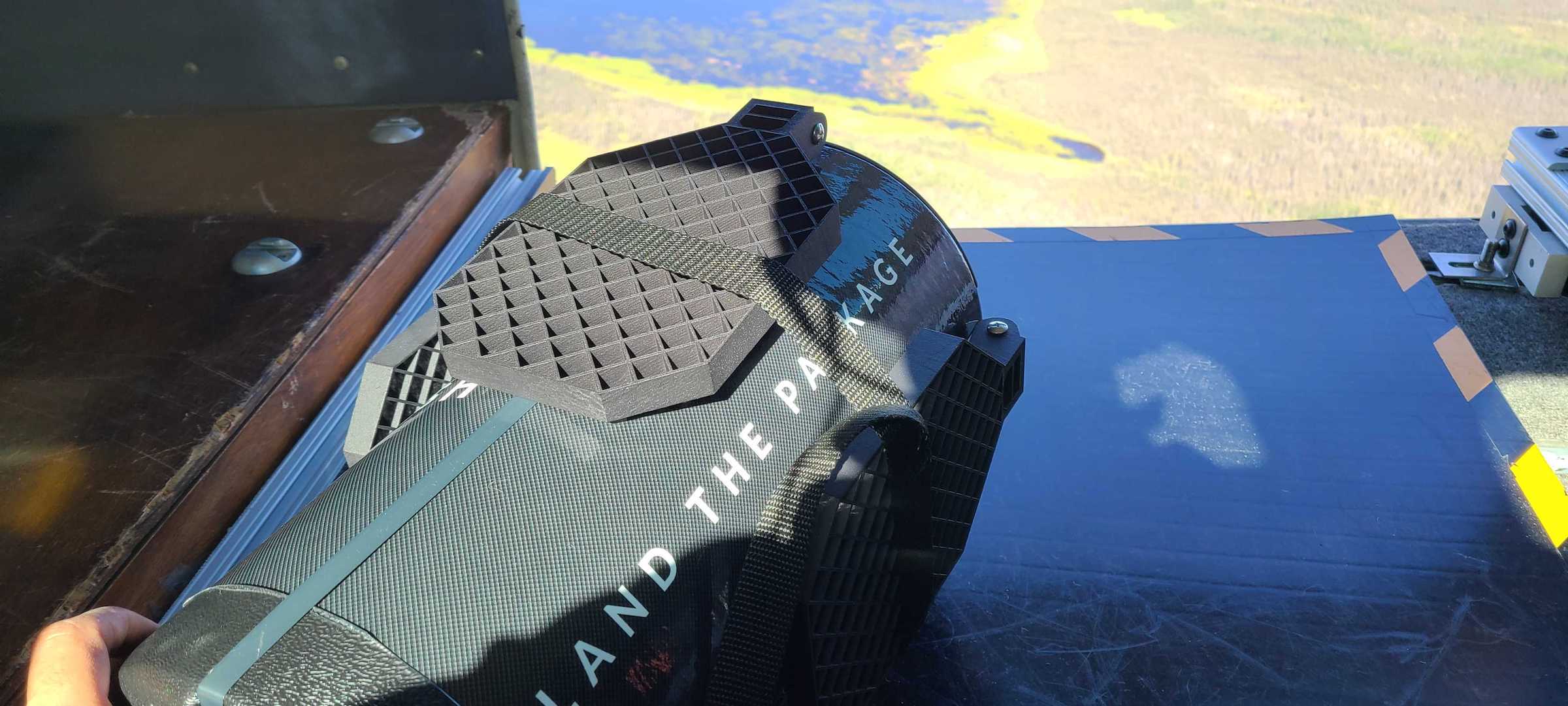
Tubular cargo pod in aircraft prior to ejection.
Courtesy photo
By Jeremiah Bartz Frontiersman.com A football coach using a hockey reference as the centerpiece for his keynote address may

Frontiersman.com With its headquarters in Wasilla, the Frontiersman has been a primary source of news for the Matanuska-Susitna

By Katie Stavick Frontiersman.com The next generation of leaders took flight this week as the Houston High School Class

By Kyle Wilkinson For the Frontiersman Keynote speaker and Carry the Cure President Bill Pagaran’s words boomed through the