Retiring teacher, coach urges Colony grads to ‘find their 68’
By Jeremiah Bartz Frontiersman.com A football coach using a hockey reference as the centerpiece for his keynote address may


PALMER — Sometimes a deep-rooted, complex problem needs to be approached from more than one angle.
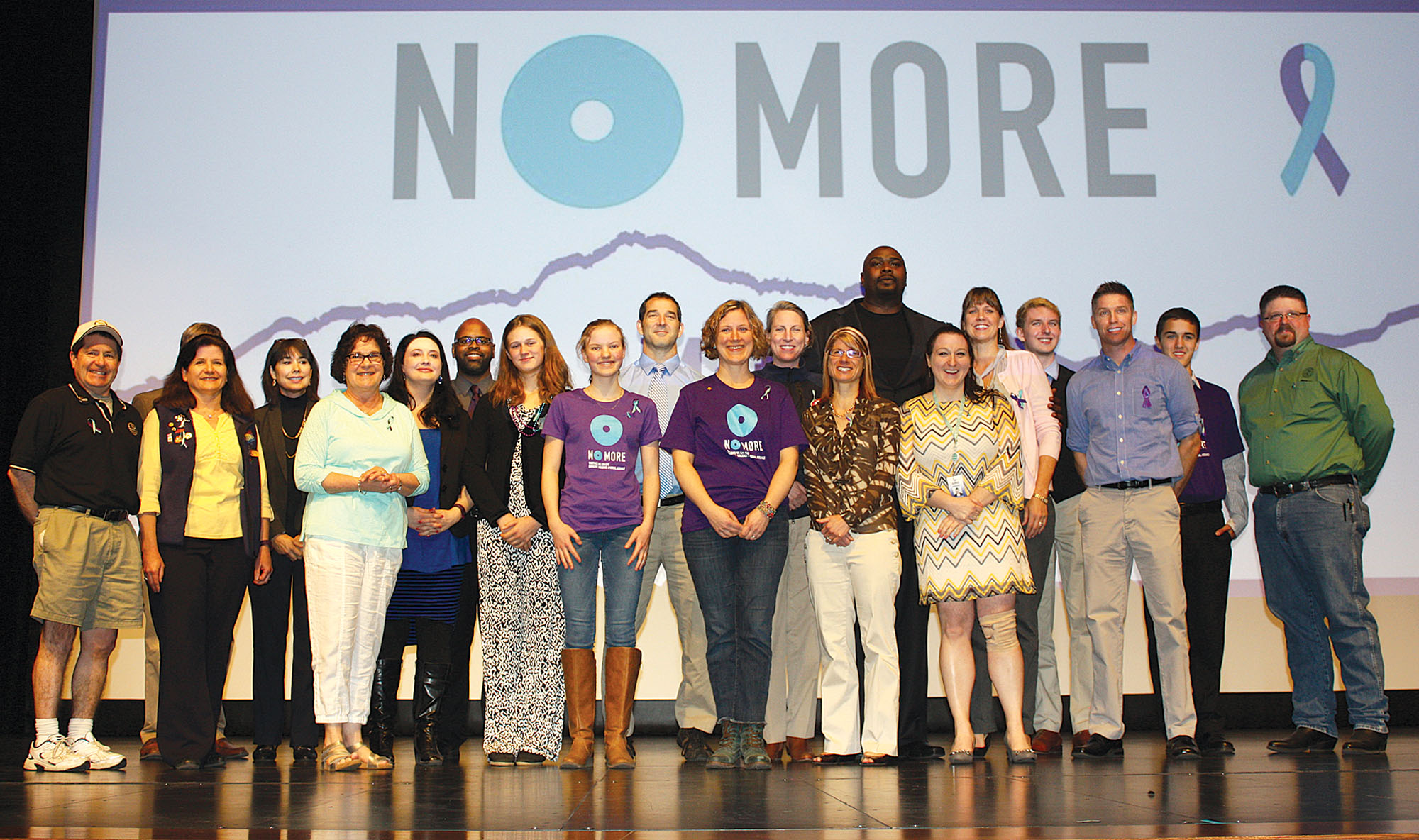
That’s why local organizers of the “No More!” campaign against sexual assault and domestic violence chose various voices for Sunday’s Mat-Su summit, set in motion by the Wasilla Sunrise Rotary Club.
“Even if one person takes inspiration to behave differently, or to see a light at the end of the tunnel of what has been a grim experience, something significant has been accomplished,” said Talis Colberg, director of Mat-Su College, in his opening remarks at the Glenn Massay Theater.
About 75 people gathered in the theater for the second annual summit, which featured speeches by former Olympians Nina Kemppel and Kevin McMahon, former NBA player Jahidi White and others with a stake in the fight against domestic violence and sexual assault, such as Sarah Heath from Gov. Bill Walker’s office and Julie Sullivan, wife of Sen. Dan Sullivan.
Rotarian Dan Goff (also the director of business development and physician relations at Mat-Su Regional Medical Center) said the summit planning committee decided to bring in athletes to speak at the event to stress the group’s devotion to implementing positive ideology in a “team environment,” where many youth can be reached at one time in a more intimate setting than a classroom.
“Changing a culture starts with kids (and) young adults,” Goff said.
Youth also have a tendency to pay more attention to the anti-violence message coming from celebrity figures that already inspire them, or have accomplished something important to those youth, he said.
Though none of the professional athletes had been directly involved in domestic violence or sexual assault, each had personally meaningful stories to tell about the subject.
Kevin McMahon, who competed in the hammer throw at the Olympic level in the late 1990s, said part of the problem the country is facing has to do with what young men are told — and have been told since McMahon was a kid —about being “manly,” by celebrities and pro athletes.
“That story that they repeat is this: that above all other virtues that we should admire in a man, we should admire him as a conqueror — of other men, of pain, and of women,” McMahon said. “While this man-as-conqueror storyline sells (tickets), it’s a lie.”
McMahon said he was trained to believe that lie as a thrower, a martial artist and especially a football linebacker in his youth, through his Olympic career.
“For me, violence was like a drug — the harder I hit, the louder the cheers, and the more I wanted to do it again,” he said.
Though McMahon said that violence didn’t manifest in his personal life, he did see the line blurred for many of his peers (which he elaborated on offstage).
“For some, that delineation is hard to make. They go, ‘Oh so it’s great to be who I am as a boxer or a football player, but you’re expecting me to be a different person on the weekends?’”
The competitive nature of collegiate and Olympic sport did translate to McMahon’s relationships, he said, to the point where he would make it his goal on a given night to make the prettiest girl at the party go out with him, only to dump her a few weeks later. This may not have been physically damaging to anyone, but it was still hurtful to “a lot of really good people,” he said — and it sure wasn’t manly.
“Being a real man has nothing to do with violence, sports, sex, money, drinking, smoking, facial hair, toughness, and the rest of the BS story you’ve been told your entire life. I believe that being a man is being one who, despite great temptation to exploit any advantage you have of physical strength or social privilege … you work hard to protect, provide and to serve those around you.”
Former NBA player Jahidi White, the last speaker of the event, said that a person can change their course, and that that person’s past doesn’t have to define their future.
“We all have a journey, a path, and at the end of that path is something great,” White said.
White grew up in St. Louis, Missouri, in a neighborhood he said bred gang members and drug addicts — certainly not professional basketball players. He was “always in trouble” by the time he got to high school, he said, but started to believe in his dream when a coach believed in him.
White began to believe he was more than he’d been told.
“Someone along the path says, ‘You know what, I don’t want you to be all you can be … my world didn’t turn out right, so why should yours?’”
But standing up to those naysayers, White said, pays off.
Years after that high school coach gave him hope as a freshman, he was playing ball at Georgetown University, and soon for the Washington Wizards. He retired from professional basketball in 2005.
“Sometimes if you wanna fly, you have to let some weight go,” he said.
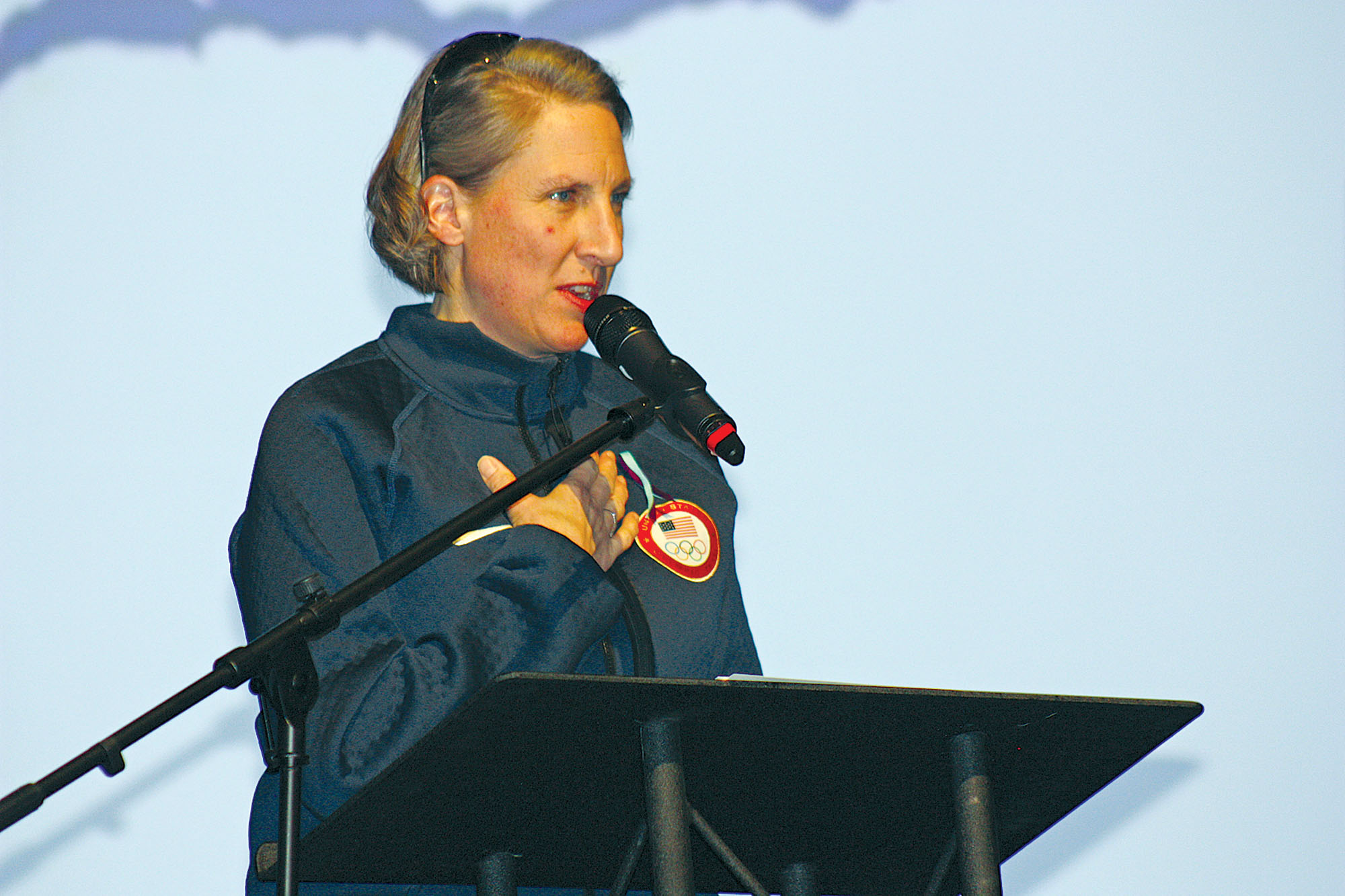
Nina Kemppel, a Nordic skier from Anchorage, is now doing her part to serve victims of domestic and sexual violence as the CEO of the Alaska Community Foundation, a position she stepped into last fall.
The foundation is currently investing $4.1 million in the improvement of Alaska’s domestic violence shelters, she said, which will cover much-needed renovations for 18 different facilities.
“We think this is one of the highest priorities that we have on our agenda,” Kemppel said.
The issue of domestic violence is also close to home for Kemppel as an individual, having figuratively lost a former friend, roommate and teammate to such abuse. The physical abuse started after the friend married the man, Kemppel said, and the two women gradually lost touch. The friend eventually moved overseas and never talked to Kemppel again.
About four years later, in 2010, Kemppel was asked by the U.S. Olympic Committee to lead a task force on sexual assault and violence in sports, armed with the question, “Is this a real problem?”
With 10 other task force members, Kemppel said she interviewed hundreds of thousands of people, scanned all the policy manuals and handbooks related to each sport reviewed, and determined that violence was indeed a problem in athletics. Given the long periods of time spent traveling and in close quarters with each other — sometimes unsupervised — as members of a family-like team, Kemppel said it was clear how easy such violence could occur among athletes and coaches without report.
She relayed the general thoughts of several female athletes who didn’t speak up for 10 years.
“Why would I come forward and accuse a coach of sexually abusing me when I could lose my right to go to the Olympics? Why would I come forward and tell someone that I think someone is hurting one of my teammates when my teammate won’t admit it to me? Why would I come forward and embarrass my family and friends, and why would I come forward to someone I didn’t trust?”
Mat-Su College student Ashley Prakash, who presented on Title IX and sexual assault on college campuses, also gave testimony that spoke to those same fears mentioned by Kemppel.
Prakash — a church-going, straight-A student who grew up in a “loving, supportive household” in the Mat-Su Valley — said she knew them firsthand.
“Abusive relationships aren’t exclusive to the trailer park or the ghetto or girls with ‘daddy issues,’” she said.
Prakash found herself in such a relationship in her late teens. She said the man she was with kicked her in the side until her urine was bloody, “took over” her money and alienated her from her friends and co-workers. But still she did not leave.
“The signs were not subtle,” she said. “You’d think I would have left.”
By 20 years old, Prakash was “trained to look only at the floor,” and to talk only to her abuser, for fear of consequences, she said. Her self esteem had been destroyed and her self-discovery stifled, she said.
Prakash had heard the “that’s what you get for staying” argument, but it did no good. In fact, she said, that attitude is harmful to victims of domestic violence because it creates shame that fuels the idea that all of the abuse, from the very beginning, is their own fault.
“It’s not an easy thing to explain. It feels like you’ve been abducted by aliens and brainwashed, or like you’re standing outside of yourself watching it happen,” Prakash said.
The couple married, bore a child and moved out of state, but nothing fixed the situation. Instead, Prakash adapted to her surroundings, perceiving a sense of normalcy in the broken cell phones and the slaps in public. She started abusing prescription drugs and marijuana.
It wasn’t until she saw her son cry the first time he saw his parents fight, Prakash said, that she started to wake up.
She called her brother and mother in Alaska and asked them to help her pack, and finally left her abuser on Valentine’s Day, 2011. She had been with him for 6 years. Now, she’s pursuing a nursing degree and raising her son.
“My life would’ve had me but now I have my life. Life’s too short to feel like crap all the time and too beautiful to waste on someone who can’t treat you right.”
Contact reporter Caitlin Skvorc at 352-2266 or caitlin.skvorc@frontiersman.com.

By Jeremiah Bartz Frontiersman.com A football coach using a hockey reference as the centerpiece for his keynote address may

Frontiersman.com With its headquarters in Wasilla, the Frontiersman has been a primary source of news for the Matanuska-Susitna

By Katie Stavick Frontiersman.com The next generation of leaders took flight this week as the Houston High School Class

By Kyle Wilkinson For the Frontiersman Keynote speaker and Carry the Cure President Bill Pagaran’s words boomed through the