Retiring teacher, coach urges Colony grads to ‘find their 68’
By Jeremiah Bartz Frontiersman.com A football coach using a hockey reference as the centerpiece for his keynote address may


PALMER — Like dozens of others, Larry Kendrick was looking for a bargain.
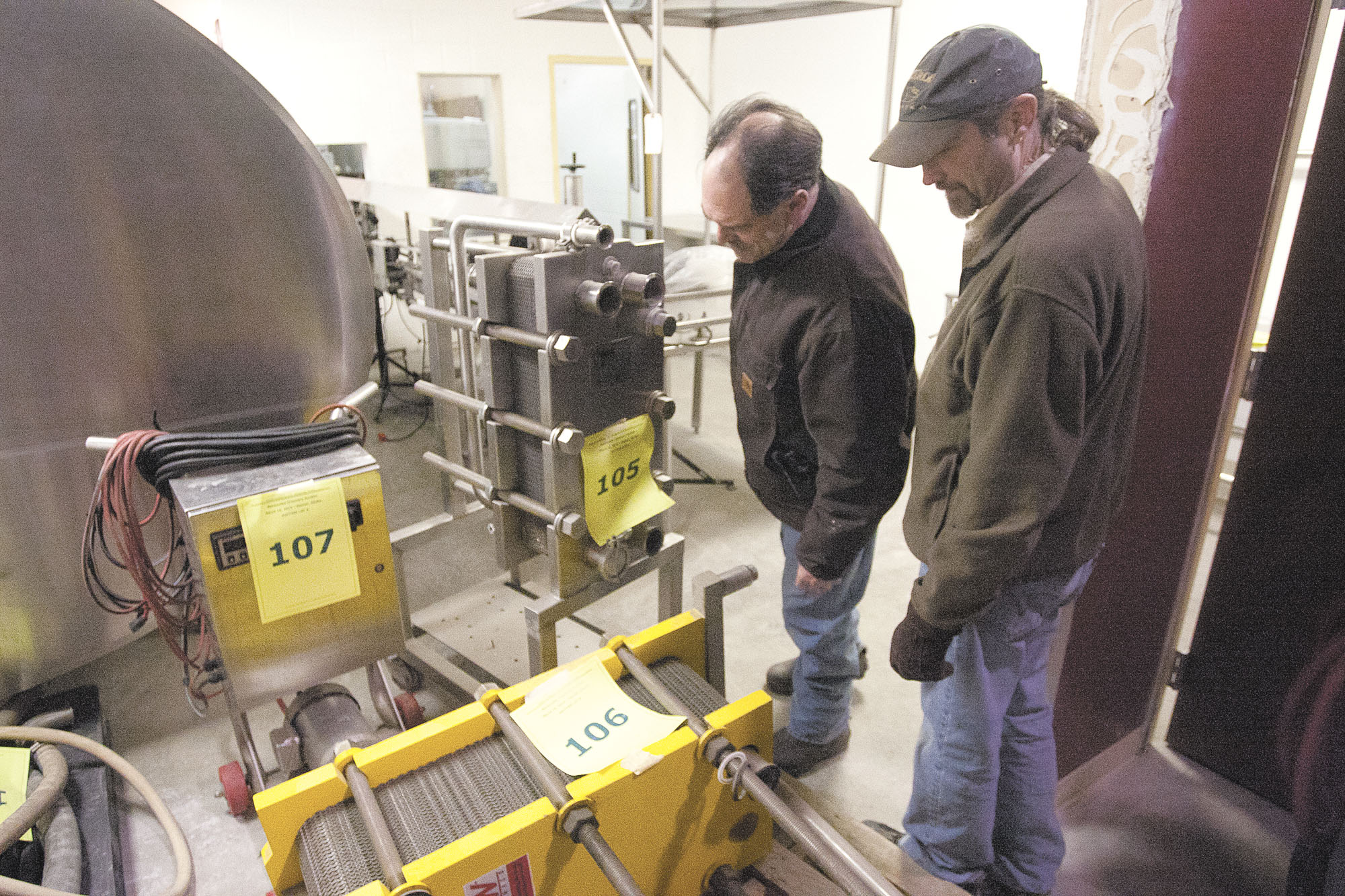
“I’m here for the scrap metal, which most of this is,” said the Anchorage scrap metal dealer minutes before an auction began Saturday morning for all the fixtures and equipment from the now defunct Matanuska Creamery.
Because the dairy’s equipment had been dismantled and labeled for auction, “a lot of it don’t work,” Kendrick said. “If you have one piece, you have to have four or five other pieces to make it viable.”
But as scrap, “I’ll buy it all if the price is right,” he said.
Saturday’s auction, punctuated by the sharp staccato of Denali Auction Co. auctioneer Jim Alleva, brings to an end a five-year run for the locally owned dairy venture that started up in 2007 as the longtime state-owned Matanuska Maid creamery was closed.
Opened with a $600,000 federal rural development grant and private investors, and later bolstered by $830,000 in state loans issued in 2008, Matanuska Creamery began making cheese in early 2008, and by May 2008, the first gallon-sized jugs of Matanuska Creamery milk hit the shelves at local Fred Meyer stores. A year later, the dairy was producing about 1,600 gallons of milk a day.
But a series compromising events hampered the dairy venture’s reputation and bottom line, manager and co-owner Karen Olson said. An early batch of cheese tested positive for listeria and plumbing problems at its leased facility on the Palmer-Wasilla Highway led to costly alternatives to disposing of the plant’s milk waste.
In early December 2012, the state announced it was calling in the nearly $900,000 in loans and interest it was owed, and by the end of the month had closed the doors for good.
“Isn’t this sad?” said Carol Kenley, who stopped by the auction. “I was just driving by and I thought, ‘Oh, I just got to see the last of it.’ I’m not bidding on anything, I’m just sad all this has happened.”
As part of a longtime Valley agriculture family, Kenley said she grew up on her father Clyde Oberg’s farm.
“My dad was a dairy farmer with Mat Maid years ago,” she said. “He sold his farm in ’73, but I grew up on a farm shipping milk, so I was really glad that we at least had this dairy.”
While the auction was a chance for some like Kendrick to pick up scrap metal or for others like Kenley to reminisce, Matanuska Creamery’s loss is potential gain for others.
Brad Ohs of Palmer was inspecting the dairy’s large milk tanks and stainless steel equipment.
“I have a friend who is interested in this,” he said while examining a large tank. “He’s wanting to use it for burying and as a solar heat tank for heating water.”
Morris Bryner of Anchorage was downright excited. He said he’s the largest brewer of craft beer in the state and is always on the lookout for stainless steel fermenting tanks.
“Stainless steel lasts forever,” he said. “It’s only expensive the first time; it’s free after that. We go everywhere there’s stainless steel.”
He admits, though, that some of the 200-gallon Matanuska Creamery tanks are rather large for those who brew beer as a hobby.
“Yeah, 200 gallons would be a big batch for us,” he said. “That’s plenty to drink for awhile.”
By the time the dust had settled Saturday, everything sold collectively for a rough estimate of about $134,000, said Amanda Swanson, a loan officer with the state Division of Natural Resources who organized the auction.
“It went pretty well. Everything sold,” she said. “We were trying to be optimistic and we were expecting about as much as we got.”
Swanson said most of that will go to pay the auctioneer and cover other auction-related expenses. The rest, she said, will be applied to the balance owned on the state loans. The only collateral on the loans was the creamery’s equipment and fixtures.
“Now that those are all sold, as far as the remaining loan balance, that’s up to the (state Department of Law),” she said.
Along with the equipment used in processing milk, auction attendees could bid on pallets of empty milk crates and empty milk jugs, commercial refrigeration units and a lot of assorted general office and shop equipment in various levels of repair.
For Kendrick, though, Saturday was just a culmination of the inevitable. He said that prior to the state seizing the dairy, Matanuska Creamery officials contacted him about buying some of the equipment.
“I knew it was going under long before (the state) took it away from them,” he said. “They wanted me to buy a bunch of this stuff before they were going out of business. But I knew better, because the state had the paper on it. You get in trouble if you do that, if you’re buying stuff that’s already collateral for a loan.”
If any of his bids are successful, Kendrick said he knows exactly what will happen to his purchases.
“It’ll be sawed up and gone by the end of the week in trailers going to Portland, Ore.,” he said.
No cheese to chew
While auction-goers had plenty of dairy equipment, metal tubing and other various items to bid on, they all went away hungry, as none of the nearly 40,000 pounds of cheddar cheese that was stored at Matanuska Creamery when the state shut the doors was sold.
That’s because in the weeks leading up to the auction, state officials threw away the cheese, sparking Olson and other creamery supporters to cry foul, claiming the state was throwing away good cheese that could have been sold to be put toward the debt.
“That was really bad,” Olson said of the state’s handling of the cheese. “They staged a TV clip and we had offered to help them take care of that cheese. Part of the problem was (the state Board of Agriculture) wanted the DEC (Department of Environmental Conservation) to guarantee the cheese. Well, the DEC doesn’t guarantee food.”
What state officials did find when they inspected the cheddar was cheese that was unfit for human consumption, including mice that had burrowed into some of the cheese, said Jay Fuller, assistant state veterinarian with the DEC.
Whether some of the nearly 20 tons of cheese was OK to eat will never be known, Fuller said. That’s because to determine which cheese was good and which was contaminated would have required “very cost prohibitive” testing to the tune of “tens of thousands of dollars.”
“A lot of it had been eaten by mice and there was chewed-up packaging,” he said. “The cheese was grossly contaminated and that was it. We can’t say it would make a person sick to eat it. What we told (the Board of Agriculture) is that if it was grossly visually contaminated or stored in the same area as some that was contaminated, it can’t be considered very safe at all. We couldn’t guarantee that it was safe, and that’s the breakaway.”
For her part, Olson said any problems with that cheese had developed in the 10 weeks the state had control of it, not on her watch.
“If we had been (maintaining) that cheese, it wouldn’t have been like that,” she said. “We never, ever had a problem. In fact, twice I told them they’re not taking care of that cheese.”
In the end, Olson said she didn’t attend the auction, and she has mixed emotions of sadness and bitterness over how the dairy ended.
“It’s just sad, really,” she said. “It’s a sad day for everybody involved with Matanuska Creamery, and that includes all the producers. The marketplace now is hopelessly muddled and a lot of the supermarkets are asking themselves why they should even bother with Alaska milk. It was an uphill battle to begin with.”
Contact reporter Greg Johnson at greg.johnson@frontiersman.com or 352-2269.

By Jeremiah Bartz Frontiersman.com A football coach using a hockey reference as the centerpiece for his keynote address may

Frontiersman.com With its headquarters in Wasilla, the Frontiersman has been a primary source of news for the Matanuska-Susitna

By Katie Stavick Frontiersman.com The next generation of leaders took flight this week as the Houston High School Class

By Kyle Wilkinson For the Frontiersman Keynote speaker and Carry the Cure President Bill Pagaran’s words boomed through the