Retiring teacher, coach urges Colony grads to ‘find their 68’
By Jeremiah Bartz Frontiersman.com A football coach using a hockey reference as the centerpiece for his keynote address may


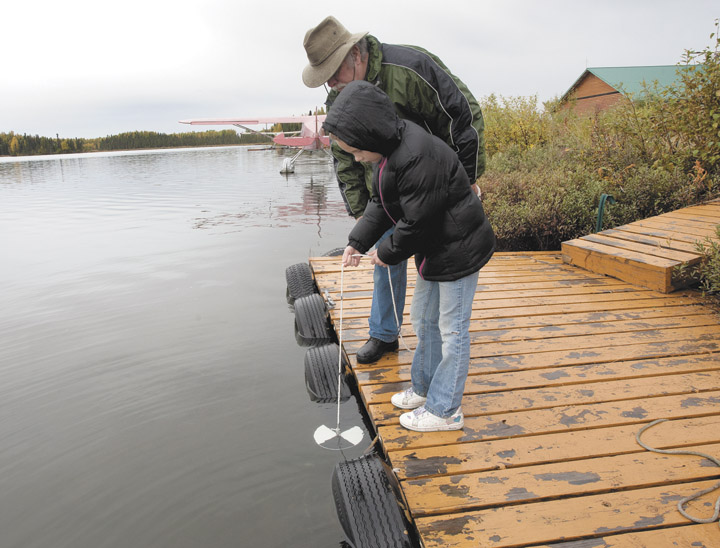
WILLOW — In Suzanne Bounds’ fourth- and fifth-grade science class, connecting the dots between bookwork and real-world science is only a field trip away. A short walk to the Willow Air Service floatplane dock on the banks of Willow Lake gives students an opportunity to apply what they are learning in the classroom.
“We are studying our aquatic environment now before the lakes freeze up,” Bounds said as she gathered materials and her 25 students for Friday’s hands-on study of the nearby lake. “We are looking at our watershed. We are looking at measurements of Willow Lake as part of our watershed.”
The study spans the teachings of two curriculums. The first is the Mat-Su Borough School District-mandated Full-Option Science System (FOSS). The second is the JASON Project, which was created by Dr. Robert Ballard and is a partnership between the Sea Research Foundation and National Geographic.
Both are great programs, Willow Elementary principal Andy McDermott said.
“The FOSS program is hands-on, but the JASON Project has some neat stuff,” he said. “The kids get a chance to dialog with scientists who are out in the field.”
McDermott said he and Bounds talked about the program last year and decided this year to put it on top of the FOSS curriculum. McDermott said the two tie in well with each other.
“It is a different way of presenting some of the same material,” he said. “So they get it in FOSS once and they get it a second time in the JASON stuff.”
Mat-Su School District policy mandates teachers teach a certain curriculum.
“Which we do,” McDermott said, adding Bounds had experience teaching the JASON Project in another school district and she wanted to add it to her classroom here. “This is our first year doing it, and I think we are the only school in the district using the JASON Project as a supplement to the FOSS system.”
McDermott also said that Bounds has done a lot to get the science education integrated into the district’s adopted curriculum.
“She purchased the program on her own with her own money,” he said. “She has really gone out of her way and put a lot of extra time into making it work.”
Bounds first saw the JASON Project in action when her son was in eighth grade.
“His science teacher was using the JASON Project and was taking kids on a field trip and asked for parents to help. So I went along,” she said.
What she saw amazed her. “We went to SeaWorld and on a huge theater screen we watched him (Dr. Ballard) discover two worms in the Sea of Cortez.”
Bounds knew that seeing things happen live was a great way to help students connect the dots of science. She reiterates, however, that FOSS science is a great system. But without another avenue, students are only reading about something someone did and are not getting to talk to scientists on the computer while they are doing it or seeing how it applies to where they live in the world.
The programs mesh together, Bounds said. FOSS has a lot of activities the kids do with water, but it is all done in the classroom. The JASON Project helps tie the classroom to the real world.
“It makes all the things we are learning in FOSS connect with all of the thing we are seeing out in the real world. It’s that real world science as opposed to just classroom activity,” she said.
Bounds believes if you give students something tangible, they are more likely to understand it and stay interested.
“If you can make it real, then they connect to it,” Bounds said. “Then they get it. By doing it and seeing it you can make it real.”
That is what Bounds hopes to accomplish with the field trip to Willow Lake.
“When we get to the lake the students are going to be making notations about the area they are in,” she said. “They are going to measure the temperature of the water, the speed of the current and so forth. They will look at the sediment at the edge of the water and beside the water and see what they have there.”
She said what she is trying to do is get her students interested in learning more about the nearby lake and how that can be applied to what they have been studying.
“Hopefully, what will happen is the things we talked about and learned today will stay with them and they will look at things differently,” she said.
For student Keliah Young, it was a lot better than being buried in a book.
“It was fun and we learned a lot today,” she said. “I think we learned more by going out there.”
Young said it was neat how they used an orange to measure the speed of the current.
Classmate Jessie Newman agrees. “I like this kind of science better than doing bookwork.”
Once all their information is compiled and checked, students will send it back to the JASON Project where it will be entered into the worldwide network of information that has been collected by kids for a number of years. This added bonus gives students ownership in what they are doing, Bounds said. Not only are they doing science, they are contributing information to science and the Jason Project.
For Bounds, the two curriculums are a great way of grabbing students’ interest, a way to help them connect the dots in science.
“You want to open up the door for them to pursue inquiry of their own, for them to generate questions,” she said. “And for them to answer their own questions through discovery.”
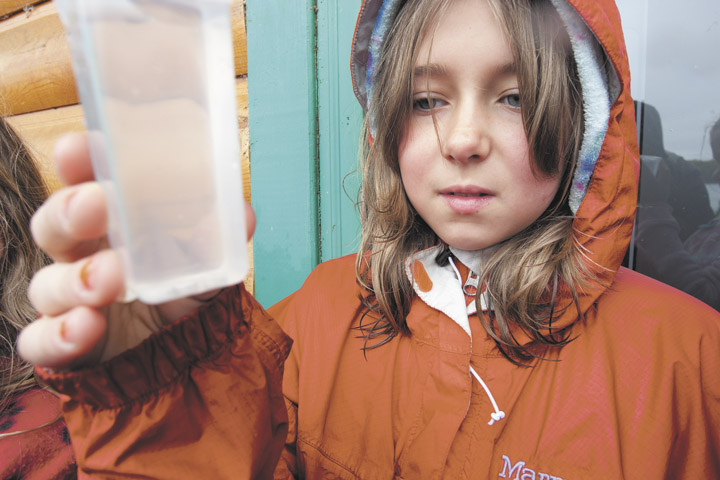
ROBERT DeBERRY/Frontiersman.com

By Jeremiah Bartz Frontiersman.com A football coach using a hockey reference as the centerpiece for his keynote address may

By Katie Stavick Frontiersman.com The next generation of leaders took flight this week as the Houston High School Class

By Kyle Wilkinson For the Frontiersman Keynote speaker and Carry the Cure President Bill Pagaran’s words boomed through the

By Jeremiah Bartz Frontiersman.com The community of Palmer is known for a couple of things. At or near the