Retiring teacher, coach urges Colony grads to ‘find their 68’
By Jeremiah Bartz Frontiersman.com A football coach using a hockey reference as the centerpiece for his keynote address may


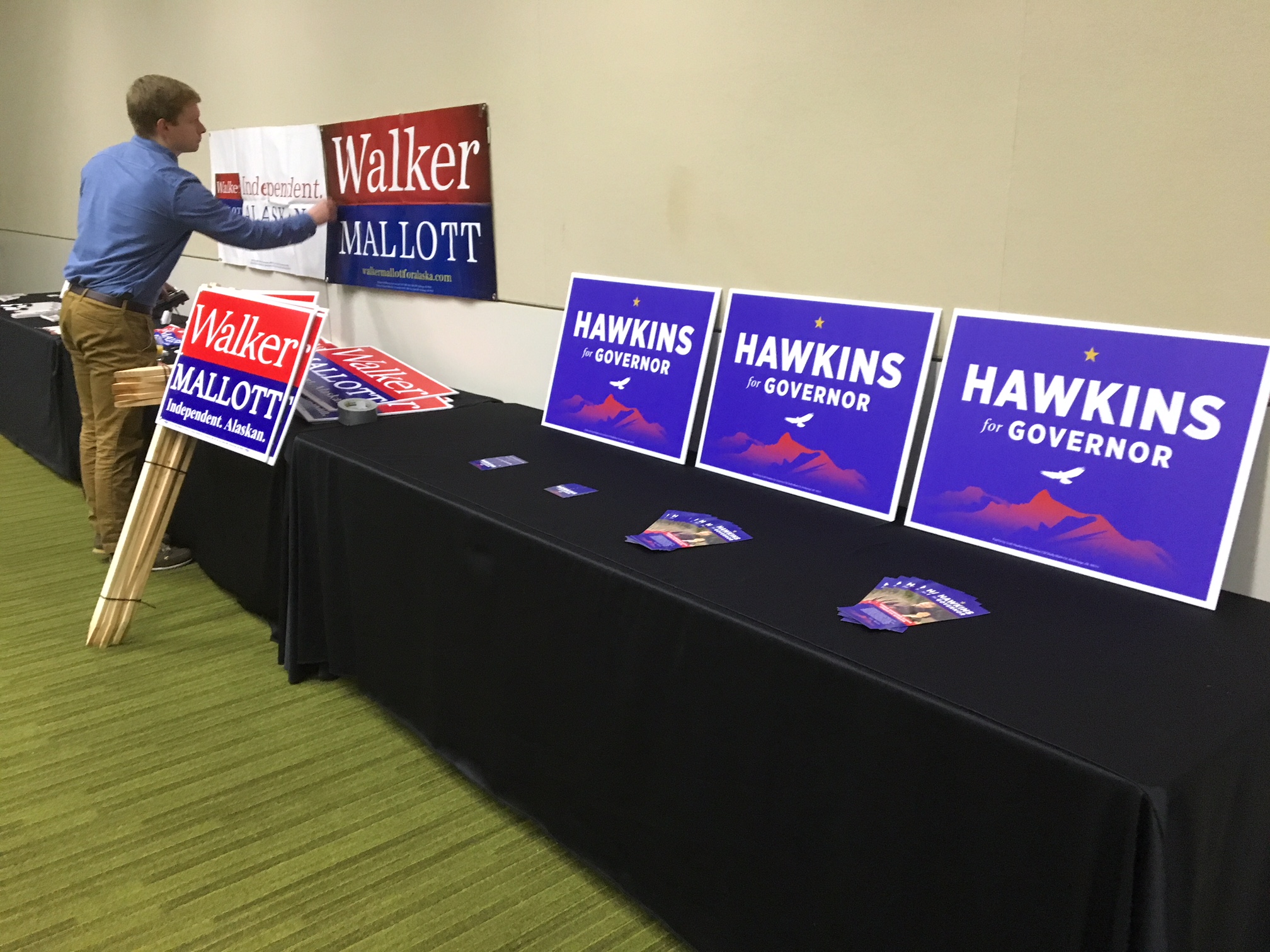
ANCHORAGE — The political season is starting early. Three candidates for governor in the 2018 election, including incumbent Gov. Bill Walker, squared off in Anchorage for one of their first debates Thursday, April 25.
A fourth candidate, State Rep. Mike Chenault, a Republican, was unable to attend because of the extended legislative session in Juneau.
Two other Republicans, former State Sen. Mike Dunleavy of Wasilla and Anchorage businessman Scott Hawkins, showed up to parry questions with Walker.
The Alaska Industry Support Alliance, the oil service company trade group, sponsored the event. Questions to the candidates focused mainly on resource development and business issues.
All three agreed on moderation in oil and gas tax policy, streamlining regulatory procedures and permitting and the need for more support for strategic infrastructure to support economic development.
There were sharp differences, however, on Walker’s initiative for a state-led natural gas pipeline project.
The governor defended the plan, indicating that when North Slope producing companies pulled back from the project they asked the state, which was then a minority partner, to take the project over.
In taking the lead, the state can do things the companies can’t, Walker said. “We can provide a lower cost of delivery (of liquefied natural gas) because our cost of capital is lower,” than the companies’, Walker told members of the Alliance.
It’s also unusual for producers to own pipelines, he said. Usually it’s done by third parties. “There’s not a single pipeline in the U.S. that is owned by a producing company,” Walker said.
It’s appropriate for the state to lead the Alaska LNG Project, he said. “This is infrastructure. It’s like a road or a state ferry system, which are projects traditionally run by government.”
Dunleavy had a different take.
“Everyone wants to monetize this stranded resource, but we have to make sure this is done right, and I have some questions. What are the risks? Does the state have the capability of managing this?” he asked.
Dunleavy also said he would reestablish a relationship with the Legislature on Alaska LNG, which, he said, has deteriorated under Walker, and he would also bring the North Slope producers back into the project.
Walker disputed Dunleavy’s promises on the legislative relationship. “We’re following the law,” he said, referring to Senate Bill 138, which lays out the framework for state support, including legislative oversight.
“Just this morning we were in discussions,” with lawmakers on a proposal to give Alaska Gasline Development Corp., the state gas corporation managing Alaska LNG, the authority to solicit equity investments.
Hawkins agreed with Dunleavy on the importance of bringing the producing companies back. “I just don’t see go-it-alone as a winning strategy,” Hawkins said. He also said AGDC has to be “very careful in negotiating with China as a strategic partner. China is a rival to the U.S. in the long term,” he said.
Hawkins’ central concern, however, is state management.
“If you love what the state did with Alaska Seafood International or the grain terminals at Valdez and Seward, you’ll love go-it-alone,” on the gas pipeline, Hawkins said with sarcasm.
Alaska Seafood International, or ASI, was a plan to develop a large seafood plant in Anchorage financed by the Alaska Industrial Development and Export Authority, the state’s development finance corporation.
AIDEA invested $50 million in ASI before it failed. The investment was partly recouped, at just under 50 cents on the dollar, when the seafood plant building was sold to a local church group.
The grain terminals were part of the 1980s state-led Delta Barley Project, which did see farms eventually develop, but not to export grain, which was the original idea of state planners.
All three candidates agreed on state support for infrastructure, however. Hawkins mentioned the Mustang oil field development on the North Slope as a small example of what the state should do. At Mustang, AIDEA made limited investments in a road, pad and a small oil processing plant to help the developer, Alaska-based independent Brooks Range Petroleum, get the project off the ground.
Walker spoke of his administration’s work on a possible network of low-cost snow-pack roads that could give isolated North Slope communities surface access to the Dalton Highway and also be useful for the oil and gas industry.
All three candidates also agreed on the importance of state fiscal reform and the establishment of a framework to guide use of Permanent Fund earnings for the state budget and citizen dividends. Dunleavy said he would divide the Fund earnings draw, which would be done on a sustainable basis, half between the PFDs and half to support the budget.
Hawkins said the Permanent Fund should be managed like an endowment, with a percent-of-market-value, or POMV, draw. “This is a no-brainer. We should get this done soon,” he said.
Hawkins also said spending can still be cut. “The state operating budget is an 800-pound gorilla,” weighing down state finances. “It’s the biggest 800-pound gorilla in the nation, too,” a reference to Alaska having the highest per-capita state spending in the nation.
Walker has maintained that the state budget is now about right after having been cut $1 billion over the last three years. There are special circumstances due to the state’s sheer size that requires a large budget, Walker reminded.
“We have 200 airports to maintain. We’re just a big state. We should be proud of that,” he said.

By Jeremiah Bartz Frontiersman.com A football coach using a hockey reference as the centerpiece for his keynote address may

Frontiersman.com With its headquarters in Wasilla, the Frontiersman has been a primary source of news for the Matanuska-Susitna

By Katie Stavick Frontiersman.com The next generation of leaders took flight this week as the Houston High School Class

By Kyle Wilkinson For the Frontiersman Keynote speaker and Carry the Cure President Bill Pagaran’s words boomed through the