Retiring teacher, coach urges Colony grads to ‘find their 68’
By Jeremiah Bartz Frontiersman.com A football coach using a hockey reference as the centerpiece for his keynote address may


WASILLA — State officials want to stabilize budget revenues threatened by declining oil revenues.
To do that, they would combine cuts of as much as half a billion dollars with a plan to effectively exchange one source of the annual Permanent Fund Dividend with the revenue source causing the instability. As with anything with potential ramifications for the state’s annual payout, the plan appears to face skepticism among residents, many of whom rely on the checks for a small measure of financial stability.
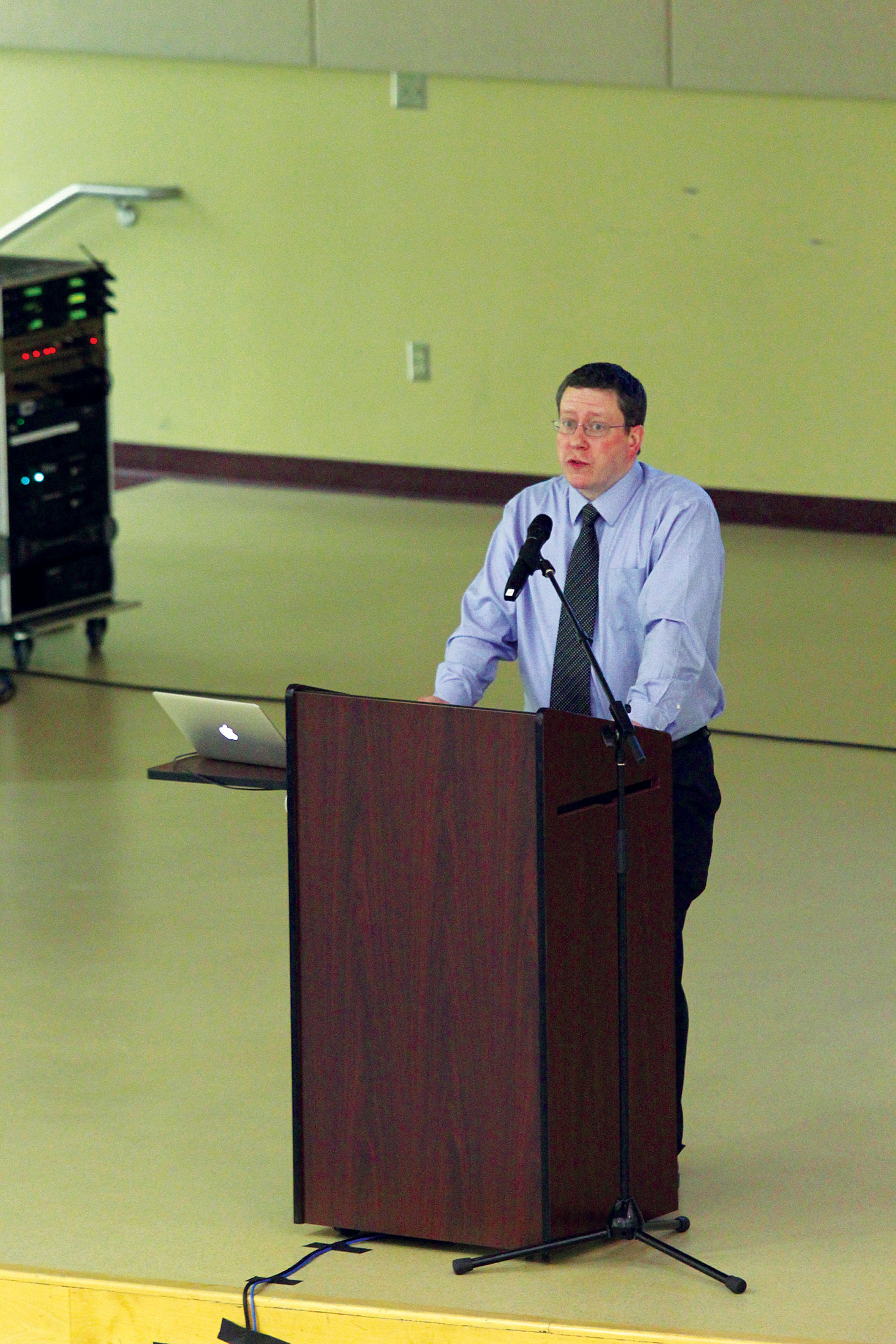
Oil revenues, which make up about 90 percent of the state budget, are declining due to slumping oil prices and decreasing production in the oil pipeline. Oil has plummeted from a 2008 high, when the government collected roughly $4 billion in oil revenues, to about $2 billion this year, said Attorney General Craig Richards during a community forum on the issue held Friday at Teeland Middle School in Wasilla.
The fall-off creates a wide gap between the $5 billion operating cost of the state government and the money available to pay for it, roughly $3 billion. Years of high oil prices and robust production have created about $14 billion in reserves, which the government is presently burning to keep the doors open and the lights on, Richards said.
“That means that in five, six, seven years, depending on how oil prices cut, the state of Alaska is broke,” he said. “And by broke, I mean broke-broke.”
The administration of Alaska Gov. Bill Walker has pitched the idea of using the earning reserves of the Permanent Fund — roughly the collected money earned each year by the state’s mineral and oil-funded $53-billion investment portfolio of bonds, stocks, real estate, and other devices — as a means to stabilize the budget. Including the fund, the state has about $60 billion in undesignated financial assets available to address the problem, Richards said.
Officials want to take a fixed amount out of the permanent fund for the government, using the permanent fund to smooth out swings in oil prices, Richards said. It would eliminate the massive shortfalls, and at the same time guard against the spending excesses of boom years, Richards added.
“The advantage of this, of course, is by providing stability in your budget, by not having these giant swings in your budget caused by oil prices, you are instituting a very strong spending restraint,” he said. “It effectively puts the Legislature and the state government on an allowance. They know every year, right as rain, what the revenues are gonna be, so they can’t go spend a bunch in the future because oil prices happen to be high or oil revenues happen to be high again.”
Under the plan, the dividend check amount would be tied to natural resource royalties instead of stock market performance, Richards said.
“The dividend would then go up or down depending on how well our natural resources (perform)”, he said.
If the questions posed Friday night were any indication, Alaskans view the program with skepticism.
More than one questioner tied possible PFD changes back to Walker’s support for a liquid natural gas pipeline.
“It seems to me, like this is kind of like, I hate to say it, ‘I get my gas pipeline or you don’t get your dividend,’” said a woman from North Pole.
Residents would essentially be forced to support resource extraction to get their annual checks.
“I think that’s kind of an immature attitude,” she said.
A move toward a resource-based PFD check would create a more stable system, Richards said, prompting some shouting.
“Stable for who?” someone called out.
“Stable for the whole system, for everybody, ” Richards answered. “It changes the dividend payout formulation to reward natural resources vs. the stock market, and that is a change. But in terms of the other pieces, it provides immensely more stability to our economy and our state budget.”
Borough assemblyman George McKee pointed out that individual citizens would no longer receive a PFD check, but a resource royalty check. However, the fund’s name wasn’t the issue, nor was the fact that the government was essentially taking the stable payout while leaving individuals with a declining payout as oil production eventually disappeared.
“That’s fine, I understand that,” he said. “That’s Mother Nature. That’s economics. But I don’t see government in being totally transparent about that. If you stood up there (and) you said, ‘You’re gonna get a dividend, it’s going to go down for eight years,’ I’d say, ‘Great, good for you.’ But I don’t hear that.”
Contact Reporter Brian O’Connor at 352-2270, brian.oconnor@frontiersman.com, or on Twitter @reporterbriano.

By Jeremiah Bartz Frontiersman.com A football coach using a hockey reference as the centerpiece for his keynote address may

Frontiersman.com With its headquarters in Wasilla, the Frontiersman has been a primary source of news for the Matanuska-Susitna

By Katie Stavick Frontiersman.com The next generation of leaders took flight this week as the Houston High School Class

By Kyle Wilkinson For the Frontiersman Keynote speaker and Carry the Cure President Bill Pagaran’s words boomed through the