Retiring teacher, coach urges Colony grads to ‘find their 68’
By Jeremiah Bartz Frontiersman.com A football coach using a hockey reference as the centerpiece for his keynote address may


Editor’s Note: Project 49 is a monthly series from the University of Alaska Anchorage, highlighting characters and events from Alaska history that have been preserved in the university’s archives. The UAA/APU Consortium Library Archives and Special Collections are open to the public. This is the first of a two-part series on Benzie Ola “Rusty” Scott. See Sunday’s Frontiersman for the second part of this story.
In 1932, Amelia Earhart became the first woman to fly solo across the Atlantic Ocean. Two years later, Texas-born trucker Benzie Ola “Rusty” Scott packed up her two-ton Chevy for a move from California to Alaska that would kick off her own chain of firsts: first woman truck driver in the territory, first woman to drive trucks for Alaska’s Fort Richardson, first woman to drive the newly constructed Alaska Highway, first woman to drive through the Whittier tunnel.
Letters from her brother, Lanna Zoell Scott, a Matanuska Colonist (Scott Road in Palmer runs through his original homestead), had convinced her there was fresh opportunity in Alaska for a middle-aged vegetable and dairy hauler with empty pockets and a strong back. And indeed, she got right to work as a freelance trucker upon her arrival, transporting laundry, mail and occasionally miners who’d had just a little too much to drink.
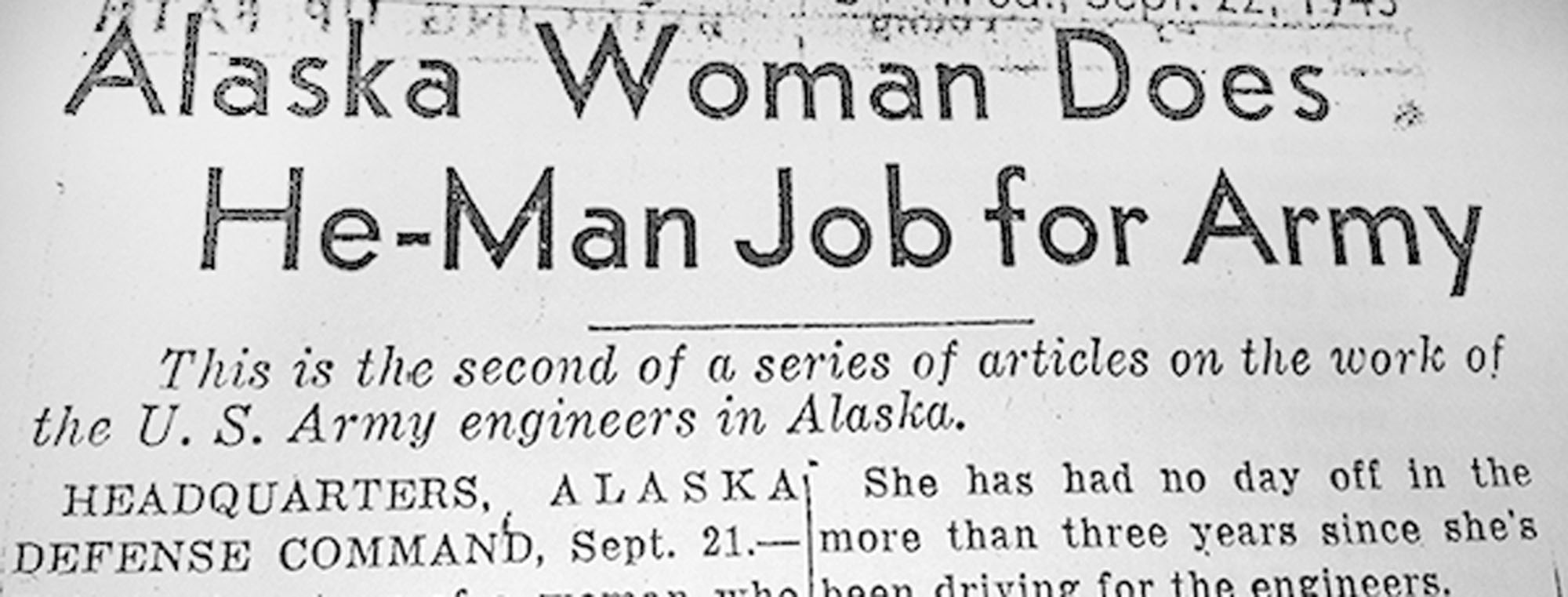
In 1940 with six years of all-season Alaska driving added to her already lengthy road credentials, she was hired at Fort Richardson and assigned to drive for the engineering division.
By one account in the University of Alaska Anchorage archives, Rusty (known as Rusty Dow, following her marriage to Dartmouth ski champ Russell Dow in 1939) had spoken up about her desire to drive the new highway.
“Without the ruffles and stiff stuff that is the usual decorum between a general and one of his workers, ‘Rusty’ Dow sat cross-legged in the office of the late Simon Buckner Jr.,” according to the October 1975 edition of The Great Lander Shopping News. “She told the commanding general of Alaska Defense Command in World War II, ‘There are two places I want to drive a truck: the Burma Road and the new ALCAN Highway.’
“‘I can do nothing about the Burma Road,’” the general told the auburn-haired truck driver. ‘The ALCAN might be different,’ he said to the woman in coveralls, driver for the Anchorage Corps of Engineers.”
Efforts to connect Alaska, the northernmost territory in the United States, to the rest of the country were fast-tracked following the Pearl Harbor attack in December 1941.
Road crews blazed a 1,600-mile road in 234 days. With approval from the U.S. Army, Congress and President Franklin Delano Roosevelt, construction of the Alaska Highway, or the “Alcan” as many travelers know it today, began in March 1942. A rough-hewn route was completed in October that same year, though it was largely impassable to commercial vehicles until 1943. Rusty would get her chance in June 1944.
The day Rusty learned she would get a green light to drive the new route came as a surprise.
On June 1, 1944, she pulled her truck into the loading dock on base and was greeted with, “Rusty, the major wishes you to report to him at once,” she wrote in a handwritten account of her drive. In her own words:
“Now, said I to myself, I wonder what I’ve forgotten to do — as I made a mental calculation on my travels through the working hour of the day thus far. Could I by any chance be in the major’s doghouse as I seldom received such an abrupt summons.
“Immediately I put in an appearance at the major’s desk. We have been informed that you wish to drive the Alcan highway, said he. Yessir I stammered. Well here are your travel orders, approved by General Buckner. Report to Merrill Field in two hours where you will take a plane to Fairbanks. Upon arrival there report to North West Service Command, from whom you will receive further orders.
“Yessir — I was able to reply weakly thinking of just how much preparation I could make in two hours.
“But evening found me reporting to my new assignment at Fairbanks with a clean pair of G.I. coveralls under my arm, and my toothbrush and pair of pliers and a screwdriver in my pocket.”
A reporter for The Anchorage Daily Times caught up with her before her flight to Fairbanks and asked about her plans. From the article published June 2, 1944, “‘Rusty’ Dow To Drive Highway: Will Be First Woman Piloting Military Road” is her response.
“‘I don’t know what it’s all about,’ Mrs. Dow said as she hurriedly gathered up a few personal belongings for the trip, ‘but I do know it’s going to give me the biggest thrill of my life.’”
Editor’s note: See Sunday’s Frontiersman for the conclusion of ‘Rusty’ Dow’s story as she hits the highway in a Studebaker 6x6.
Perhaps it was just nerves, but Rusty’s stomach was churning on that flight from Anchorage to Fairbanks to pick up her truck and cargo. According to her journal, she had to look around for the “burp bucket” and was relieved to hit calmer air space and cooler air midway through the trip.
Safely on the ground at North West Service Command, Rusty was matched with her truck, a 10-wheeled Studebaker 6x6 that she writes was “as temperamental as a wolverine after a long winter,” with busted gas and mileage gauges, no speed indicator and bald tires.
The stockpile of truck parts had been picked over, so she was out of luck on any major repairs — she’d later report checking fuel levels in her 40-gallon tank with a stick while driving the Alaska Highway.
Male drivers in the motor pool gave her the side-eye as she inspected her truck, but they conceded to offer her a little advice. From Rusty’s handwritten account:
“This was a man’s job on a man’s road, built by men, in its entirety, and I was thoroughly conscious that my position was that of an intruder on man’s domain. But as a whole they were kind and well meaning, with their advice and suggestions given in a kidding manner, but frankly they were skeptical, they did not believe that I could drive the road. … Later as I lay under the truck checking I overheard a conversation between of group of old timers on the road discussing the pros and cons of women drivers, and one said to the other,’ well, Bill, if it becomes so tame that women can drive it then it’s time to roll our sleeping bags and move on to the next job.’”
The head-shaking wonderment wasn’t limited to the motor pool. A reporter for an Outside newspaper had a similar reaction to Rusty and another female driver, Deloris “Diddy” Morrill, who arrived in Alaska in 1944 and also drove cargo for Fort Richardson. His article is emblazoned with the headline, “Male Truck Drivers Note: 2 Women Haul Alaska Freight.”
‘Was I a WAC’
Nobody needed to worry whether Rusty was tough enough to tackle “a man’s road.” Like the wartime Rosies who had taken over heavy labor jobs left vacant by men serving overseas, Rusty had grit; maybe more than was strictly healthy.
Edna Borigo, a teacher who arrived in Alaska in 1918, wrote one story about Rusty that has been archived with her collected papers and photos. It includes this anecdote:
“While working for the Army Rusty broke her leg while skiing. ‘Went five days with the danged thing busted,’ she said, ‘then passed out like a cream puff. One of the officers ripped off my mukluk. X-rays were made before I could escape doc’s office. Doc put a half-cast on my leg, handed me a pair of crutches and commanded me to stay off my feet for 10 days and use the crutches for 3 months. I went home, cut off that cast and went back to trucking. It hurt like all get out but I wasn’t going to be tied up all that time.’”
On June 4, Rusty and her “temperamental wolverine” of a truck hit the road loaded with five tons of cement. At every checkpoint, she was met with surprise and a request to see her orders. Was she authorized? Was she a WAC (the newly formed Women’s Army Corps)? Was she test-piloting the road to see if women could drive it?
Delayed by truck repairs, Rusty pulled into Destruction Bay Post by Lake Kluane in the early morning hours of June 6, where a startled soldier in the mostly empty mess hall dropped a skillet at the sight of her. Her paperwork was again inspected “most thoroughly.”
The following day in the mess hall she learned about the D-Day landing from soldiers who had picked up the information on the midnight broadcast.
Arriving with the midnight sun in Dawson Creek, B.C.
Weathering flat tires (she regularly weeded tires of road debris and nails with her pliers) and a full slate of other engine troubles, Rusty arrived at Whitehorse Command, having averaged better than 200 miles per day. She offloaded her cargo and received a fresh load in a new Studebaker 6x6 with orders to head for Dawson Creek, B.C.
Rusty pulled into Dawson in the wee hours of the morning and, finding most of the post snoozing, backed her truck into a quiet corner and decided to catch a little shuteye herself in a sleeping bag up on top of her truck load. Roosters from a nearby farm woke her just a short time later.
“Across the road was what appeared to be vacant Quonset huts. I reached for my coveralls and started to dress when suddenly the Quonset huts became alive and I found myself in my sleeping bag with an audience of interested G.I.s who had suddenly discovered me. As modestly as possible, I managed to clothe myself while in the bag and crawl wearily down. By then a cheerful voice called to me would I like a cup of coffee.”
Fortunately, she noted, she was allowed to take a much-needed bath and wash off 1,600 miles of military highway before she had to pose for photos.
United Press reporter Lloyd Tupling asked Rusty what she thought of her trip.
“It’s a beautiful highway,” she said. “It should be preserved because it’s a picture of what American people can do when they have to. Not only that, but it won’t require any more maintenance than any other road in the north. It’s got a good roadbed.”
Still just halfway through her assignment, Rusty fired up her truck the following evening for the return trip to Alaska with tractor parts, reconditioned tires and supplies.
Capturing Alaska on canvas
Many headlines later, the woman the Saturday Evening Post called “the dean of women war workers in Alaska” retired from driving and embraced painting and homesteading with husband Russ. The Alaska Legislature honored her in 1988 for her achievements and she passed away the following year, three days after her 95th birthday.
Rusty’s Alaska can be seen in paintings — including some done in fluorescent oils and best viewed with black lights — that have been displayed and sold throughout Alaska.
Jamie Gonzales is a University of Alaska Anchorage writer who covers stories from the campus community. A guide to the full Rusty Dow collection at the UAA/APU Consortium Library Archives and Special Collections is available online at http://tinyurl.com/qyyovv2.

By Jeremiah Bartz Frontiersman.com A football coach using a hockey reference as the centerpiece for his keynote address may

Frontiersman.com With its headquarters in Wasilla, the Frontiersman has been a primary source of news for the Matanuska-Susitna

By Katie Stavick Frontiersman.com The next generation of leaders took flight this week as the Houston High School Class

By Kyle Wilkinson For the Frontiersman Keynote speaker and Carry the Cure President Bill Pagaran’s words boomed through the