Retiring teacher, coach urges Colony grads to ‘find their 68’
By Jeremiah Bartz Frontiersman.com A football coach using a hockey reference as the centerpiece for his keynote address may


PALMER — About 70 people filled the Palmer Train Depot Wednesday to listen to “Salmon Live Here,” a storytelling event in conjunction with the Mat-Su Salmon Habitat Partnership’s annual “Salmon Symposium.” The Symposium is a two-day event that celebrates the Valley’s wild salmon and brings people from various backgrounds — from scientists to fishermen — all together under the same roof to unite under the love for Alaska’s wild salmon. One of the main objectives to promote the conservation of salmon populations by exchanging resources, thoughts and ideas — sharing each other’s talents, knowledge and information to ensure a future filled with salmon. The symposium took place on Wednesday and Thursday this week. The storytelling session followed the events of the first day.
“Awesome first day! That was fun. I was skeptical at first but that was a great show,” one Fish and Wildlife field officer said before he left.
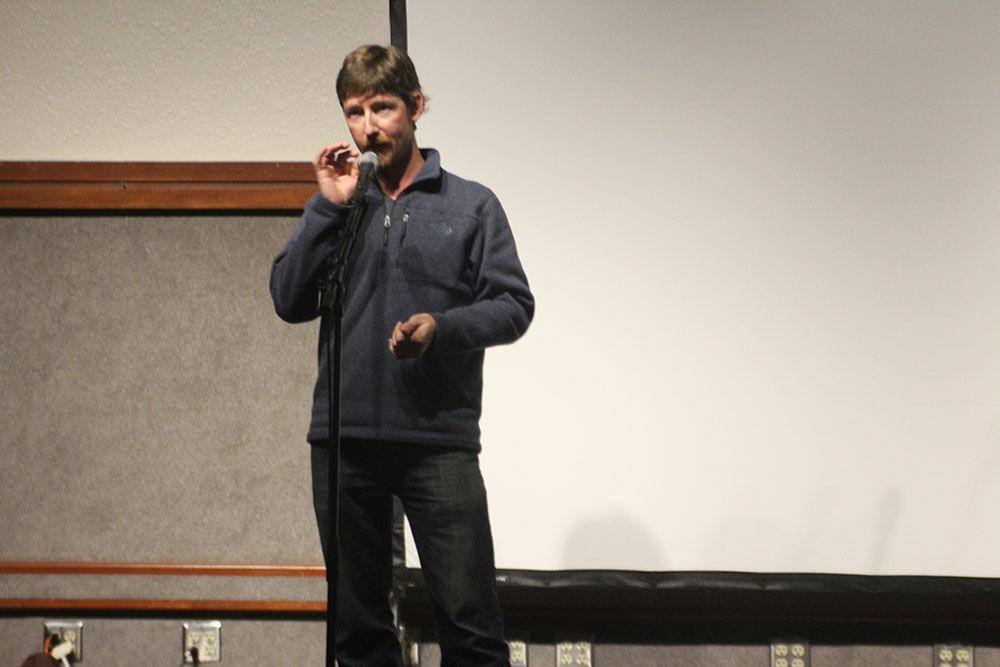
Seven people with assorted experiences shared their stories about salmon. Mike Wood was the emcee for the evening.
The audience was captivated by all the yarns spun by fellow fish lovers. They hooted, hollered, laughed, gasped, and wowed in unison for all of the juicy parts. Wood is on the board for the Susitna River Coalition and the founder of the Su Salmon Company, a commercial fishing operation that harvests and sells Cook Inlet Salmon at the mouth of the Susitna River. He also shared some of his own tales.
“I bet you all have a story that’s worth telling; keep telling them,” Wood said.
Joshua Ashline is a fisheries biologist for the United States Fish and Wildlife Service. Ashline shared a story from the field. Ashline’s team spent the last decade tracking groups of coho salmon. They monitored their migration path from birth to the ocean and back to spawn. They were trying to record how many were making it back. When the salmon were very young, they had rice-sized radio tags placed in them. He said that in his line of work, they typically focus on the general population of salmon so it’s rare to focus on individual fish. In his tale, he recounted the story of two fish who returned from the sea to spawn at the same time.
“We got to see this individual story play out,” Ashline said.
The fish were named Beauty and the Beast. He and his team began closely monitoring their path, getting attached to their journey, hoping they made it their destination. After reviewing the data, it turned out the two fish spent most of their life together and were returning to their origin. One of the technicians on his team asked, “I wonder if they will spawn together? Wouldn’t that be the most wonderful story?”
In the story of Beauty and the Beast, the antagonist for the Beast was the hunter, Gaston. This salmon’s Gaston was a river otter; so the Beast died before he could make it to the spawning grounds. The Beauty did make it to the final destination. After she died, the team cut her open to see if she spawned.
She hadn’t reproduced.
So, the characters’ names were changed to Romeo and Juliet to better suit their tragic tale.
“Who would have thought that guy could come up with that beautiful story?” said David Albert, Director of Conservation Science for The Nature Conservancy in Alaska.
Albert said earlier in the day, Ashline shared his team’s findings about their ten-year study on the Coho salmon populations. That story was the more scientific in nature. Albert admitted that when Ashline shared his narrative, it resonated with him like the rest of the audience. So after being informed in the afternoon, he was entertained in the evening by the same man. He noted that the storytelling component was a valuable addition to the Symposium. He said attributed the science to the head and the stories to the heart. To him, the narrative adds a human element. His surrounding salmon enthusiasts agreed and shared his sentiments.
“We tell our stories; it’s part of the Alaskan experience,” Albert said.
Sue Mauger is the Science Director for the Cook Inletkeeper, a nonprofit organization that aims to protect Alaska’s Cook Inlet watershed and the life it sustains. She said that events like the symposium are vital to protecting Alaska’s wild salmon. It’s a continuous conversation that needs to keep going; because once people stop talking about it, the fight is over. She said that unlike other states down below, it’s not too late for Alaskans to save what they have. To her, the Symposium is vital to affect change.
“It’s special and we all still have it. We think we can do things differently,” Mauger said.
Jessica Speed was the driving force behind the symposium. She is the Coordinator for the Mat-Su Basin Salmon Habitat Partnership and the Conservation Coordinator for The Nature Conservancy of Alaska. This is the 10th year for the symposium so Speed wanted to do something special and try something they’ve never done before. She recruited Emily Tallman to put the storytelling event together. Tallman said the goal was to gather a diverse group of speakers that played off each other’s experiences. After the night was through, many felt that’s exactly what happened.
“That’s the important part of stories: they teach you something and they keep you going,” Wood said.
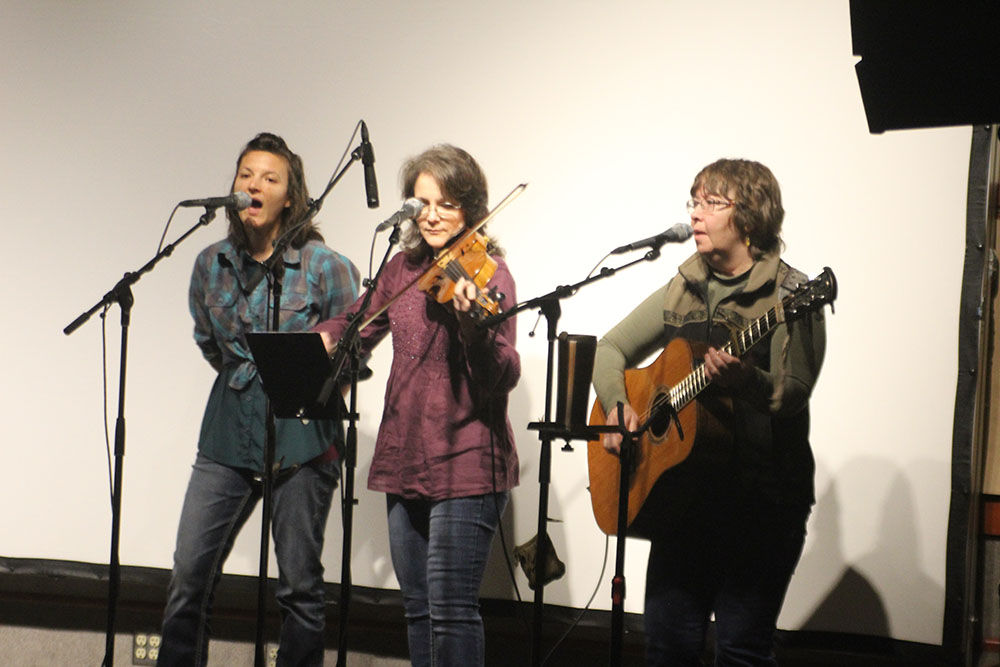
A Valley-based band called the Mountain Waxwings performed for the evening. They played Celtic-sounding, folk/bluegrass music, harmonizing their three voices like a group of bards that came down from the mountain, from the days of old. The lyrics of their final song captured the theme of the evening: “We are crossing the water, our whole lives through. We are making a passage that is straight and true.”
“I don’t think there’s anything like it in the Mat-Su. It’s a one stop shop,” Speed said. “In our over 10 years, the Partnership has been successful in building bridges between people committed to the future of salmon in the Mat-Su: local government, business, federally recognized tribes, scientists, nonprofits, subsistence fishery users, commercial fishing industry, sportfish groups and concerned individuals.”
According to Speed, since 2006, the Partnership supported over 80 salmon habitats related projects in the Valley, with over 2.5 million dollars. Examples of projects supported by the Partnership include: the 2017 Mat-Su Fish Passage Program (Mat-Su Borough), Wetland Loss Assessment in the Matanuska-Susitna Borough (Kenai Watershed Forum), and Guidelines for Developing around Salmon Habitat in the Mat-Su (The Nature Conservancy). To learn more visit: www.matsusalmon.org

By Jeremiah Bartz Frontiersman.com A football coach using a hockey reference as the centerpiece for his keynote address may

Frontiersman.com With its headquarters in Wasilla, the Frontiersman has been a primary source of news for the Matanuska-Susitna

By Katie Stavick Frontiersman.com The next generation of leaders took flight this week as the Houston High School Class

By Kyle Wilkinson For the Frontiersman Keynote speaker and Carry the Cure President Bill Pagaran’s words boomed through the