Retiring teacher, coach urges Colony grads to ‘find their 68’
By Jeremiah Bartz Frontiersman.com A football coach using a hockey reference as the centerpiece for his keynote address may


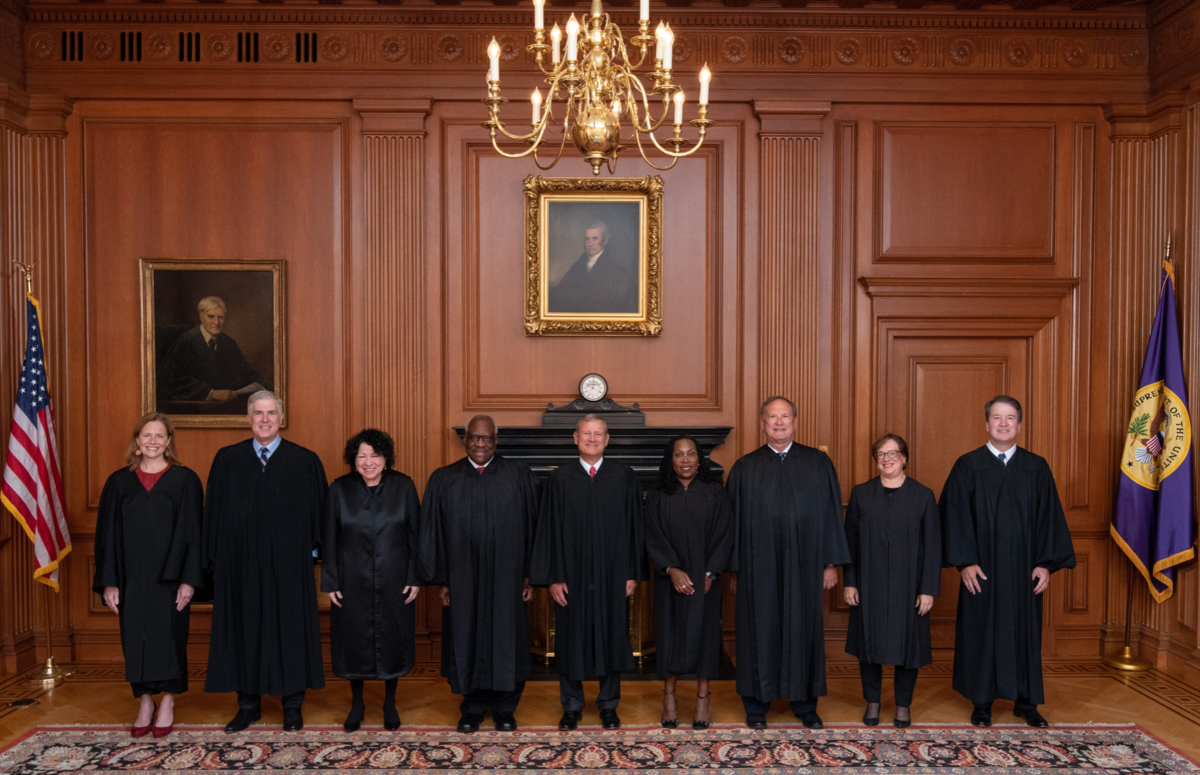
Last week, the Supreme Court issued a ruling that could have major implications on colleges and universities as students gear up for the upcoming school year.
On Thursday, the high court struck down affirmative action in college admissions, declaring race cannot be a factor when considering student admission.
In a 6-3 decision, the conservative SCOTUS majority overturned cases reaching back 45 years, ruling that the admissions programs used by the University of North Carolina and Harvard College violate the Constitution’s equal protection clause, which bars racial discrimination by government entities.
Ending affirmative action overturns a long-standing precedent that has been in place since the 1960s as a tool to prevent discrimination at selective institutions, many of which historically only admitted White students.
Writing for the majority, Chief Justice John Roberts explained that college admissions programs can consider race simply to allow an applicant to explain how their race influenced their character in a way that would have a concrete effect on the university. But a student “must be treated based on his or her experiences as an individual — not on the basis of race,” Roberts wrote.
The majority overruled its 2003 decision in Grutter v. Bollinger, which upheld the University of Michigan Law School’s consideration of race “as one factor among many, in an effort to assemble a student body that is diverse in ways broader than race.” Justices Clarence Thomas, Samuel Alito, Neil Gorsuch, Brett Kavanaugh, and Amy Coney Barrett joined the Roberts majority opinion.
The case was brought about 11 years after the court’s decision in Grutter, by a group called Students for Fair Admissions. The group, founded by Edward Blum, a conservative activist who had also spearheaded a challenge to the admissions policy at the University of Texas at Austin, brought the case to the SCOTUS after the lower courts upheld both North Carolina’s and Harvard’s admissions policies, where it asked the justices to overrule their previous decision in Grutter and completely bar the consideration of race in university admissions altogether.
The court that agreed to take up both cases last year was a very different, and much more conservative, court than the one that had upheld the UT-Austin policy 7 years before. Justice Anthony Kennedy, the author of the UT-Austin decision, retired in 2018 and was replaced by Justice Brett Kavanaugh, while Justice Ruth Bader Ginsburg was succeeded by Justice Amy Coney Barrett.
In a 40-page opinion, Chief Justice Roberts addressed both the Harvard and UNC cases, beginning with a review of the SCOTUS’s past decisions interpreting the equal protection clause. He wrote that while those decisions reflect the clause’s central purpose in “doing away with all governmentally imposed discrimination based on race,” the Supreme Court had only allowed universities to use race-based admissions programs “within the confines of narrow restrictions.” Chief Justice Roberts said that both the Harvard and UNC programs, “however well-intentioned and implemented in good faith,” do not comply with those restrictions.
He went on to stress that the court’s decision did not bar universities from ever considering race on a case-by-case basis, instead indicating that schools can consider “an applicant’s discussion of how race affected his or her life, be it through discrimination, inspiration, or otherwise.”
However, he warned, a “benefit to a student who overcame racial discrimination, for example, must be tied to that student’s courage and determination. Or a benefit to a student whose heritage or culture motivated him or her to assume a leadership role or attain a particular goal must be tied to that student’s unique ability to contribute to the university.” In contrast, programs like the ones used by Harvard and UNC have “concluded, wrongly, that the touchstone of an individual’s identity is not challenges bested, skills built, or lessons learned but the color of their skin. Our constitutional history does not tolerate that choice.”
In writing the dissenting opinion, Justice Sonya Sotomayor emphasized that the “limited use of race” by colleges and universities “has helped equalize educational opportunities for all students of every race and background and has improved racial diversity on college campuses.”
“Although progress has been slow and imperfect, race-conscious college admissions have advanced the Constitution’s guarantee of equality and have promoted.” She cited Brown v. Board of Education’s “vision of a Nation with more inclusive schools.”
“The devastating impact of” Thursday’s decision, she concluded, “cannot be overstated.”
Justices Elena Kagan and Ketanji Brown Jackson joined Sotomayor’s dissent.
The majority’s decision left the door open for service academies like the U.S. Naval Academy and West Point to continue to use, at least for now, race-conscious admissions programs.
Closer to home, the University of Alaska Anchorage (UAA) says that they do not anticipate the SCOTUS ruling having a major impact on admissions.
"We're reviewing the Court's decision and its impact on our admissions and programs but do not anticipate significant impacts to our processes. The University of Alaska, guided by the Board of Regents, is committed to improving the diversity of our entire system to make all our students, faculty, and staff feel welcomed and supported, and to fostering an open, inclusive, and vibrant educational experience across the system. The more integrated we are -- the more diversity that we have in all of our programs -- the stronger we become,” says Jonathon Taylor from the University of Alaska System's Office of Public Affairs.
The University of Alaska oversees UAA, the University of Alaska Fairbanks, and University of Alaska Southeast.
"Our 3 universities each have their own admissions processes; none of them use race as a sole basis for determining admission. The Board of Regents, based on input from the universities, determined that the UA System would have open admission to anyone who meets the minimum academic requirements."
In response to the SCOTUS decision, a civil rights group is challenging legacy admissions, saying the practice discriminates against students of color by giving an unfair boost to the mostly white children of alumni, and violates the Civil Rights Act.
Legacy admissions is the practice of giving priority to the children of alumni, and has faced growing pushback in the wake of last week’s Supreme Court’s decision. The NAACP has thrown its support behind the effort on Monday, asking more than 1,500 colleges and universities to even the playing field in admissions, including by ending legacy admissions.
The civil rights complaint was filed Monday by Lawyers for Civil Rights, a nonprofit based in Boston, with the Education Department’s Office for Civil Rights.
To read the full SCOTUS opinion, click here: www.supremecourt.gov/opinions/22pdf/20-1199_hgdj.pdf

By Jeremiah Bartz Frontiersman.com A football coach using a hockey reference as the centerpiece for his keynote address may

Frontiersman.com With its headquarters in Wasilla, the Frontiersman has been a primary source of news for the Matanuska-Susitna

By Katie Stavick Frontiersman.com The next generation of leaders took flight this week as the Houston High School Class

By Kyle Wilkinson For the Frontiersman Keynote speaker and Carry the Cure President Bill Pagaran’s words boomed through the