Retiring teacher, coach urges Colony grads to ‘find their 68’
By Jeremiah Bartz Frontiersman.com A football coach using a hockey reference as the centerpiece for his keynote address may


WASILLA — There was a lot to be said by students and some of Alaska’s educational leaders at the Alaska Association of Student Governments conference last week.
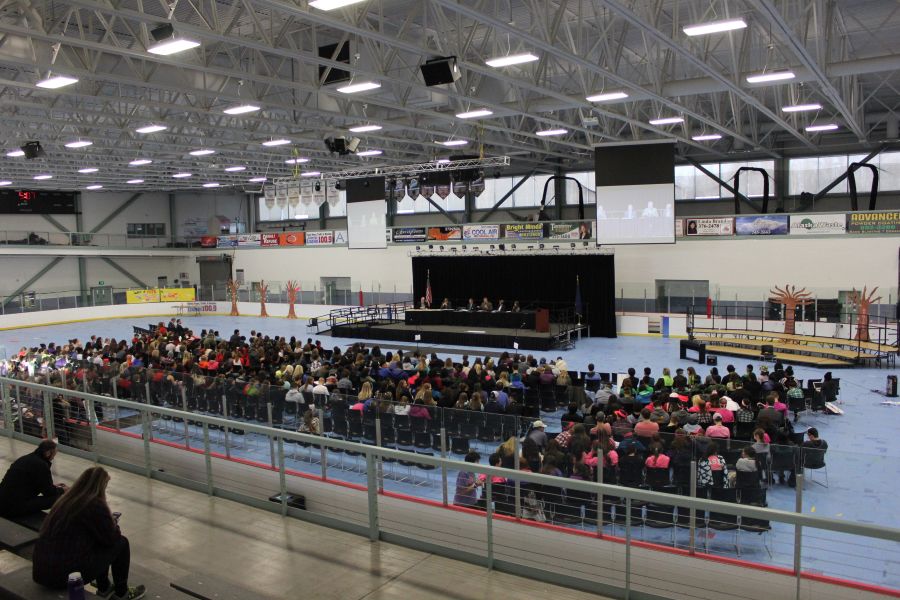
Wasilla High School hosted the semi-annual, statewide conference for the first time at the Curtis D. Menard Memorial Sports Center Oct. 13-15. With 561 delegates registered in advance and about 530 in attendance, Wasilla advisor Anthony Jensen said it was the largest gathering he’d ever seen.
The event culminated Friday in a panel discussion with Mat-Su College Director Talis Colberg; Dr. Jeff Anderson from Wayland Baptist University in Wasilla; Sen. Mike Dunleavy (R-Mat-Su); Mat-Su Borough School District (MSBSD) Assistant Superintendent Dr. Monica Goyette; and Dr. Susan McCauley with the State Department of Education and Early Development.
Moderator and University of Alaska Anchorage history professor Paul Dunscomb kicked off the discussion with a question about the definition of student leadership.
Panelists generally agreed that, as Colberg said, leadership in general is a “balance between trying to represent people the way you think they want to be represented and trying to do the right thing.”
Anderson added that a good student leader is “a communicator and a collaborator,” with a “moral compass” to provide direction in the individual’s life, and McCauley endeavored to encourage students with the idea that “good leaders aren’t necessarily tied to how things turn out.”
Another question put to panelists hinted at student concern for the future of public education, given Alaska’s current financial state.
“We will always have a responsibility to provide a free and appropriate education to students,” Goyette said, even with the “financial crisis.”
She said the economic slump might even be a good thing, because “when we’re lean, we tend to be more creative and more innovative” — a sentiment that echoes statements made by both Gov. Bill Walker and former MSBSD Superintendent Dr. Deena Paramo in the last year.
“It will take all of us working together to help redefine what education looks like,” she said.
Goyette suggested more money for “teacher-directed, online learning” for secondary students and a “blended model” of “project-based learning” in elementary schools — whatever offers students to most opportunity.
“As educators … we don’t view our goal as providing a high-quality education. We view our goal as that you obtain a high quality education,” she told the sea of students.
Dunleavy surveyed the audience on their attendance of charter schools, public home school programs and college classes during high school, with dozens of hands raised for each category. He said that’s something you wouldn’t have seen 34 years ago, when Alaskans were only permitted to attend “neighborhood schools,” and that education in Alaska will continue to evolve.
“The State of Alaska will continue to fund public education, because it is a mandate … but the face of public education, I believe, is going to change with time,” Dunleavy said.
That goes for higher education as well, Anderson and Colberg said.
“(We’re) moving from a geographically-based educational system to the university of everywhere, where people can pick up credentials and coursework … from a wide variety of platforms,” Anderson said. “(But) we have to do something about the affordability gap.”
Colberg said, on behalf of University of Alaska President Jim Johnsen, that it’s complicated.
“This was a poor state when I was born, and it was a poor state until oil came, (but) we did have an adequate system that got people educated. We have a lot more options now … and as Sen. Dunleavy said, it’s a changing world,” he said. “President Johnsen is doing his best with the Board of Regents … to try to make this a system that’s versatile, affordable and sensible.”
McCauley returned to Goyette’s comments, saying that affordable and diverse class offerings for students in remote areas of Alaska can be mediated in part by online learning.
“We have to look at how we can leverage technology to provide a higher quality of education to those students than we are doing right now,” she said.
At least one student didn’t agree with the solution of online classes championed by speakers throughout the conference.
North Pole High School student and 2018 class president MacKenzie O’Connor said she is currently enrolled in online “eLearning” classes, and that it hasn’t been particularly effective.
“Personally, as a student, I feel as though I do not learn as well due to the lack of face-to-face contact and teacher-to-student relationship,” she said.
O’Connor said the eLearning model was apparently implemented because North Pole and other interior schools either don’t offer enough classes, don’t have enough teachers qualified in the subjects students need and want, or don’t have enough teachers period to cover all students without it.
“I feel this holds students back from reaching their full potential within their education, causing future problems, and I was wondering ... if you guys had thought of a solution,” she said, addressing the panel.
As Goyette and McCauley had already voiced their opinions, Anderson took the mic to tell O’Connor about his university’s practice of offering online and in-person classes together.
“They are clunky, but they’re getting less clunky all the time,” he said. “It’ll get better, that’s all I can say now.”
O’Connor also asked about “distance delivery classes,” which includes the widespread APEX program in the Mat-Su Borough.
“It’s come a long way,” Goyette said. “My recommendation would be that all high school students take at least one online class before college to help them prepare for the dual-platform there.”
A sophomore from Bethel Regional High School had a similar question about remote education and college readiness in his community.
In preface to his question, the student explained the nature of Yupik and other Alaska Native schools, which he said have lower standards than schools in less rural areas of the state. This means many students get “decent grades,” but with “inferior curriculum” that results in a high college drop-out rates among people he knows, he said.
“Even though I think that learning about our heritage and culture is great, I, along with many people in my community, feel like it’s hurting the students’ education,” he said. “These students are not ready for college and adult life outside of rural Alaska.”
“How do you plan to fix this?” he asked.
“The first way that we quote-unquote ‘fix it,’ is students like you speak up about it. You don’t keep quiet about this, you say exactly what you’re saying, ’cause it’s not OK,” McCauley said. “At the same time, we have to recognize (the challenges): … high rates of teacher turnover, difficulty in recruiting teachers to rural Alaska ... (and) really small schools”
“I’m not saying that I have any brilliant solutions here,” she continued. “I just want to applaud you for speaking up about a situation that I don’t think we talk enough about.”


By Jeremiah Bartz Frontiersman.com A football coach using a hockey reference as the centerpiece for his keynote address may

Frontiersman.com With its headquarters in Wasilla, the Frontiersman has been a primary source of news for the Matanuska-Susitna

By Katie Stavick Frontiersman.com The next generation of leaders took flight this week as the Houston High School Class

By Kyle Wilkinson For the Frontiersman Keynote speaker and Carry the Cure President Bill Pagaran’s words boomed through the