Retiring teacher, coach urges Colony grads to ‘find their 68’
By Jeremiah Bartz Frontiersman.com A football coach using a hockey reference as the centerpiece for his keynote address may


By CAITLIN SKVORC
Frontiersman.com
WASILLA — Shaw Elementary School is leveling the educational playing field for students in its pre-kindergarten through fifth-grade classes with a unique artistic opportunity.
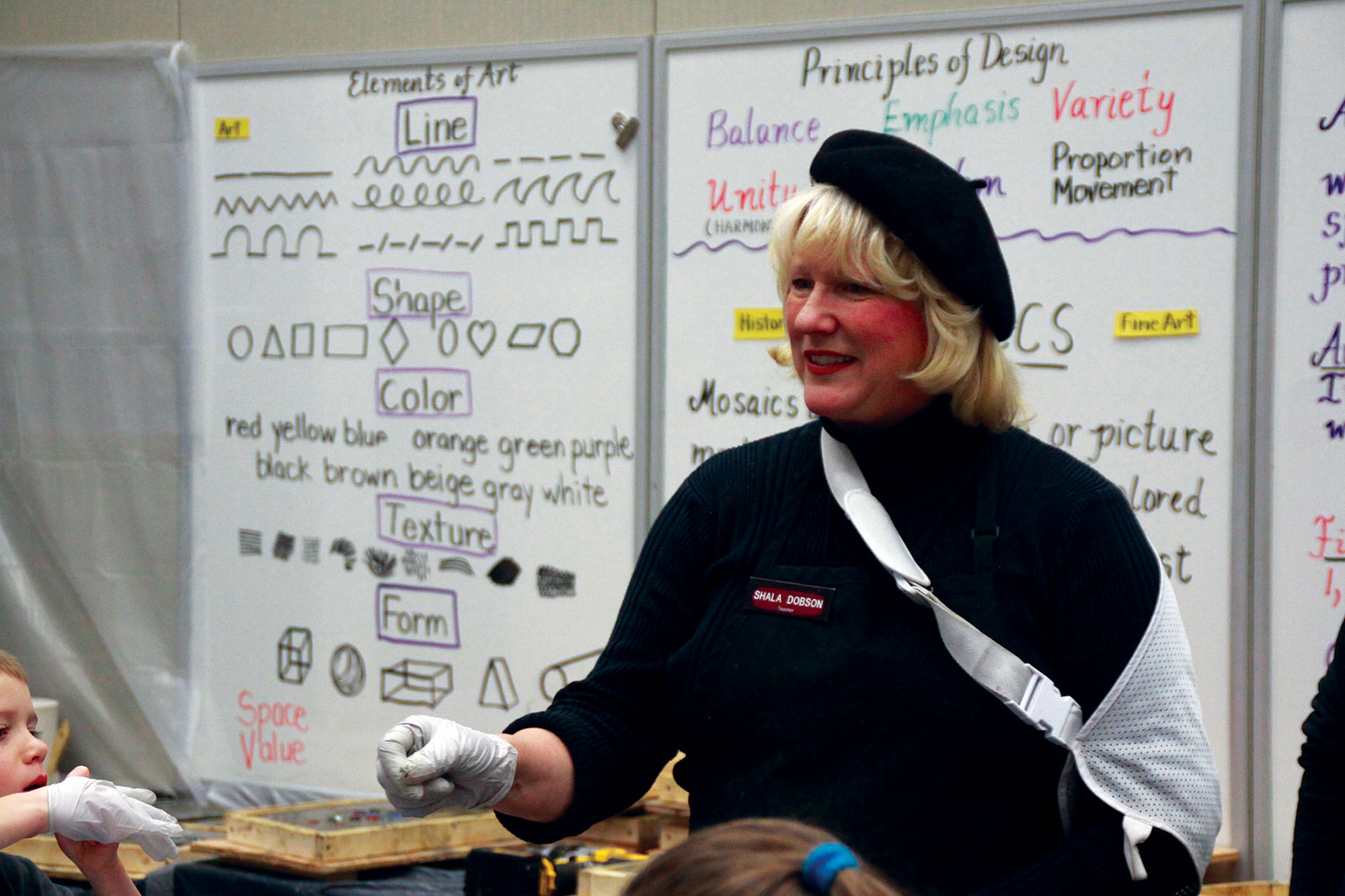
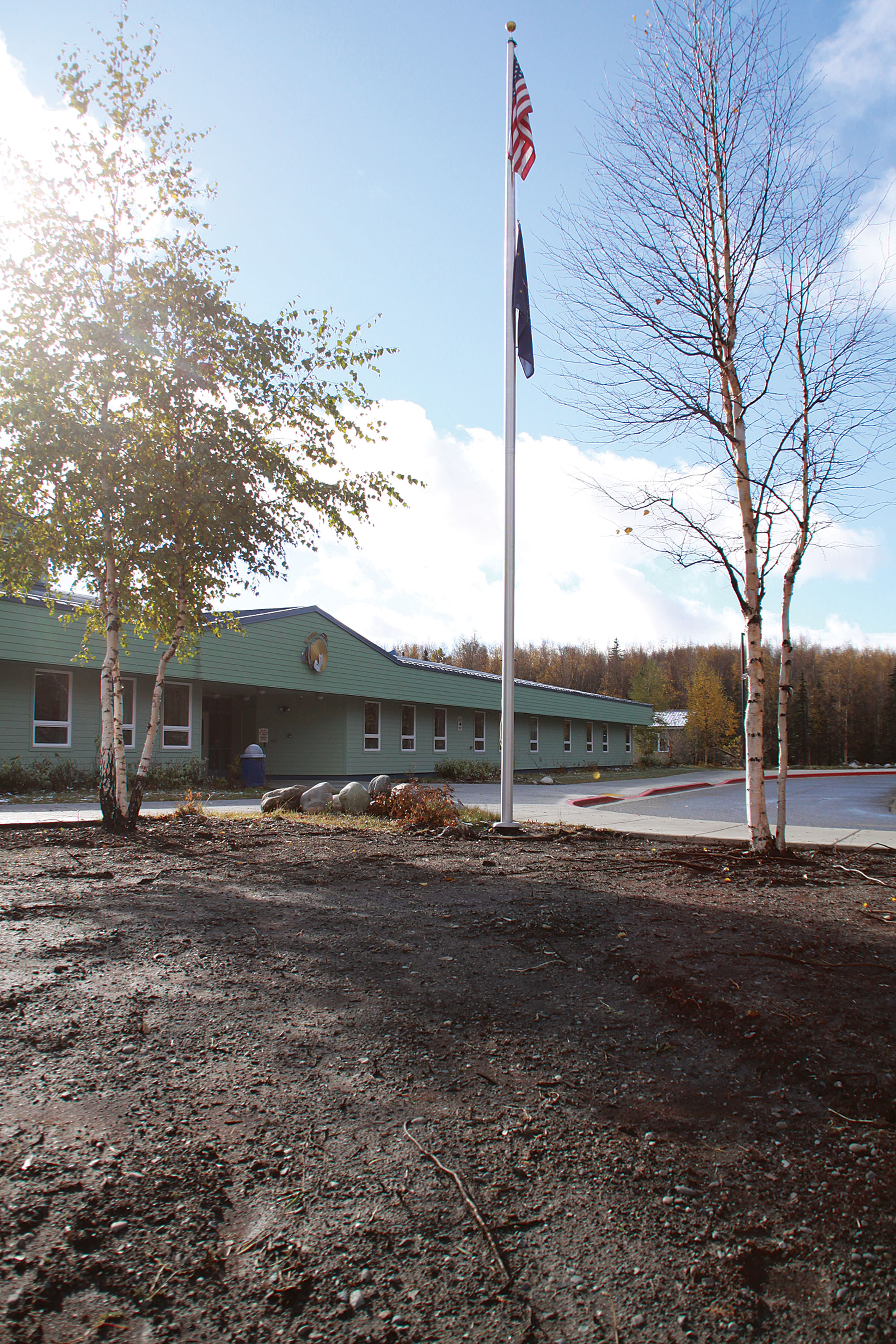
For the last three weeks, Shaw students have been learning about elements of art, principles of design and the structure of spirals and labyrinths, all in preparation for the creation of a maze of mosaics. The maze will eventually be installed in a dirt area in front of the flagpole at the front of the school.
The project — which involves all Shaw students and uses materials from Arctic Mermaid Mosaics, Lowe’s and artist in residence Shala Dobson — is funded by an Artist in Schools grant from the Alaska State Council on the Arts, the National Endowment of the Arts and the Rasmuson Foundation.
Fourth- and fifth-grade teacher Brian Porcello said he was inspired to write the grant after seeing a similar mosaic at a Talkeetna playground.
“I thought it would be a cool thing for the school to try to do,” he said.
Dobson and her husband, Jim Dault, both sculptors, seemed a good fit for the project, Porcello said, given their previous experience as artists in residence at Shaw and in other schools. The couple has created at least 10 pieces for Alaska schools through the National Assembly of State Arts Agencies’ Percent For Art program.
“We’re fortunate to have Shala come in and expose kids to every building block of the artistic concepts,” said Maija Fritts, a second-year teacher at Shaw.
But what Dobson brings to the table goes beyond color, shape and line. She and Shaw Elementary teachers have worked science, math and history into their art lessons.
According to Porcello, one of the requirements of Artist in Schools grant recipients is to create a legacy, which in this case is manifested in two ways: physically, with the mosaic maze, and intellectually, in the principles and concepts taught to the students.
In regard to the physical creation, Dobson said, “this is a huge undertaking,” by virtue of how many students are involved. But the more hands that are used to make the labyrinth, the more people there are to appreciate the art for years to come.
“Most of the time projects like this are only temporary,” Dobson said. “This one is supposed to be permanent, and that way (the students) have a real kinship to it.”
In regard to the intellectual legacy, one key concept is the Fibonacci Sequence — the series of numbers, starting with 0 and 1, that perpetuates by adding up the last two consecutive numbers (0, 1, 1, 2, 3, 5, 8, 13…). Evidence of this sequence is found in the patterns of sunflowers, seashells and other natural phenomena.
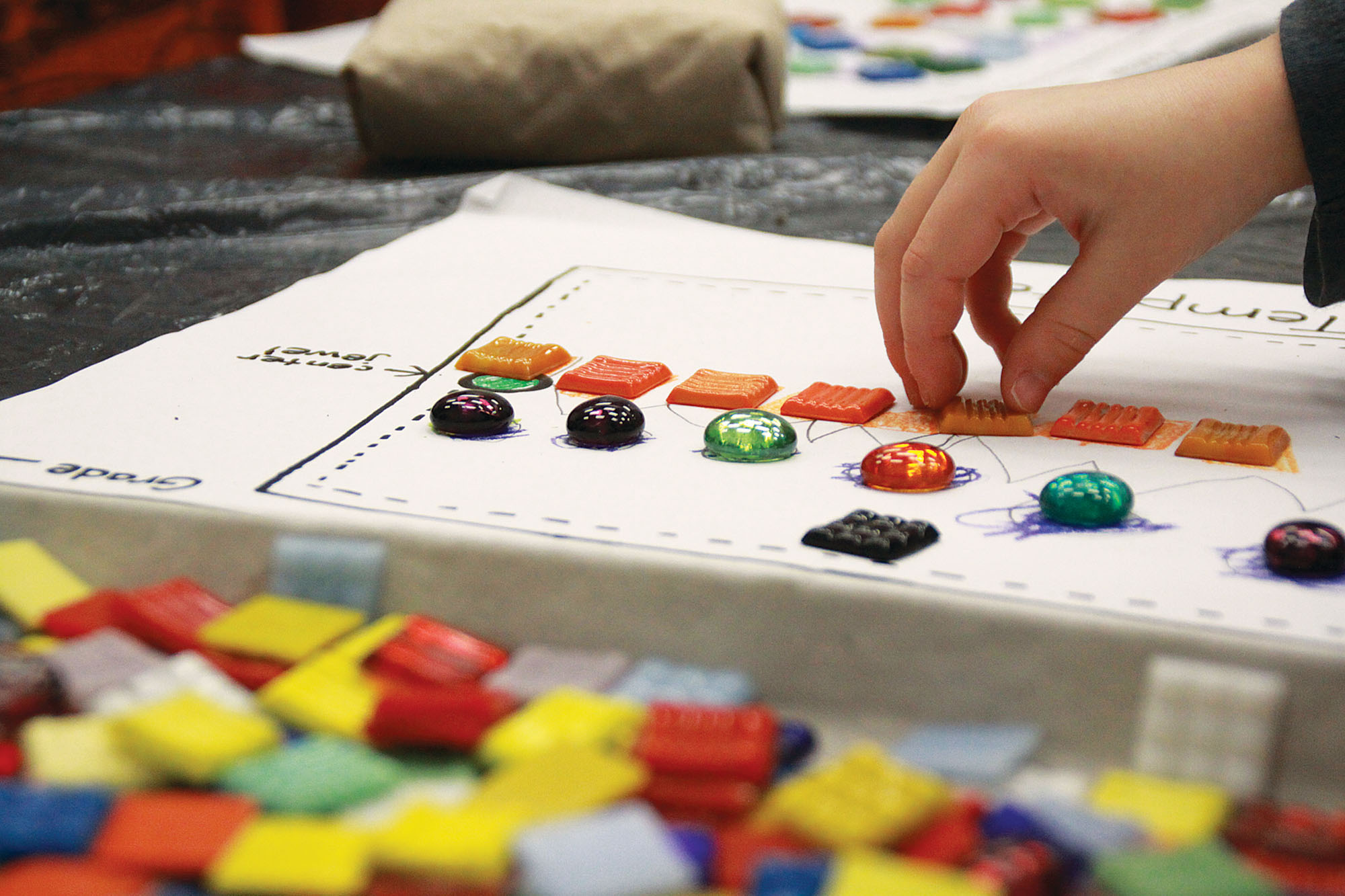
For the project, students learned about the history of Leonardo Fibonacci, as well as the mathematics of the sequence. The outline of the “Shaw labyrinth” or “Sundog spiral,” as the students and teachers are calling it (for the school’s mascot), will consist of the students’ trapezoidal pavers, which are eight inches long on top, and 13 inches long on the bottom — two consecutive numbers in the Fibonacci sequence.
“The biggest payoff with this (project) is watching the kids make all those connections,” Porcello said. “There’s nothing more satisfying than watching a bunch of fourth graders crack that code of how that sequence works, and watching kindergarteners form that line of symmetry and say, ‘hey, I did it.’”
In some cases, however, what a student will take away from creating his or her mosaic is less mathematical and more personal.
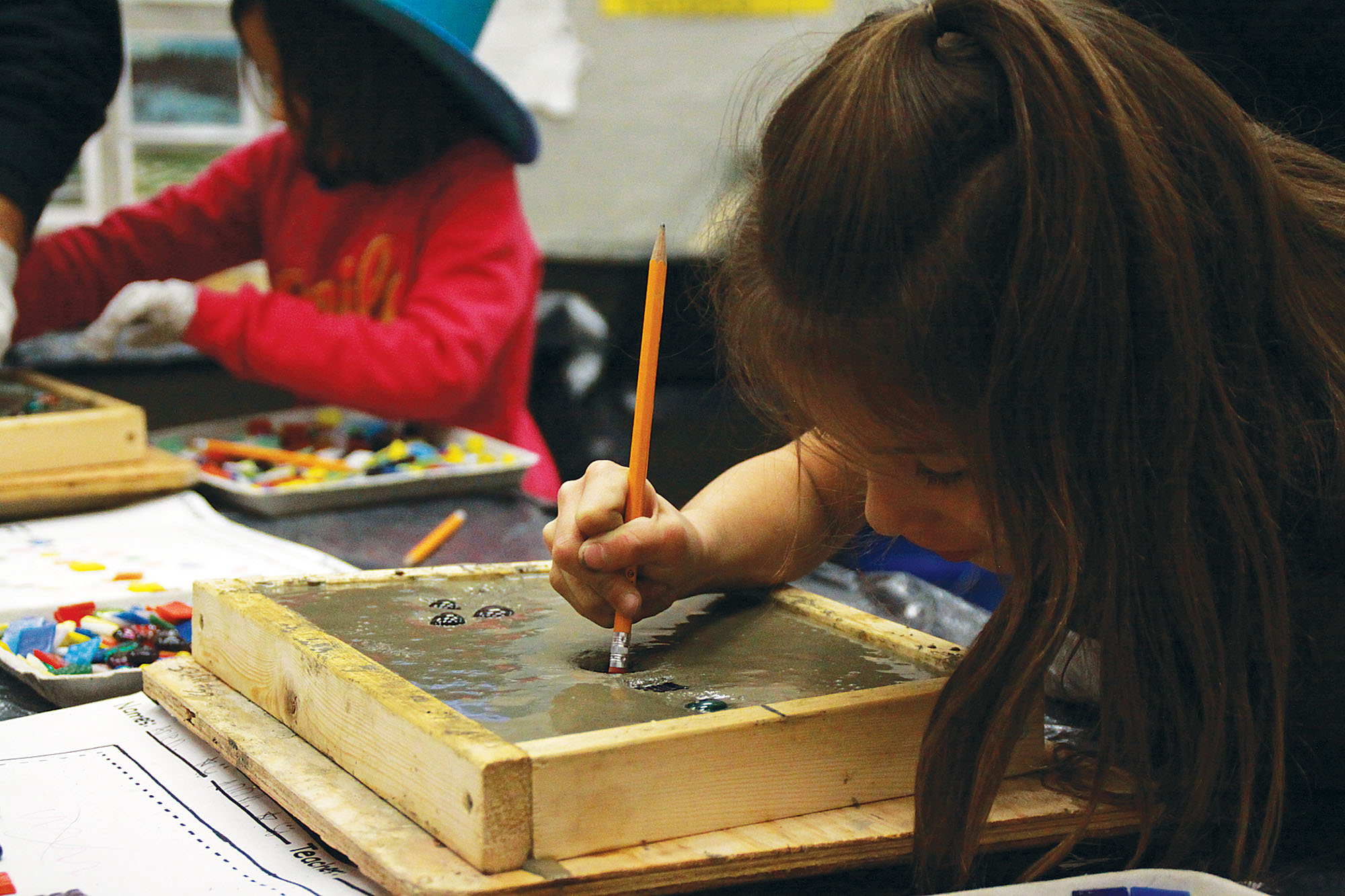
“We work as a team,” said first-grader Kyla McChargue, as she placed a glass tile into a trapezoidal mold of wet concrete on Wednesday.
Kyla’s mother, Dena McChargue, who attended her daughter’s class as a volunteer helper, said those personal connections and emphasis on hands-on learning may be more telling of the school’s success than the formulas presented to the students in a book.
“It definitely feels like Shaw invests a lot in their kids,” McChargue said.
Even first-grade student Annabella Burley, who recently moved to Alaska from Virginia, noticed a positive difference between Shaw and her former school.
“We never got to do this in Virginia,” Annabella said, putting the finishing touches on her and her partner’s tile.
Inciting that sort of wonder, excitement and appreciation of art and the possibilities within early on, Porcello said, is what will produce big ideas in the years to come.
“If we want innovators in the future, we’ve gotta use both sides of our brains,” he said.
The finished labyrinth will consist of around 350 tiles, to be installed within the next month, weather permitting. Dobson said she would just like it to be finished by The Labyrinth Society’s World Labyrinth Day on May 7, 2016.
Shaw teachers trained by Dobson will continue to teach the lessons associated with the project, and the molds used to make the tiles (fashioned by Dault) will be available for future use by other schools.
Contact reporter Caitlin Skvorc at 352-2266 or caitlin.skvorc@frontiersman.com.

By Jeremiah Bartz Frontiersman.com A football coach using a hockey reference as the centerpiece for his keynote address may

Frontiersman.com With its headquarters in Wasilla, the Frontiersman has been a primary source of news for the Matanuska-Susitna

By Katie Stavick Frontiersman.com The next generation of leaders took flight this week as the Houston High School Class

By Kyle Wilkinson For the Frontiersman Keynote speaker and Carry the Cure President Bill Pagaran’s words boomed through the