Retiring teacher, coach urges Colony grads to ‘find their 68’
By Jeremiah Bartz Frontiersman.com A football coach using a hockey reference as the centerpiece for his keynote address may


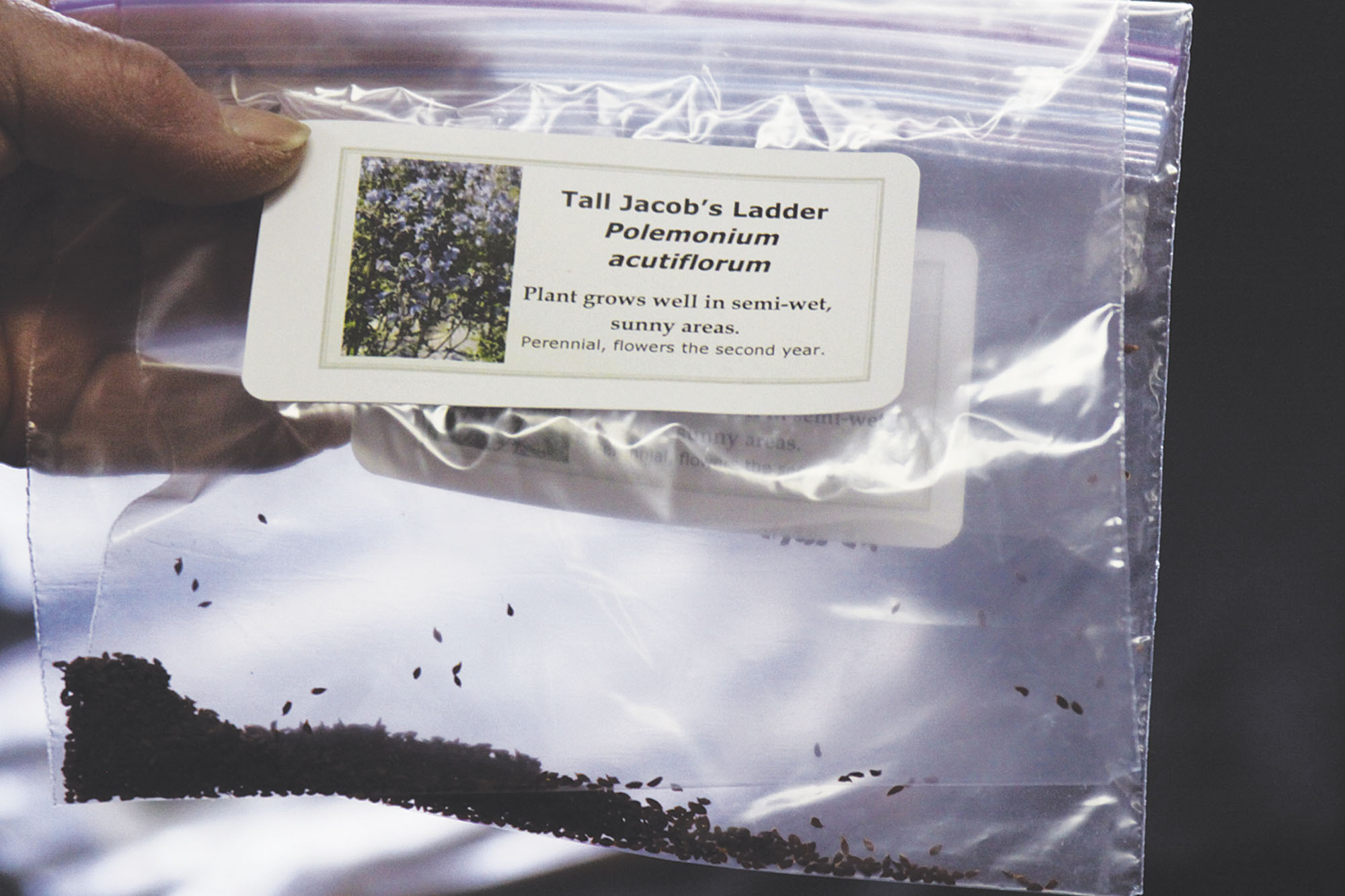
PALMER — If gardeners could take one thing from the returned Palmer seed swap Monday: think like a seed.
That advice comes courtesy ethnobotanist and native plant enthusiast Peggy Hunt, who spoke briefly about growing native species of plants.
“For instance, if you’re gonna plant a seed from a native plant, think like that plant and how it produces its seed and when it produces its seed,” she said.
That might entail a whole host of schemes designed to fool seeds into thinking it’s the wrong time of year so it’ll sprout early, Hunt said. For example, putting the seeds in the refrigerator, on moist paper towels, or abrading the surface with sandpaper Hunt said.
“If I’m trying to plant that seed, I need to say that seed is falling in the fall, it does not want to germinate in the fall,” she said. “It has some sort of mechanism inside that seed to prohibit it from germinating.”
For example, willow trees — and other forms of perennial native plants — produce lots of seeds early in the year, Hunt said. This is done in part because many of the seeds will die before they ever experience the conditions required to germinate, Hunt said.
Knowing how to trick plants is important, because traditional plants have numerous uses, Hunt said. Perennial hiker's foil devil's club contains an inner bark useful in traditional medicines, Hunt said. She said she can derive numerous uses from a square yard of native plant growth.
"I use it (devil's club) on my hands for arthritis," she said. "It was used for tuberculosis."
The seed swap March 9 was the first in about five years, and was offered as part of the Depot Farmer’s Market, organizers said. The original seed swaps sprang out of a former Frontiersman gardening column, the Dirt Divas. The event allows local gardeners to bring in their favorite seeds for trade. For example, Dan Elliot brought apples containing the seeds he brought for sharing, Hunt brought native plant seeds to share.
Amid all the talk of, and enthusiasm for gardening, one planned talk, delivered by Adina’s Acres plantsman Charles Stillman — his tongue-in-cheek business card reads, “Transplants, Consulting, Dragons Slain” — stood out, as much for its understated matter-of-factness as for its eye-catching title: "Corn and Cannabis."
“When people think of cannabis, most people tend to think of sativas, which are these big tropical lofty things with great big huge stems that can reach tremendous sizes and often even be a perennial, depending on the climate, or indicas, which are usually thought of as these short squat things in the back of John’s garage that no one really talks about,” he quipped.
Stillman's presentation was originally focused on growing corn and melons — both resource-intensive plants, which are not normally associated with northern climates, he said. However, so many gardeners asked Stillman to address marijuana cultivation instead, that he switched topics.
Some gardeners still suffer what he called "an intense visceral reaction" to pot talk, in part because of the long-standing prohibition on the plant, according to Stillman.
"I certainly understand that," he said. "I have to understand that because it helps me understand my clients better."
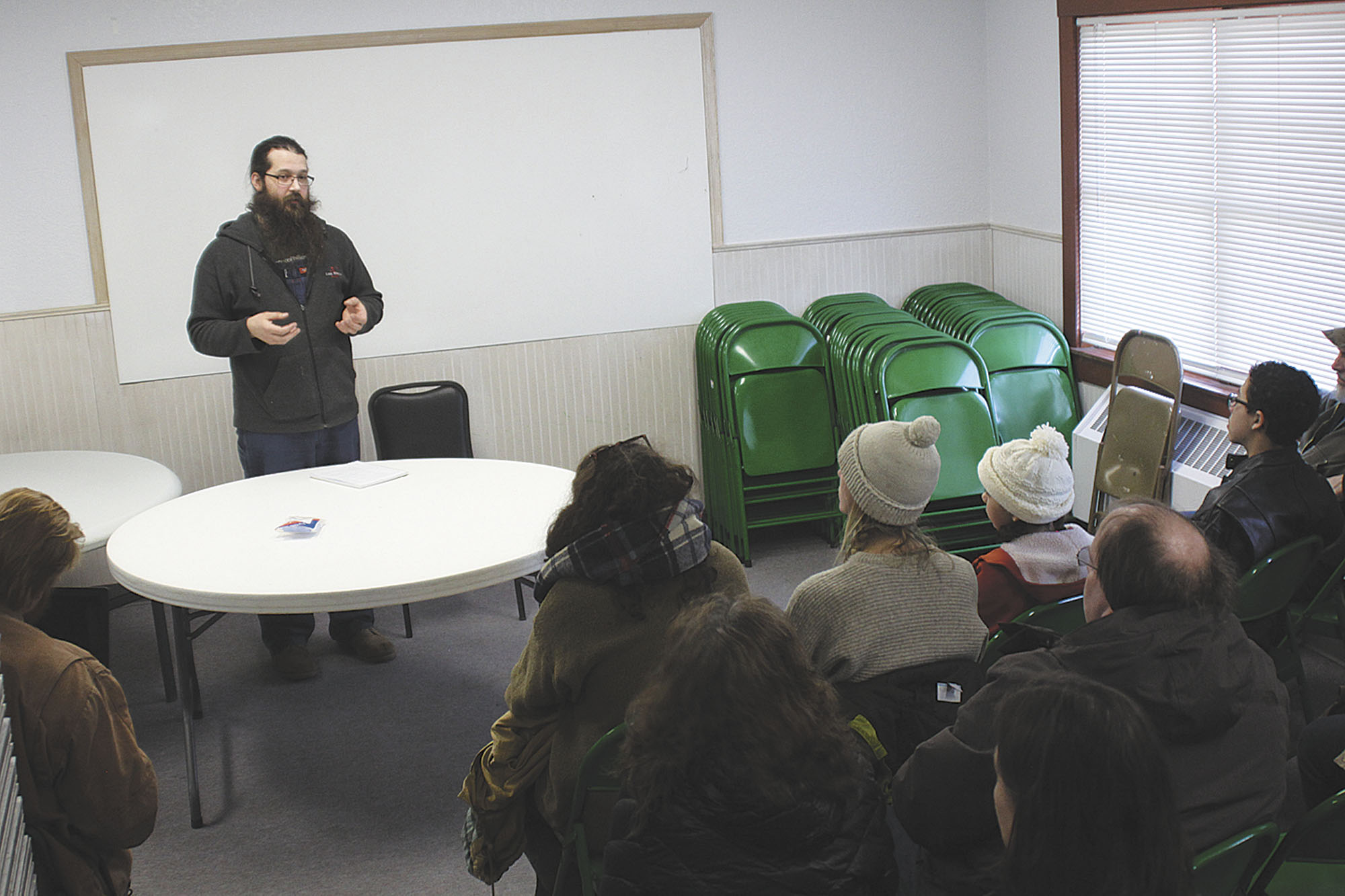
For about half an hour, Stillman covered the basics of marijuana cultivation for a standing-room-only audience in a small room in the Palmer Depot. He said he gleaned his information from biological literature and from frequent consultations with gardeners asking advice for conspicuously out-of-season crops (the University of Alaska Fairbanks cooperative extension has received numerous similar calls over the years).
For example, a third sub-species of marijuana plant, ruderalis, originates in parts of the Soviet Union and Poland, and when hybridized with sativas and indicas, can result in marijuana plants that will blossom until they exhaust their available resources or until they are cut down, according to Stillman.
Plants from this construction transform basically from photosensitive perennials — plants that bloom depending on changes in light — into annuals — plants that bloom no matter what.
"These will basically bloom themselves to death," he said.
While indica and sativa have made their way into the popular literature, scientific classification is still ongoing, Stillman said.
“This is really vague because of their genotyping,” he said.
Cannabis shares some characteristics with corn, which Stillman covered in the first half of his presentation. For example, ears of corn should be harvested shortly before the kernels turn translucent, hard, and largely inedible, Stillman said. Marijuana should be harvested when trichomes, small hair-like structures at the base of the plant’s flowers, are at their most milky, Stillman said. Harvests for the intoxicant and harvests for fibers (cannabis is harvested for both) are frequently made at different times of year, Stillman said.
Nor can marijuana simply be smoked straight off the plant, Stillman said. Prior to smoking, harvested flowers undergo a curing process similar to tobacco harvesting, in an environment of between 60 percent and 65 percent humidity and between 50 and 80 degrees Fahrenheit, according to Stillman.
"Some of the traditional ways are actually to stuff corn cobs with freshly cut buds, wrap them up really tight and bury them under a foot or more or earth, and dig them up five or six months later," he said. "This is usually referred to as Malawi cob."
Modern cures can take place in humidors set to the appropriate humidity, Stillman said.
While most of Stillman's presentation focused on inebriates and fibers, at least one member of the audience, Sally Koppenberg, was interested in marijuana for other reasons.
"There are people, I suspect, although they may not want to admit it, that are interested in the topic," she said. "I am interested in it because there's a lot of ornamental cannabis plants. Some of them have fuzz on them, some of them have brilliant pink blossoms."
"As a gardener, that's been a line of plants you can't typically put in your garden," Koppenberg added.
Contact Brian O'Connor at 352-2269, brian.oconnor@frontiersman.com, or on Twitter @reporterbriano.

By Jeremiah Bartz Frontiersman.com A football coach using a hockey reference as the centerpiece for his keynote address may

Frontiersman.com With its headquarters in Wasilla, the Frontiersman has been a primary source of news for the Matanuska-Susitna

By Katie Stavick Frontiersman.com The next generation of leaders took flight this week as the Houston High School Class

By Kyle Wilkinson For the Frontiersman Keynote speaker and Carry the Cure President Bill Pagaran’s words boomed through the