Retiring teacher, coach urges Colony grads to ‘find their 68’
By Jeremiah Bartz Frontiersman.com A football coach using a hockey reference as the centerpiece for his keynote address may


PALMER — A fictional mother of twins has been missing somewhere in the Palmer Hay Flats for the better part of three days and state volunteer search-and-rescue personnel are looking for her.
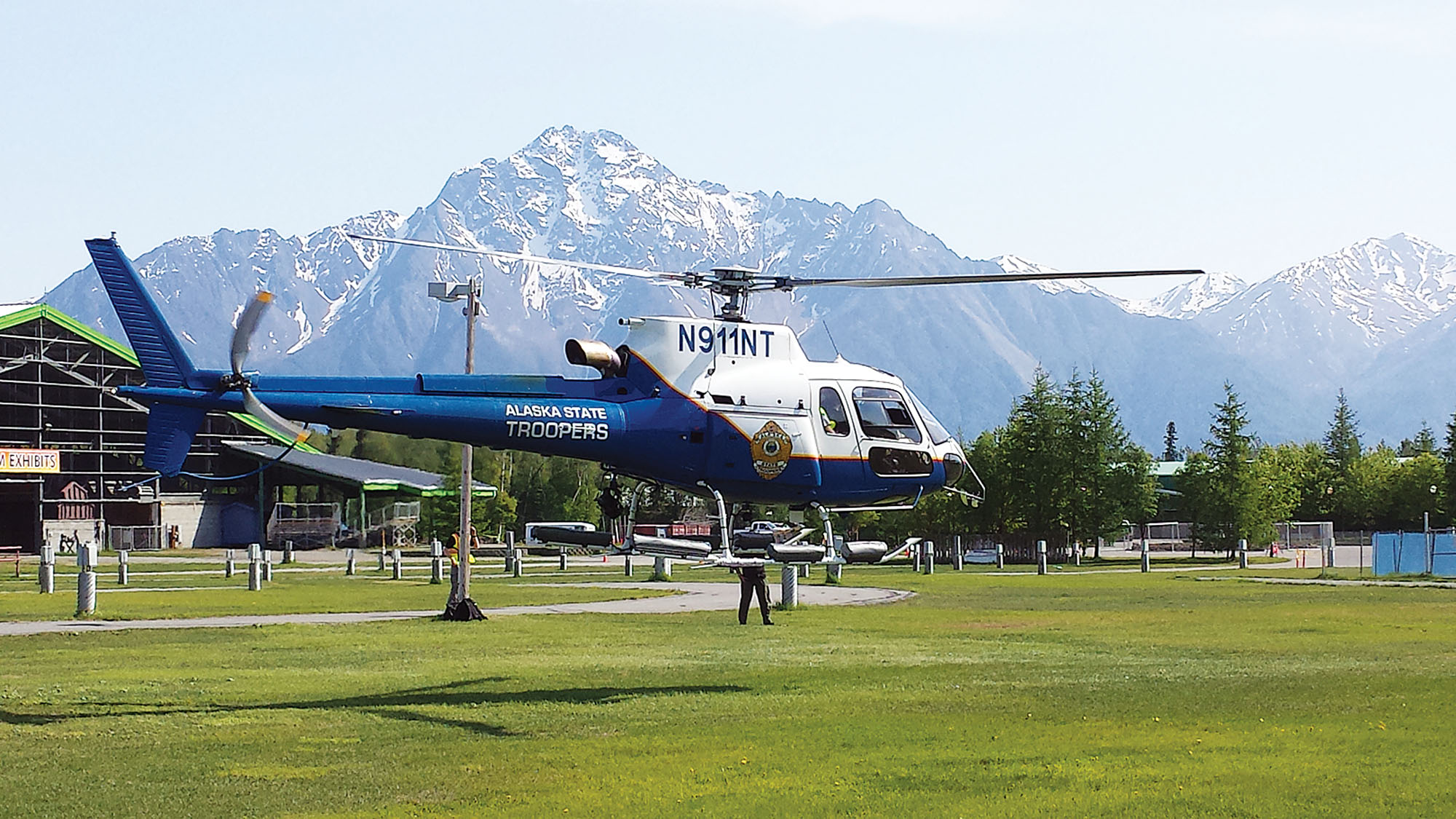
They are scouring the underbrush on foot, on all-terrain vehicles, on horseback, and by helicopter, searching for the missing fictional woman. They are learning to deal with imperfect information from her fictional twins, and learning to coordinate their efforts with a central command.
At the same time, a secretive “white cell” within the exercise is monitoring their activities via radio and helping the “missing individual” avoid premature discovery, which would end the search-and-rescue exercise too quickly, and curtail the opportunity for training.
To the casual observer, the exercise might resemble an elaborate game of hide and seek. However, the massive effort is an essential part of training for teams from the Valley and Anchorage and as far afield as Kodiak, Fairbanks and Sitka. In a state where about one person a day goes missing — rescuers tallied 367 search and rescue operations in 2014 — that training is a critical part of the mission, officials with the Alaska Department of Public Safety say.
As a media briefing was taking place Friday, officials were preparing to hand off the search from the regional teams to the central incident command, part of a deliberate escalation designed to mimic intensive search-and-rescue operations, said Lt. Steven Adams, the statewide coordinator for volunteer search and rescue.
“It’s in the process of transitioning from the initial response incident commander over to the full incident management team, and that’s taking place right now,” he said.
Search-and-rescue operations have never lacked a diversity of options, said DPS spokeswoman Megan Peters.
“We’ve actually done a body recovery before using a llama, just because it was available and the terrain type,” she said.
However, the idea of a major coordinated response is a recent development in search and rescue in the state. The Alaska Incident Management Team for search and rescue dates to about 2011, though individual search and rescue teams predate that. The Mat-Su Search-and-Rescue organization was established in 2003.
In most search efforts, the local team — in this case, the 30-member Valley organization known by the abbreviation MATSAR — would respond first and assess the situation to determine whether additional personnel are needed. Depending on the local assessment, the Alaska Incident Response Team could be activated. The team would take a quick look at the operations conducted, and coordinate among the various operations until the missing person is found, or search efforts are suspended, Adams said.
“We either find the person, or we’ve gotten to the point where we’ve exhausted all our available resources at the time and we have no leads about where to deploy additional resources,” he said.
In this simulated scenario, a volunteer playing the part of the wayward mother began walking into the hay flats from the last contact point. Actually putting a person in the field helps make the search more real for the human volunteers and MATSAR search and rescue dogs, Adams said.
That missing person will communicate with the white cell and leave a series of clues for searchers, which could include articles of clothing or an SOS spelled out in rocks.
“I don’t know how it’s going to play out, but it’ll be very realistic, because these are senior (search-and-rescue) volunteers that have written this,” he said.
Volunteers also trained with Helo-3, a resource whose absence could potentially reshape the way search-and-rescue operations in Alaska are conducted. If a worst-case budget scenario envisioned late last year comes to fruition, the aviation unit, including the two Department of Public Safety helicopters, would be grounded.
That would force troopers to rely on local military aircraft for air support. But given what’s known as the Posse Comitatus Act of 1879, which prevents military personnel from assuming civilian law-enforcement duties, a military search could continue only until remains were discovered, Adams said. Bodies could not be recovered from remote locations via military aircraft, he said.
Grounding of the troopers helicopter fleet also would impact future training exercise like this one.
“If we don’t get the funding to maintain this, it’ll probably be the last time we’ll be able to use it for training for sure. But we won’t even be able to use it for missions,” he said.
Contact Brian O’Connor at 352-2269, brian.oconnor@frontiersman.com, or on Twitter @reporterbriano

By Jeremiah Bartz Frontiersman.com A football coach using a hockey reference as the centerpiece for his keynote address may

Frontiersman.com With its headquarters in Wasilla, the Frontiersman has been a primary source of news for the Matanuska-Susitna

By Katie Stavick Frontiersman.com The next generation of leaders took flight this week as the Houston High School Class

By Kyle Wilkinson For the Frontiersman Keynote speaker and Carry the Cure President Bill Pagaran’s words boomed through the