Retiring teacher, coach urges Colony grads to ‘find their 68’
By Jeremiah Bartz Frontiersman.com A football coach using a hockey reference as the centerpiece for his keynote address may


MAT-SU - Stephen Cavanaugh survived more than 300 missions as a turret gunner in the Iraq War, but he couldn't survive the dangers of winter driving in Alaska.
The 24-year-old Fort Richardson soldier died after a Dec. 6, 2007, collision with a moose on the Seward Highway, the last of six moose-related traffic fatalities that year. Cavanaugh's story is one Alaska Moose Federation Conservation Fund executive director Gary Olson highlights as a tragedy he doesn't want to see repeated.
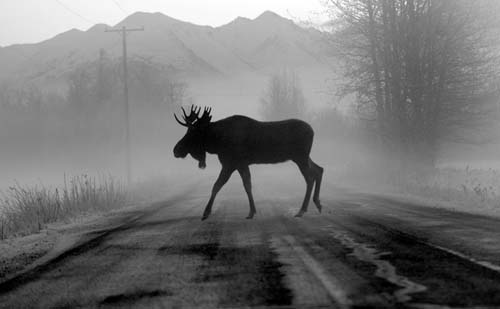
As Southcentral and the rest of the state continues to dig out from one of the snowiest winters in more than a decade, motorists are encountering moose with greater frequency, Olson said. In the Mat-Su Borough, moose-vehicle collisions are up drastically this winter and on pace to have a $10 million impact, he said.
"This is one of the worst winters to come along in a long time," Olson said. "We've requested an emergency status (from the state), and the reason is we've exceeded 200 moose collisions by the end of December."
Through Thursday, there have been 269 vehicle collisions with moose in the Valley, said Tim Peltier, acting area game manager for the Palmer office of Alaska Department of Fish And Game. Average for an entire winter season is about 270.
"We do have an increase in the number of vehicle collisions, it looks like," Peltier said. "If the snow keeps on the track that it has - and the snowiest months are still ahead - there's a possibility that may increase. It could make things difficult, but it's hard to tell at this point exactly how difficult. We just don't know what the snow's going to do."
If history is any indication, the next 10 weeks could be critical to local moose herds, and potentially deadly for motorists, Olson said. Because moose find easier foraging and walking along roads and railroad tracks when snows pile up about 36 inches or more, the large animals will repeatedly return to areas where food is easier to find.
"These herds are bunching up around the roads real bad," he said. "The deep snow (this winter) came early and often, and we're sitting with nine to 10 weeks left of winter, and typically they're the hardest weeks of winter. This is a real serious problem."
While such collisions are usually fatal to moose, people driving smaller and more fuel-efficient cars also are at a greater risk of injury or death, Olson said.
"If you look at the hood height of most cars, the hood height is below the chest of a moose," he said. "So where does the moose go when you hit it? It goes through the windshield."
Each collision with a moose costs an average of $35,000, he said, which includes vehicle damage, treating injuries, loss of work and the cost of emergency responders.
"We're easily on the way to having a $10 million-plus damage year in the Mat-Su," Olson said.
Along with more moose encounters on Valley roads comes more encroachment of the large animals in residential areas, Peltier said. It's not unusual to see moose near homes, but that can be a dangerous situation if encouraged.
While some may think they're doing moose a favor by putting out food in the winter, they're not, Peltier said. Besides being illegal, if moose know they can get an easy meal somewhere, they'll return often and can become aggressive if they don't find what they want.
"That's something we try to dissuade," Peltier said. "For one thing, it's illegal. Give them a wide berth. Give them some space in the yard and on the road."
In his 22 years as an Alaska Wildlife Trooper, Sgt. Mark Agnew said he's noticed a significant increase in interaction with humans and moose this winter.
"It seems the railroad has been killing more moose and caribou along the tracks this year, too," he said. "The deeper the snow, the more the moose get pushed off the hillsides and down into the Valley."
Foraging moose can also be dangerous to neighbors, Agnew said.
"It creates what we refer to as a nuisance moose," he said. "That moose is going to stay right there in the yard and get more aggressive, and pretty soon they start demanding the food. They'll go door-to-door looking for food, and they can get angry (when they don't get what they want)."
Keeping moose away from humans is a primary goal of the Alaska Moose Federation, Olson said. Since 2002, the group has worked to clear trails during the winter to allow moose herds to move into more preferred forage and away from roadways and railroad tracks.
"It really, really works," Olson said. "The next day after we take a Sno-Cat through there, the trail's covered with moose tracks. We've started up around Willow targeting those herds that are next to the highways. We drop trees and make deep snow trails. What happens when you come through and groom a trail, you put a crust on top of the trail and they can get back up into the trees more."
In addition to breaking trails for moose, the organization is also in the process of taking over as the agency Alaska State Troopers call to respond to moose-vehicle collisions. Gov. Sean Parnell's administration is behind the effort as well, and the state appropriated $1.8 million in its current budget to help fund that response.
"We're on call 24 hours a day," Olson said, adding AMF is doing retrieval for the Anchorage area now. "We're saving the Anchorage Police Department about two-and-a-half hours on each call with retrieval."
Aside from driving defensively and keeping an eye out for moose, there's much people can do to help encourage moose to stay away from roads and tracks, he said.
"We can do a lot of things to help stop these collisions, we can," Olson said. "It's more than just keep your wipers clean and windshields clean. We need to get these trends turned around instead of increasing all the time."
LEARN MORE
Find out more about Alaska Moose Federation, including how to volunteer,
at growmoremoose.org.

By Jeremiah Bartz Frontiersman.com A football coach using a hockey reference as the centerpiece for his keynote address may

Frontiersman.com With its headquarters in Wasilla, the Frontiersman has been a primary source of news for the Matanuska-Susitna

By Katie Stavick Frontiersman.com The next generation of leaders took flight this week as the Houston High School Class

By Kyle Wilkinson For the Frontiersman Keynote speaker and Carry the Cure President Bill Pagaran’s words boomed through the