Retiring teacher, coach urges Colony grads to ‘find their 68’
By Jeremiah Bartz Frontiersman.com A football coach using a hockey reference as the centerpiece for his keynote address may


PALMER— Alaska DNR Commissioner Corri Feige and Alaska Division of Forestry Director John “Chris” Maisch held a press conference on Wednesday to discuss the active wildfires ravaging Southcentral Alaska and recent developments against the fires.
“It’s been an extremely active fire year,” Feige said.
There’s been a total of 666 fires across Alaska this year, according to Feige. She said that as of Tuesday, the total number of acres burned went past the 2.5 million mark.
“The governor sees this as his top priority right now,” Feige said.
Firefighting crews are currently focusing the bulk of their efforts on Type 1 fires. Type 1 fires are the top priority but the other fires are still being addressed with proportionate measures.
Fire priority is determined by a number of factors including population density, total number of structures and proximity to people. Above all, Maisch explained, priority goes to communities at the highest risk for lost life.
Crews from across the Lower 48 continue to flow into the state to help fight the flames. Currently, there are 545 firefighters responding to fires across the state, according to Maisch. He said that over the next three days, 300 firefighters are arriving via jet plane. He said that 100 firefighters will arrive each day.
The National Guard is currently helping fire crews in various ways, including air support with their Black Hawk and Chinooks helicopters, in addition to working security and traffic patrols on the highways.
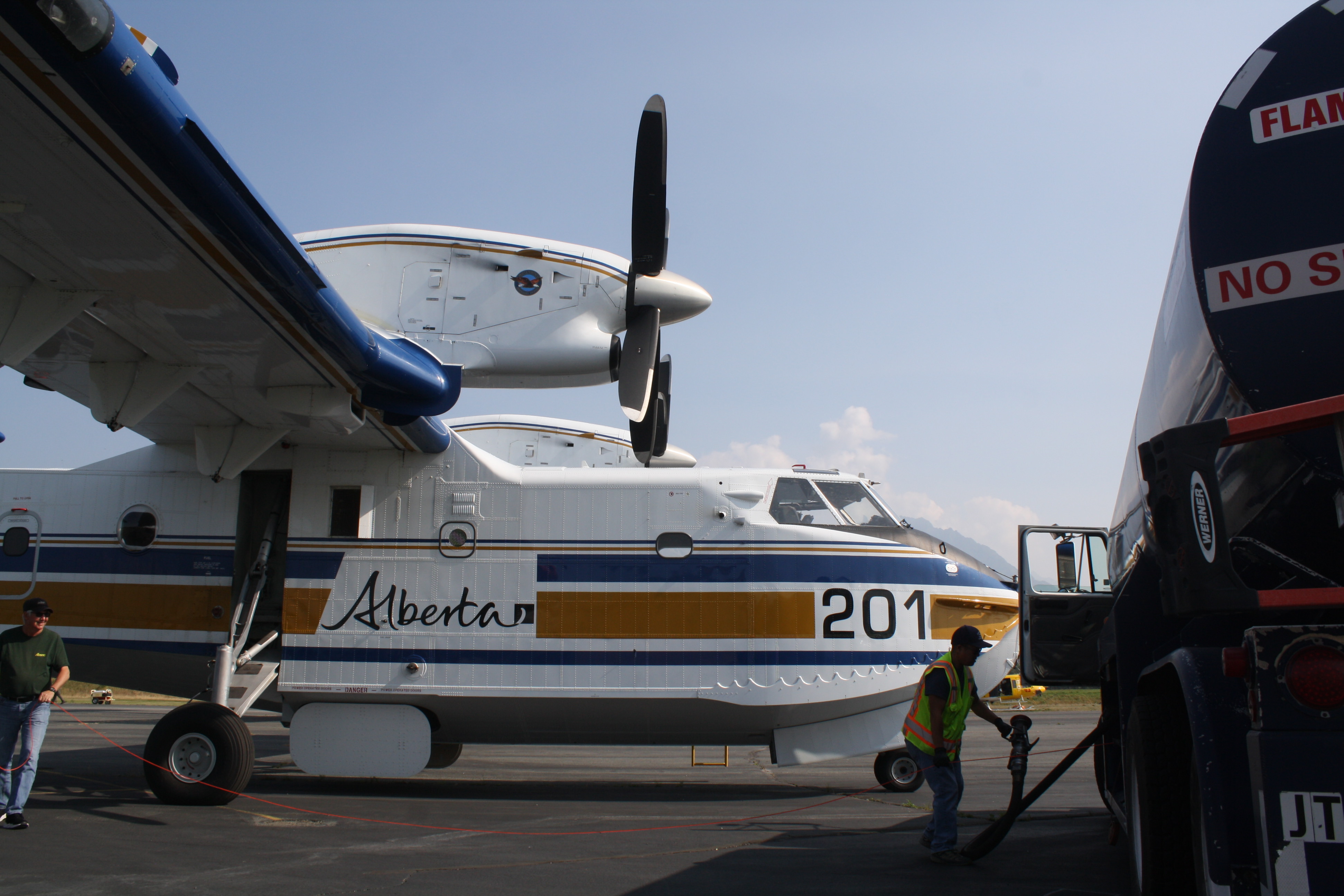
Feige and Maisch spoke in front of the Division of Forestry’s Mat-Su Regional Forestry Office near the Palmer Airport. During the conference, four large “Super Scooper” Canadair CL-215 aircrafts landed in the background.
“It’s good to see the reinforcements on the way,” Feige said.
The CL-215 aircrafts can hold 1,200 imperial gallons of water, according to John See, Anchorage Fire Department forester. He was happy to see these planes again, knowing how much they helped during the Robert Fire in 2003.
“We owe a lot to these airplanes here… You can put a lot of water on the ground with those,” See said.
All four of the amphibious, firefighting aircrafts were assigned to the Swan Lake Fire, which recently reached 140,049 acres burned. Maisch said there are two single engine water scooping planes currently at the Swan Lake Fire.
Total, there are 14 helicopters and nine aerial supervision aircrafts available statewide, according to Maisch.
“We have a small air force at our disposal right and now, and more is available if needed but… that more than fits the needs right now,” Maisch said.
Currently, the Swan Lake Fire is the top priority for statewide efforts, with 230 assigned staff, according to Maisch.
The McKinley Fire is second with 201 assigned staff. It recently reached 4,349 acres burned with increased activity on the southeast and northeast perimeters. The estimated costs are around $160,000 but the actual costs are likely to be much higher when it’s all said and done.
“There’s still obviously a lot of active fire there but they’re making very good progress on dealing with different hot spots on that fire,” Maisch said.
Maisch said that he was very glad to have the Alaska Type 2 Green Incident Management Team working on the McKinley fire. He said they’re a highly experienced crew that’s working under the direction of former Division of Forestry Wildland Fire Chief, Tom Kurth and the current Chief Norm McDonald.
“They’ve got a real heavy Type 2 Team as we call it up there, and are more than capable of handling that situation…” Maisch said.
The Deshka Landing Fire is priority number three statewide, with 45 assigned staff. It recently reached 2,200 acres burned. Private lands around Red Shirt Lake were advised to evacuate. So far, there has been no reported structural damage and no private land damage in the area.
There’s multiple layers at work as state and federal funding gets spread across the state to fight the fires. Maisch said that FEMA approved grants will pay for 75 percent of suppression costs.
The McKinley Fire has FEMA approval and they’re hoping the Deshka Fire will get approved as well.
Feige said that the state is working with the Kenai Peninsula and Matanuska Susitna boroughs and put in an emergency burn closure order, which went effective Wednesday morning. That means open fires are completely banned in both boroughs. Campfires, bon fires and burn barrels are strictly prohibited.
“There is just such a concern for any kind of spark,” Feige said.
Feige noted that people are still allowed to produce a fire as long as it has an “on/off switch” like the portable stoves fueled by propane.
“We’re very aware that hunting season opens on Saturday in the Mat-Su… We’ve been coordinating with Department of Fish and Game and the Alaska Wildlife Troopers just to remind all of our hunters and travelers and folks who are going to be out recreating out in the Susitna Basin: be particularly vigilant, ” Feige said.
The South Rolly Lake Campground and Nancy Lake Recreation Area have been closed due to high fire danger.
Despite the active wildfire, the Deshka Landing will be open during the weekend for boat launches and access to the west side of the Susitna. Feige has cautioned all hunters and people recreating outdoors at any location this weekend to be extra cautious.
“I think any place is susceptible to fire,” Feige said.
Contact Mat-Su Valley Frontiersman reporter Jacob Mann at jacob.mann@frontiersman.com


By Jeremiah Bartz Frontiersman.com A football coach using a hockey reference as the centerpiece for his keynote address may

Frontiersman.com With its headquarters in Wasilla, the Frontiersman has been a primary source of news for the Matanuska-Susitna

By Katie Stavick Frontiersman.com The next generation of leaders took flight this week as the Houston High School Class

By Kyle Wilkinson For the Frontiersman Keynote speaker and Carry the Cure President Bill Pagaran’s words boomed through the