Retiring teacher, coach urges Colony grads to ‘find their 68’
By Jeremiah Bartz Frontiersman.com A football coach using a hockey reference as the centerpiece for his keynote address may


This is not the type of news story in which quotes from Shelley Hughes would generally appear.
The state senator hailing from Palmer is most often cited for her stances regarding state financial woes, protecting Alaskans’ wallets, and ensuring public safety.
Yet, last summer when Hughes received a breast cancer diagnosis, the conservative woman who speaks openly about her Christian faith and her belief in the importance of core family values found herself having to face the other side of being an elected official — that even some of her most private matters are ultimately public.
Other than the mid-July announcement confirming that Hughes had breast cancer, she admits she has been fairly quiet about specifics regarding her health condition.
“Except to family, close friends and a few colleagues,” Hughes said.
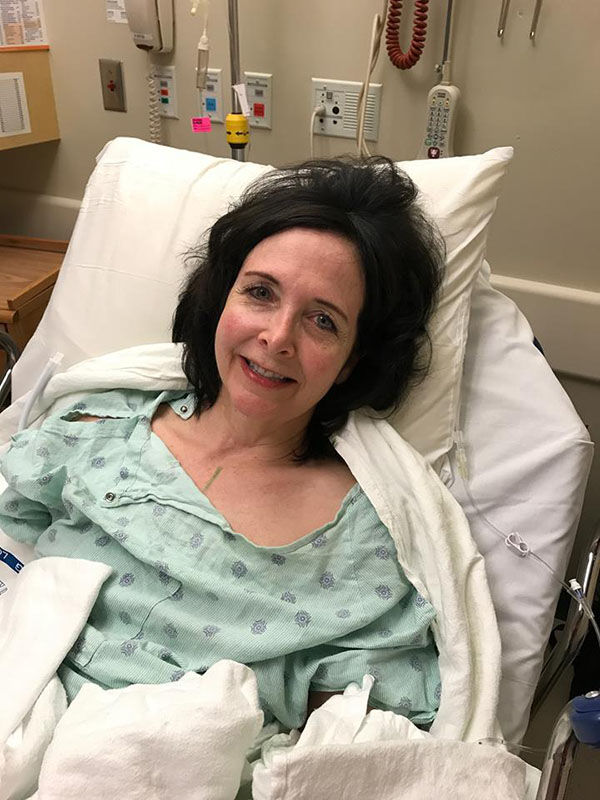
That changed last week when amongst her numerous social media posts regarding current state affairs, Hughes conducted a Facebook Live posting that outlined the time frame her treatment has taken the past two plus months, as well as how long it will take for her to resume a full schedule in her role as state senator for District F.
Though her fellow Senators are currently in Juneau, called in for the fourth special session, Hughes remains in Spokane, Wash. Hughes wanted her constituents to know why she wouldn’t be back in time for the beginning of the special session.
She also wanted her constituents to know why she — a staunch supporter of Alaska-based business and a former policy affairs director for the Alaska Primary Care Association — opted to go Outside for cancer care.
“People have been so very supportive. And people have been curious about how I am doing,” Hughes said in a telephone interview. “I feel that the more straightforward we are when we deal with these sorts of issues, the better off. I decided not to tip-toe around the disease. “
Thus, she used social media to share details of how she decided to seek treatment at Sacred Heart Medical Center, where what she describes as a “more comprehensive team approach” to her specific case was available and covered by her insurance. She talked about preparing for her double mastectomy, the changes a self-professed “lover of junk food” made to her diet to be stronger physically, and her option to use her own tissue harvested from her body versus implants in the breast reconstruction process.
Throughout the post, her trademark smile and optimism dominated the screen.
Hughes said that as a state official she not only owed the public an accounting of the past couple months, but she also wanted to convey the message that she intends to return to her duties.
And that was why she opted to leave the state for treatment.
“I am beating cancer day by day. I’m winning the battle. I plan to be a survivor and continue to stand for Alaskans every chance I get, and constituents and Alaskans needs to know that,” Hughes said. “As legislators; as one elected to be a leader in the state, we become known for one thing or another,” she continued. “I do not want to be known for breast cancer alone. I want to be known for being a champion for the people of Alaska.”
That’s why she is allowing the details of her breast cancer struggle to become public.
First challenge: Her diagnosis of invasive lobular carcinoma, a specific type of an estrogen-fed breast cancer, is rarer than others. It easily camouflages itself and, as Hughes described, it was very difficult for doctors to distinguish the borders on her tumor.
Second challenge: The Cancer Center at Providence Alaska Medical Center in Anchorage does not accept the medical insurance that state legislators receive.
Third challenge: The natural type of breast reconstruction – deep inferior epigastric artery perforator flap – that Hughes selected due to its improved long-term results currently is not performed in Alaska.
She was frustrated by these facts.
She was conflicted by the thought of what message her choice to seek treatment Outside would send to her constituents and to Alaskans in general.
Then she realized that her choices and her treatment could and would provide leadership to Alaskans by highlighting the serious issue of extremely high health care costs in Alaska.
Having one’s breasts removed is not a pretty picture.
Yet for Hughes, the process she endured to secure the opportunity for to “crush cancer” as she describes the desire for her final outcome has also been full of blessing.
It turns out one of the best medical care centers in the nation offering expertise in performing natural breast reconstruction is located in the same city where her daughter, Emily, lives.
Emily is a second-year medical resident and pregnant with her first child.
“All of my children are so incredibly supportive,” Hughes said. “But it was and is an extra measure of comfort to have her right next to me to guide me through all of this considering the medical knowledge she has and her knowledge of the medical system.”
There is a special bond between a mother and daughter when the latter is pregnant with her first child.
Having the backdrop of new life being formed in her daughter’s womb gave Hughes renewed hope.
“I was losing my breasts while hers were getting bigger,” Hughes laughed as she thought of the biological facts surrounding each woman’s situation. “I had nursed all four of my children. Losing my breasts was losing a big part of who I was.”
Yet, on Sept. 11, 2017 – the day of her surgery – Hughes found the ability to joke.
As the anesthesia team prepped Hughes for surgery, she looked down at her breasts and quipped, “Well, I guess the twin towers are coming down today.”
Her willingness to be a bit light-hearted and poke fun of herself was a moment that spread throughout the hospital’s surgical suites and others – properly gowned of course or in white coats – poked their heads in to give Hughes a thumbs-up and laugh with her.
Post-surgery did not come with comedic relief — at least at first.
After coming out from anesthesia, Hughes said she remembers looking down at her chest and choking back momentary sadness.
“I looked down and I was completely flat,” she said recalling the stark reality of the surgery.
She cried.
She would not allow that feeling to linger long, though.
She had to ready herself for the type of reconstruction she had selected. She had to keep eating those five-to-six servings of vegetables each day.
Nine days after being released from the hospital, Hughes underwent reconstruction surgery.
Deep inferior epigastric artery perforator flap or DIEP is no walk in the park as far as surgery is concerned. It involved two surgeons, a 12-hour microsurgery, and five days in the hospital. A lengthy “cutinacross” the lower belly is made, allowing the surgeon to loosen and remove skin and fat from that area that is then placed in the breast area to create new breasts. Arteries and veins are cut from the belly area and reattached to blood vessels under the arm or behind the breastbone. The tissue is then shaped by the surgeon whose goal is to match the size and shape of what was there before.
It means double recovery.
Hughes had over 30 inches of incisions that needed to heal.
The pain was intense.
It brought her to a greater understanding of another issue facing Alaska: the opioid epidemic.
“I was put on narcotic painkillers, but I quickly realized that I wanted off of those as soon as possible,” she said. “I was not going to fool around and risk becoming addicted."
Her recovery went well – at least medically. For the first week, she could barely stand for a minute or so at a time. She kept improving and two weeks ago, Hughes was up on her feet for 45 minutes at a time. Now she can last more than an hour.
Doctors are allowing her to return to Alaska on Nov. 1, earlier than typical, with the caveat that she not resume a full work schedule and makes sure to rest and recline frequently. Instead, Hughes will ease back into her busy schedule.
Because of her decision to have a full mastectomy rather than lumpectomy, and because the type of cancer isn’t particularly responsive to chemo, Hughes is thrilled she will not be subjected to chemotherapy.
“Women who go through chemo are my heroes,” Hughes added after sharing her good news. “But I will say, hormone therapy is no picnic.”
Her medication is causing insomnia and arthritic-like sensations in her hands, and she has to take it for five years. Her biggest concern is the high rate of bone density loss and hip and back fractures due to the medication.
She admits that will challenge her, but it won’t stop her. “I am eager to get back to serving Alaska,” she said. “My health comes first, though. The last thing I want is a setback. I want to reassure Alaskans that I’m taking care of myself for my family’s sake, but for their sake, too.
Browse the social media posts made by Sen. Shelley Hughes of Palmer this past week and you’d be hard-pressed to stay focused on the fact that she is recovering from a double mastectomy and major reconstructive surgery.
Between Facebook Live through which she states her official opinion regarding state crime legislation and a steady stream of posting of the events and news stories from Juneau during the fourth special session, Hughes medically excused absence hasn’t kept her out of what she considers crucial state conversation.
The state budget continues to weigh heavily on Hughes.
“We as representatives of state government still have some very hard reductions to make,” Hughes said. “The state’s private sector simply cannot support as robust of state government as we had when oil prices were high.”
The state’s economic woes have been an issue taking up more than its fair share of her first year as a state senator.
Now – even though her vote late last June against the a $4.1 billion state budget has left her on the outside of the Alaska Senate Majority – Hughes said she will use her position in the state legislature to push for health care changes in Alaska.
“I am the poster child for that,” she said. “Health care costs in Alaska are simply too high. It is a huge burden on Alaskans. There’s no reason why we should wait on and expect DC to solve all our problems; Alaska is unique. Just like I’ve worked to protect Alaskans’ wallets, I had to protect my own wallet by going outside for care. I look forward to the day when Alaskans won’t have to do what I did and can stay in-state affordably. We have a lot of work to do to get the cost of care down to a reasonable amount, but this work is essential for families, seniors and individual Alaskans.”
Author’s Note: Sen. Shelley Hughes was clear that there are many qualified physicians in the state of Alaska. Her case presented a combination of unusual circumstances that led to Outside treatment. She also wishes to thank her sister-in-law, Chris Steiner, of Chugiak for the nutritional guidance Hughes received. Sen. Hughes also pointed out a bill she has filed that aims to be a first step in lowering health care costs in Alaska, SB119. Reach Hughes when the legislature is not in session at her Mat-Su office 907-376-3725 or via her official email: senator.shelley.hughes@akleg.gov.

By Jeremiah Bartz Frontiersman.com A football coach using a hockey reference as the centerpiece for his keynote address may

Frontiersman.com With its headquarters in Wasilla, the Frontiersman has been a primary source of news for the Matanuska-Susitna

By Katie Stavick Frontiersman.com The next generation of leaders took flight this week as the Houston High School Class

By Kyle Wilkinson For the Frontiersman Keynote speaker and Carry the Cure President Bill Pagaran’s words boomed through the