Retiring teacher, coach urges Colony grads to ‘find their 68’
By Jeremiah Bartz Frontiersman.com A football coach using a hockey reference as the centerpiece for his keynote address may


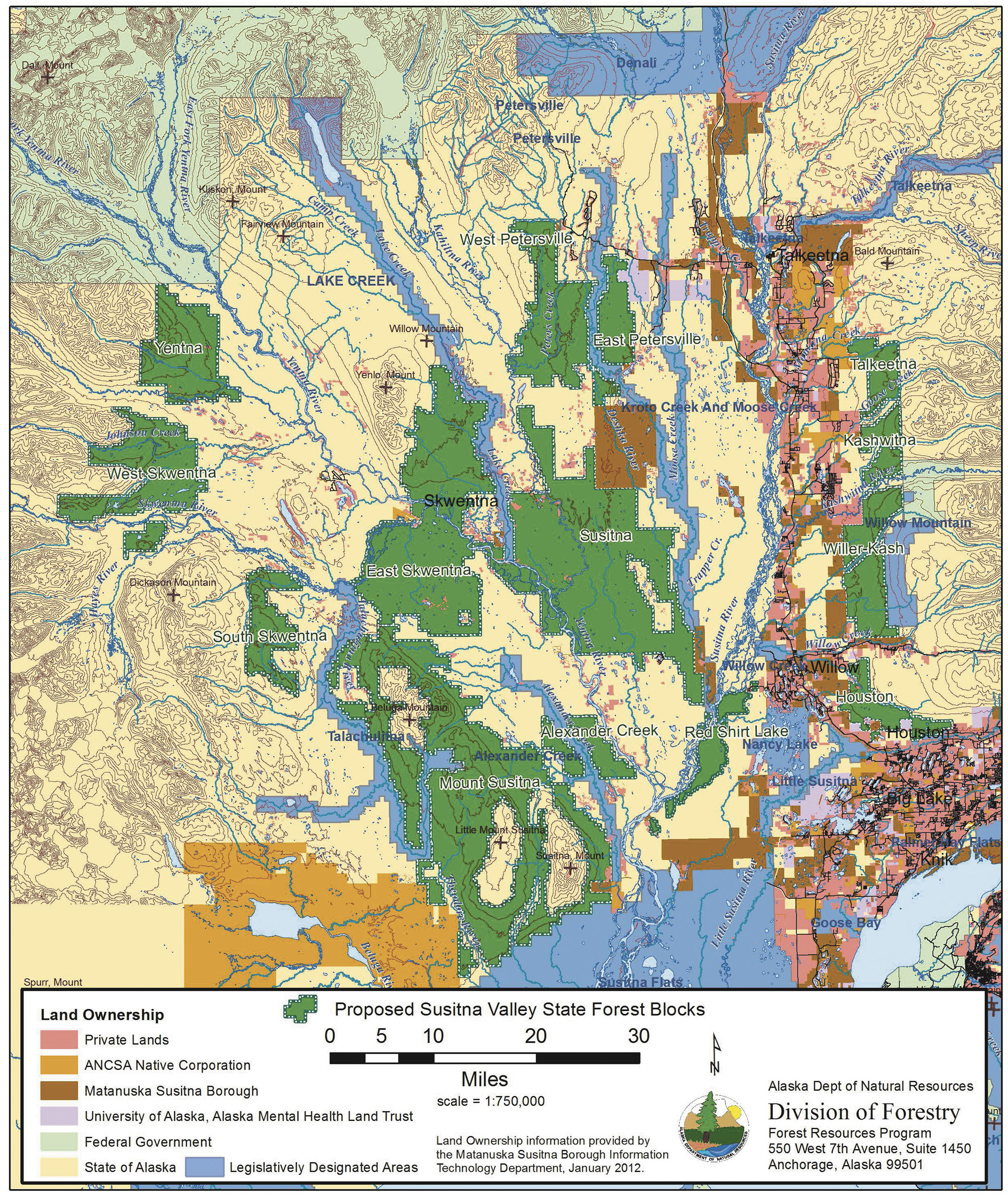
PALMER — The state Division of Forestry is trying to spread the word about its idea to create a 763,200-acre state forest out of 33 parcels of land in the Matanuska and Susitna valleys.
“The Division of Forestry will be able to manage the state forest for a long-term timber supply for local processors,” according to a brief synopsis of the plan DOR has drafted up.
State Sen. Linda Menard championed the would-be Susitna State Forest in the Legislature last year, passing it through the Senate before it stalled in the House. What the state has put together and is seeking comment on is the basic structure of what the forest would be.
There are maps available at forestry.alaska.gov/whatsnew.htm by scrolling down to “Proposed Susitna State Forest Concept.” The division held a series of public meetings and webinars over the last couple of weeks to gather input and solicit feedback.
While 763,200 acres sounds like a lot, in the grand scheme of state land managed by the Department of Natural Resources in the Valley, it’s tiny. DNR has 9.5 million acres of forestland, 2.1 million of which allows timber management.
The designation would set aside the state land in those areas to be managed as a forest. Timber would be sold to processors. Existing private plots in the area would stay as-is.
“All state land designated for settlement in the current area plans would remain available for purchase by the public,” according to DNR’s bound information packet on the topic.
At a town hall meeting Menard held back in March, Forestry officials described the designation as putting forestry management first. Everything else — mining, trapping, hunting, recreation — would be allowed.
The state is reluctant to do that on the land presently because all that land could be sold off to developers. Which isn’t necessarily a bad thing, state officials say, but it is detrimental to long-term planning of the type forestry is talking about, where trees are cut for firewood or other uses and replanted.
“Ten years later, those trees that we planted are bulldozed over for a subdivision,” Forestry’s Rick Jandreau said at Menard’s meeting. Nothing against subdivisions, he said, but “that makes us really reluctant to invest in those kinds of projects.”
Knowing that nothing less than an act of the state Legislature can convert that land into private or developed land, DNR says in its packet, means Forestry could also collaborate with other state departments like Fish and Game to work on restoring fish habitat.
Contact reporter Andrew Wellner at andrew.wellner@frontiersman.com or 352-2270.

By Jeremiah Bartz Frontiersman.com A football coach using a hockey reference as the centerpiece for his keynote address may

Frontiersman.com With its headquarters in Wasilla, the Frontiersman has been a primary source of news for the Matanuska-Susitna

By Katie Stavick Frontiersman.com The next generation of leaders took flight this week as the Houston High School Class

By Kyle Wilkinson For the Frontiersman Keynote speaker and Carry the Cure President Bill Pagaran’s words boomed through the