Retiring teacher, coach urges Colony grads to ‘find their 68’
By Jeremiah Bartz Frontiersman.com A football coach using a hockey reference as the centerpiece for his keynote address may


WASILLA — Many Mat-Su schools recently participated in the national Red Ribbon Week, but students and staff are questioning the effectiveness of the anti-drug campaign.
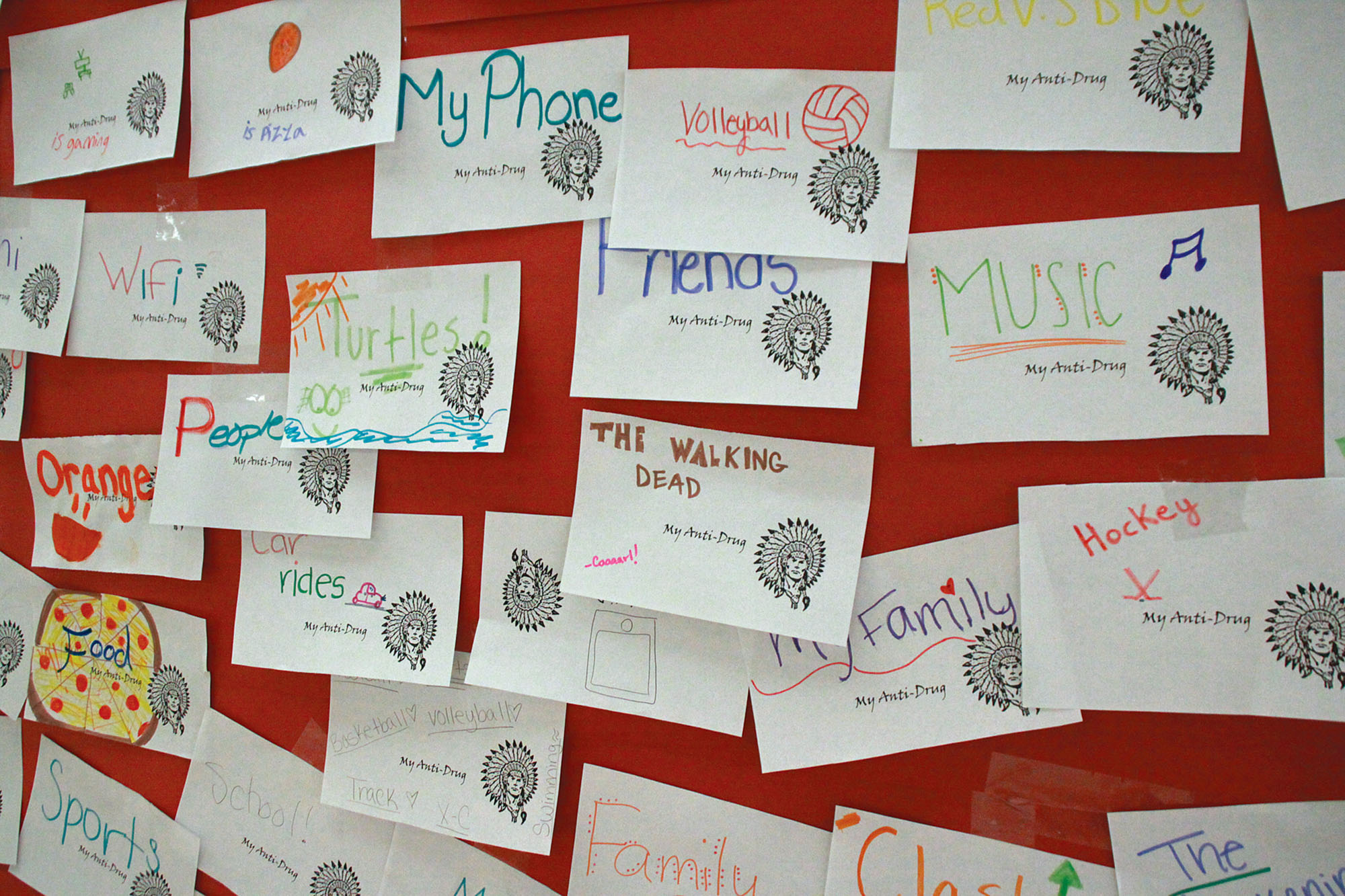
At Wasilla High School on Thursday, various spirit week signs and posters advertising the campaign lined stairwells and hallways, products of Tony Jensen’s leadership class. The class had labeled Tuesday of that week a “Red Out,” and covered one wall near the main entrance with red paper, leaving smaller white slips for students to write down their “anti-drug.” Contributions included sports, music and TV shows, but also “turtles,” “pizza” and “rehab.”
The class also worked with John Notestine’s digital media class on a public service announcement (not completed during Red Ribbon Week), and hosted a “mini dance,” Jensen said, during the school’s extended lunch break on Wednesday.
Though Jensen and his students perceived engagement on some level by most students throughout the week, several said they thought that, overall, the message was not received.
“I think it’s because kids don’t really care,” said junior Sarah Prosser.
Freshman Madison Ressler said timing may have also been an issue, with Halloween and school sports ending or starting up near the end of October, but age is also an important factor in drug education, she said.
“Some seniors, they’re adults, so they’re learning to do things on their own and they’re more exposed to everything,” Ressler said. “Red ribbons are not going to prevent them from doing something if they don’t want to (stop).”
Jensen agreed, saying the practice of wearing red ribbons for the week is best received among younger students, in part because high school students are “more worldly.”
“In the Valley, I think most people know high school students face choices about using drugs on a daily basis,” he said.
Freshman Claire Childs attested to that, saying she personally knows or has known students and adults who illegally use steroids, marijuana, heroin and pills on a regular basis. One was a neighbor, one a relative, others classmates.
Despite the education students receive in health class or at the nurse’s office — two large posters of youth with cutaways to their drug-altered insides hang on the wall there — Childs said most of her peers don’t really know what’s happening to their bodies when they take drugs.
“It’s killing brain cells. Your brain’s shutting off temporarily and sometimes it doesn’t come back on, and a lot of kids don’t get that,” she said. “They think it’s a social thing or it’s fun when really it’s just hurting yourself.”
Still, the leadership class was at a loss for how to better reach their peers with the anti-drug message. Several students confessed that they tended not to associate with heavy drug users, and therefore do not frequently have opportunities to personally and positively influence their classmates.
Putting a face on it
At Teeland Middle School later that afternoon, student leaders were also in charge of the Red Ribbon Week festivities, and attempted to reach their 750 peers at an assembly through a skit about the effects of tobacco on the body. National Junior Honor Society members played characters Breathe Easy, Emphy Sema and Cancer Klein on a quiz show modeled after BBC’s “The Weakest Link.” Each eighth-grader tailored her answers to what she knew of the character/disease she represented, and Breathe Easy, of course, was declared the winner.
However, entertainment was only a part of the group’s presentation, and what followed likely made more of an impact in regard to the anti-drug campaign.
Teeland assistant principal Brad Bell invited Stephanie Bowman to the floor, and at least one student gasped when she explained her presence.
“I am a recovering heroin addict,” she said.
Ready to be nine months clean on Nov. 10, Bowman said she has never lasted more than that long before relapse. Now she’s on round two of trying to stay off drugs since she started using in 2010, and nearing the wrap of her case with Office of Children’s Services, which began when her kids were taken away in 2013.
As fresh as the wounds are, Bowman was encouraged by her eighth-grade daughter, Dusti, who volunteered her to speak at the assembly.
“It’s a pretty big opportunity for me,” Stephanie Bowman said to the crowd.
She then launched into her story, briefly describing her times in and out of prison — once for stealing thousands of dollars of jewelry from her parents — her physical deterioration (she “looked like death,” though only her parents could see it, she said) and watching her friends succumb to their drug of choice.
“I’ve seen people die from this. I’ve watched people OD. I’ve seen people get shot during drug deals. I was homeless for a year. And I didn’t care. I just wanted to get high,” she said.
Heroin is the hardest drug to quit, Bowman said, and she recalled the detoxification process for her daughter’s peers — shakes, sweats, vomiting and loss of appetite. She was prescribed eight pills a day for three months to treat her for Hepatitis C, which she said she contracted “just from sharing needles with my ex.”
But times are different now. Bowman said she’s long since left the man her got her started on heroin, and is currently enrolled at Ashford University online, working on a degree for social work so she can help others “get their lives back on track.”
What authorities say
After the applause for Bowman cleared, Alaska State Trooper Jeffrey Viernes took the microphone to urge students to report any person who offers them drugs, and to remind them that, if they’re convicted of illegal drug use, they won’t be getting any federal grant money for college.
MY House founder Michelle Overstreet then spoke statistics, telling students that their odds of becoming addicted to any drug drops from 1 in 5 to three out of every 100 if they wait to experiment until they’re 21. While abstinence is best, it would be unrealistic to expect that of everyone at this point, she said.
“The drinking age is 21 for a reason. Your brain isn’t completely developed until you’re about 25, and the younger you are when you start putting alcohol and other drugs into your body, the faster your brain cells adapt to that being there,” Overstreet said.
And thus begins the downward spiral into addiction.
Overstreet challenged students to rise if they were willing to change the numbers, with one caveat.
“This isn’t just a deal where you stand up and holler, this is a deal where you make a difference,” she said. “I’m gonna see you again, and if you were here and you stood up, I’m gonna ask you: did you mean it?”
Contact reporter Caitlin Skvorc at 352-2266 or caitlin.skvorc@frontiersman.com.



By Jeremiah Bartz Frontiersman.com A football coach using a hockey reference as the centerpiece for his keynote address may

By Katie Stavick Frontiersman.com The next generation of leaders took flight this week as the Houston High School Class

By Kyle Wilkinson For the Frontiersman Keynote speaker and Carry the Cure President Bill Pagaran’s words boomed through the

By Jeremiah Bartz Frontiersman.com The community of Palmer is known for a couple of things. At or near the