Retiring teacher, coach urges Colony grads to ‘find their 68’
By Jeremiah Bartz Frontiersman.com A football coach using a hockey reference as the centerpiece for his keynote address may


MAT-SU — For a handful of Last Frontier hunters, Monday could bring a new opportunity along with their New Year.
With the opening of the third annual Mat-Su targeted winter moose hunt, the state Division of Wildlife Conservation and Department of Fish and Game expect to issue a record number of permits to take moose in targeted areas.
“The program was originally started to address nuisance moose issues,” said Todd Rinaldi, an area wildlife biologist for Fish and Game based out of the department’s Palmer office. “A nuisance moose is a moose that presents safety concerns with humans. We may have moose that get into gardens, and we encourage people to put up fences. But the farmers are a different story.”
Along with problem moose getting into winter hay and feed storage for farmers, animals foraging for food along roadways create hundreds of dangerous moose-vehicle collisions a year, Rinaldi said.
Since its inception in the winter of 2010-11, the targeted hunt “has since evolved into involving hunters to participate by removing moose in these high-population areas,” he said. “By their presence and their aggregations along the road system, they are providing safety risks to humans.”
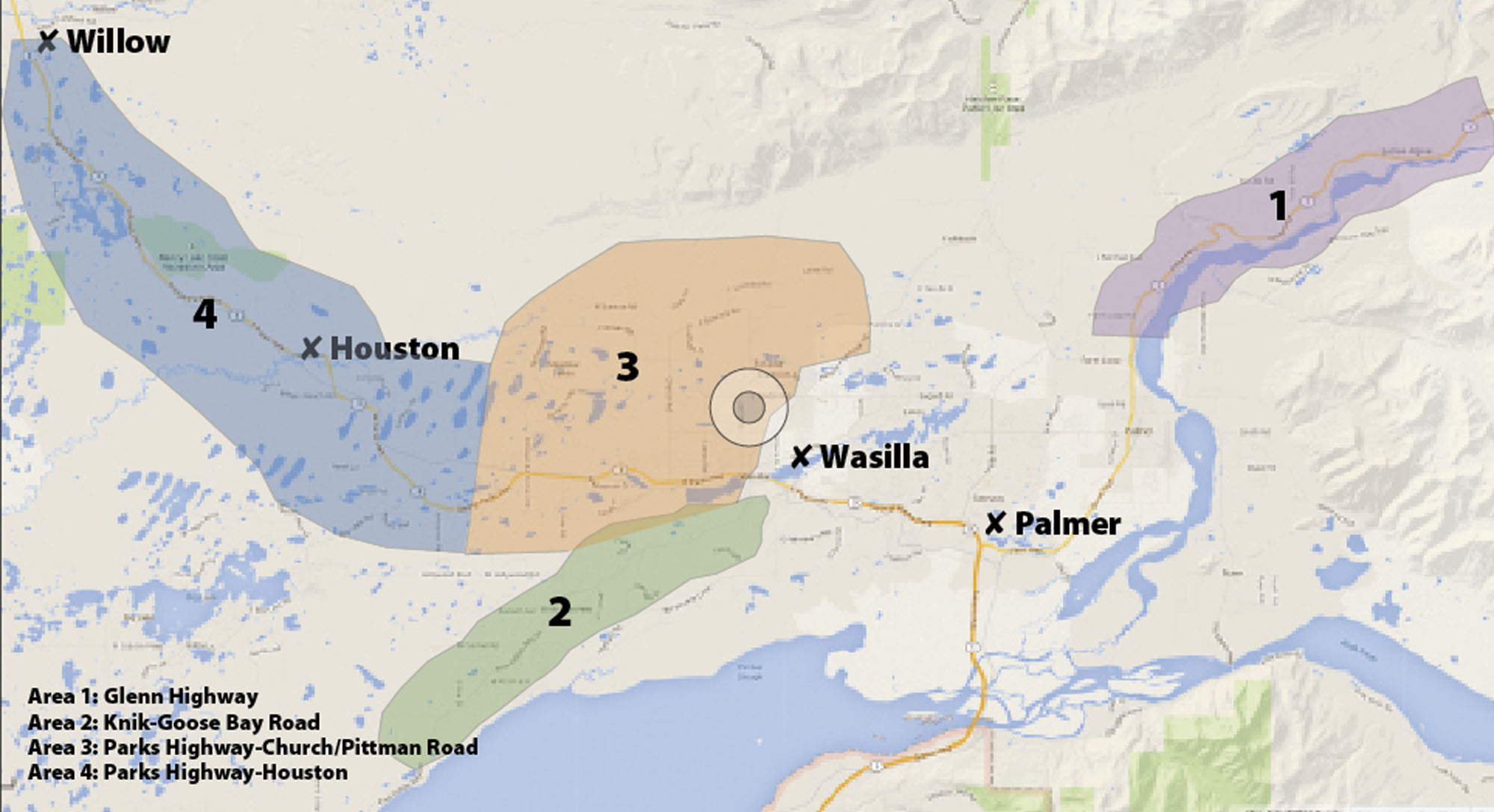
Starting Monday, the department will begin selecting eight hunters at a time to hunt in the targeted areas in Units 14A and 14B. Overall, Fish and Game could issue up to 200 permits for areas in 14A between now and March, and up to 100 permits in 14B, Rinaldi said. Unit 14A will see hunts happen in four high-traffic areas around Sutton, Big Lake, Palmer and Wasilla. Unit 14B will host hunts in the Parks Highway corridor just north of Willow to the Talkeetna River.
Because the program is still young, it hasn’t generated enough data yet to determine just how much of an impact it’s having in reducing the number of vehicle-moose collisions along Valley roadways, Rinaldi said. But common sense and the basic premise of the hunts is sound, he said.
“We’ve taken this common-sense approach and the assumption is we’re going to reduce the potential and the likelihood of vehicle-moose collisions,” he said. “The assumption is it makes sense, and it’s common sense that this would work.”
There also isn’t a concern that taking more moose would be detrimental to Valley herds, Rinaldi said. In many ways, the growth of the Mat-Su’s human population has been mirrored by the moose.
“People forget we have a very healthy and growing population of moose in the Valley,” he said. “I wouldn’t say it’s overpopulated, but it’s above the number set by the state. When a (human) population is growing like our population is growing, we have a very high number of cows in our population. … So, we are going to have to remove some cows from this population.”
Although there are a number of ways humans can come into contact with moose in the wintertime, vehicle-animal collisions are by far the most dangerous, Rinaldi said.
On average, the Valley sees about 280 vehicle-moose collisions each winter.
In recent years, however, those numbers have fluctuated wildly. In 2008-2009, 345 moose were killed by vehicles. In 2009-2010, that number dipped to 247, then to 227 in 2010-2011. In the winter of 2011-12, Alaska and the Valley saw record amounts of snowfall, which forced a large number of moose to forage for food along roadways and 445 were killed. So far this winter, Rinaldi said that as of Friday, 128 have been killed in the Valley.
“Unit 14A is somewhat of an anomaly,” he said. “With the (human and moose population) growth rate, one of the contributing factors could be the development that’s going on, and that development is creating good habitat for the moose. You’ve got fields growing back in and you have some fallow fields not being farmed anymore, and the same with selective harvest of wood, the railroad swath from Point MacKenzie — that’s clearing land and creating swaths of land for them to range. Then you have the Miller’s Reach Fire, which has provided habitat for moose for years.”
The popularity of the targeted hunt program is evident this winter, Rinaldi said. While the department had 198 applicants last winter, this year more than 1,100 people applied for the hunts. The success rate for those hunters has also been high, he said. In the first year, 50 permits were issued and 44 moose (88 percent) were taken. Last winter, 198 permits were issued at 148 moose were harvested (75 percent).
“We anticipate the success rate to be similar this year,” Rinaldi said.
Although it’s too late to apply for this winter’s hunt (enrollment was in October), anyone wanting to learn more about the Mat-Su targeted moose hunts can be seek out a 2013-14 Alaska Hunting Regulation booklet or head to the department’s website at hunt.alaska.gov.
Contact Greg Johnson at 352-2269 or greg.johnson@frontiersman.com.

By Jeremiah Bartz Frontiersman.com A football coach using a hockey reference as the centerpiece for his keynote address may

Frontiersman.com With its headquarters in Wasilla, the Frontiersman has been a primary source of news for the Matanuska-Susitna

By Katie Stavick Frontiersman.com The next generation of leaders took flight this week as the Houston High School Class

By Kyle Wilkinson For the Frontiersman Keynote speaker and Carry the Cure President Bill Pagaran’s words boomed through the