Retiring teacher, coach urges Colony grads to ‘find their 68’
By Jeremiah Bartz Frontiersman.com A football coach using a hockey reference as the centerpiece for his keynote address may


WASILLA — With oil prices slumping, Alaska Department of Revenue officials are looking for a few billion dollars.
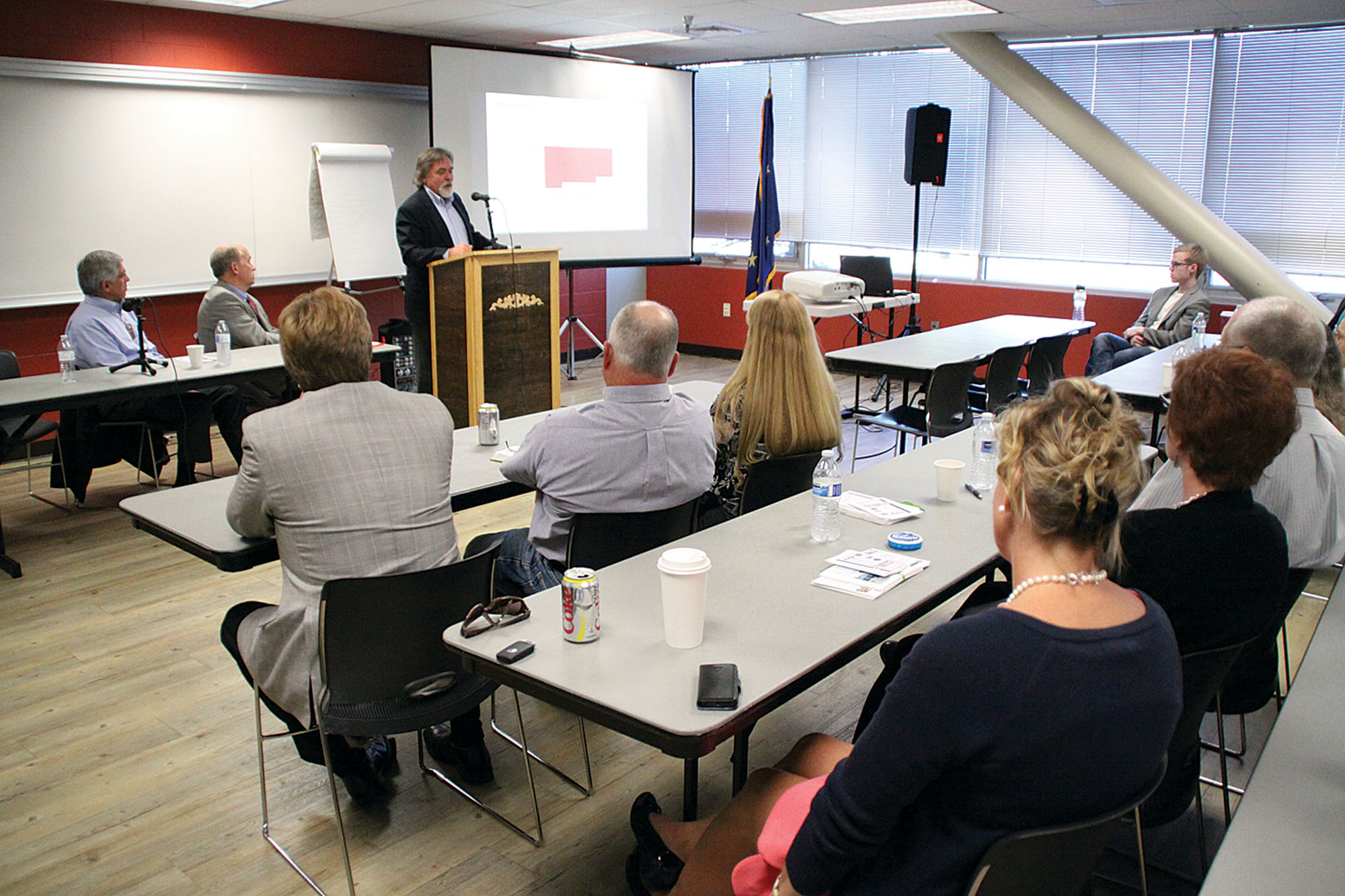
A 60 percent drop in the market price of oil between June 2014 and January 2015 means the Alaska needs about $4.9 billion in unrestricted general funds in order to balance the state budget next year. But projections anticipate only $2.2 billion revenue, leaving a $2.7 billion gap, according to revenue figures. Friday’s forum at the Curtis D. Menard Memorial Sports Center was a small-scale version of a multi-day forum at the University of Alaska Fairbanks earlier in the year also called to engage Alaskans in helping craft a plan to balance the budget.
Alaska Department of Revenue Commissioner Randall Hoffbeck Alaska is burning through its savings at a rate of $7 million per day.
“From the time this meeting starts until time that it ends we’ll be another $750,000 in debt,” he said of the two-hour meeting. “That’s the significance of the gap.”
At that rate, the state’s savings reserves will be exhausted by 2018.
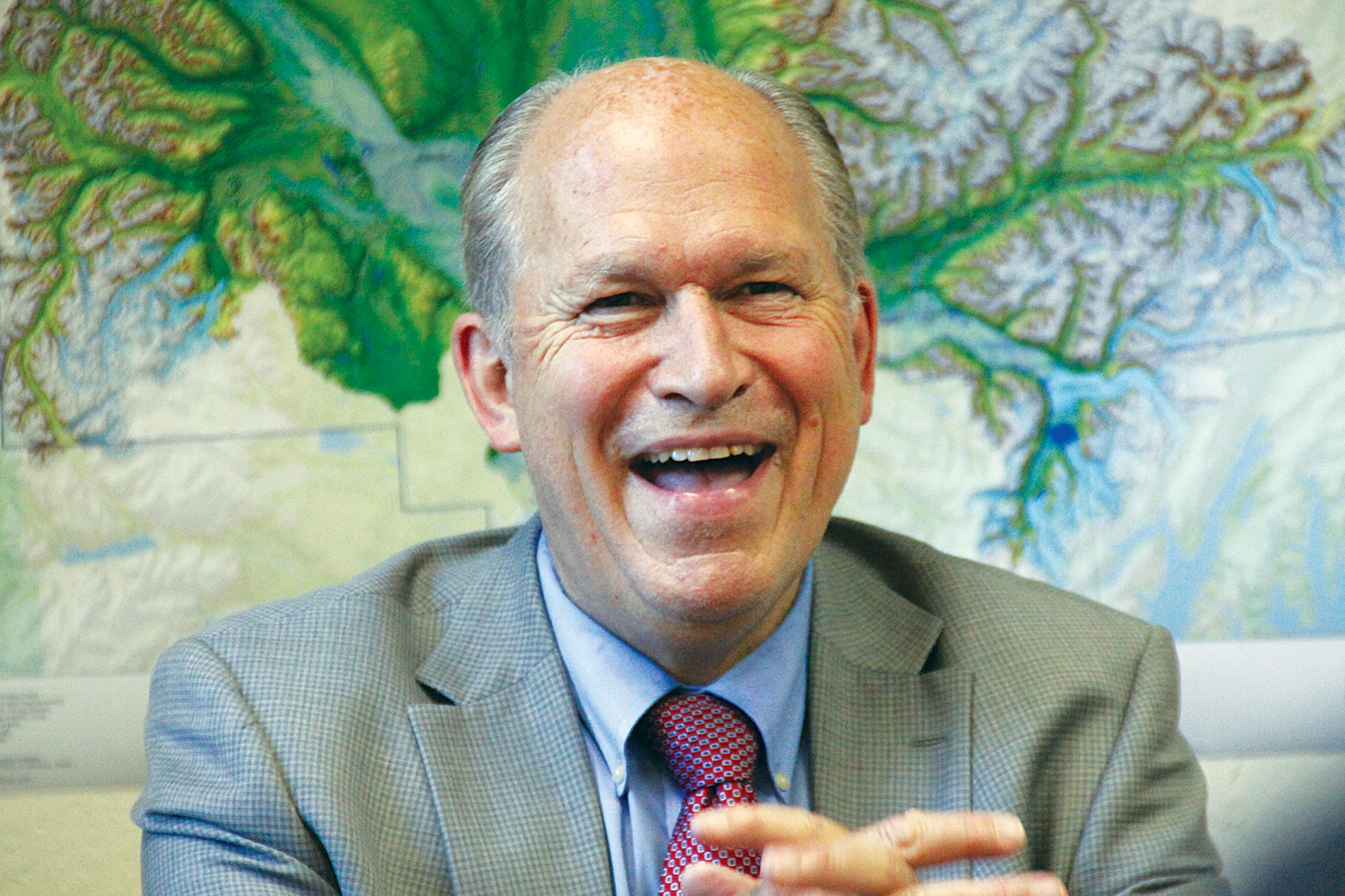
Layoffs of state employees will likely get Alaska taxpayers some of the way — though not all the way — to a balanced budget, Alaska Gov. Bill Walker said.
“If we laid off every state employee, it would not balance the budget,” he said.
The government has already cut the budget by $1 billion, Hoffbeck said. They’ve kept essential services and trimmed non-essential programs, he said. Deeper cuts will eliminate programs, Hoffbeck said.
“All that we were able to leave in the budget was life, health and safety,” he told a crowd of about 100 Valley residents at the forum. “We’ve kept the prisons running, we kept the troopers on the streets, we’ve included about half the necessary health care plan.”
State government spends about 10 times more in nominal dollars than it did in 1975, revenue figures show. Those figures appear to spike dramatically in about 2013 when presented on a line graph.
However, adding inflation and population to the picture shows a more gradual increase stretching back to roughly 1999. The state spends roughly $21,000 in inflation-adjusted dollars per capita in the 2016 budget versus about $12,000 per capita in 1975. Both figures are well short of the $31,000 per capita peak recorded in 1982. The 2016 budget also marks a downward tilt to steeper increases recorded between roughly 2010 and 2013. Present-day agency spending falls well shy of the $8,000 per capita peak recorded in 1983, coming in at about $6,000 per capita, state figures show.
“Agency spending now is substantially lower than it was in the go-go days right after the pipeline,” Hoffbeck said.
Oil revenue likely won’t recover to the $100-per-barrel levels that allowed that 2014 spike in the first place, Hoffbeck said. Instead, most projections put the likely stable per-barrel price between $50 and $80 per barrel, he said. That’s not high enough to avoid a combination of tax increases and cuts to programs, officials said. Hoffbeck said it would take $109 barrel oil to balance the budget on oil alone.
“We’re going to live in this world for quite a while,” Walker said, referring to tight revenues.
Eliminating cuts or oil revenues from the equation means officials must tap other forms of revenue. For example, state figures show capping the Permanent Fund Dividend at $1,000 could generate $2 billion in additional revenue.
Increasing Alaska’s tax rate to the national average annual of $2,200 per person would generate $1 billion in revenue. That could include measures as diverse as a health care provider tax, a business license tax, an income tax (officials are considering a tax structured around 15 percent of the federal tax burden), a state payroll tax, a sales tax, a fuel tax, or a statewide property tax, Hoffbeck said. Officials have considered almost 30 different forms of tax, and presented seven different possible tax avenues at the forum.
Hoffbeck’s presentation drew some criticism from Valley conservatives who attended the meeting. Opponents floated an oft-repeated criticism that federal Medicaid expansion would prove a bait-and-switch, and Alaska taxpayers would be forced to pick up the tab long-term.
“Let’s add some more stupid stuff, then we’ll have a real problem,” said Palmer resident Mike Coons. “This is BS, I’m totally against it.”
Walker said there is massive public support — 170 organizations have issued statements in support of the expansion — for the expansion. He also pointed out that the state had obtained a memo from the Secretary of Health and Human Services saying they would be allowed to withdraw from the expansion in the future. He’s applied for four waivers, that if approved, could also send more federal dollars to Alaska to aid with Medicaid expansion, Walker said.
“I haven’t seen anything with this much support, except maybe statehood,” he said.
The Wasilla forum, like the Fairbanks forum is designed as a form of public outreach on an issue difficult for a lot of people to grasp. The administration has also prepared an interactive worksheet allowing taxpayers to change various parts of the state budget and see how their changes impact the budget, available online at 1.usa.gov/1HI6tIy.
The idea behind making a game out of the task of balancing the budget is to make the issue as accessible as possible to as many people as possible, Walker said.
“I don’t know we’ll see a lot of people saying ‘Gather round the table, kids, it’s time for sustainable budget,’” he joked.
Contact Brian O’Connor at 352-2269, brian.oconnor@frontiersman.com, or on Twitter @reporterbriano.

By Jeremiah Bartz Frontiersman.com A football coach using a hockey reference as the centerpiece for his keynote address may

Frontiersman.com With its headquarters in Wasilla, the Frontiersman has been a primary source of news for the Matanuska-Susitna

By Katie Stavick Frontiersman.com The next generation of leaders took flight this week as the Houston High School Class

By Kyle Wilkinson For the Frontiersman Keynote speaker and Carry the Cure President Bill Pagaran’s words boomed through the