Retiring teacher, coach urges Colony grads to ‘find their 68’
By Jeremiah Bartz Frontiersman.com A football coach using a hockey reference as the centerpiece for his keynote address may


The Alaska Institute for Justice’s (AIJ) mission is to promote and protect the human rights of all Alaskans, including immigrants, refugees, crime victims including survivors of domestic violence and sexual assault, and Alaska Native communities by providing critical services to these underserved populations through legal representation, language access, training and educational programs and advocating for climate justice.
This series of six articles, Human Rights: Legal, Social, and Climate Justice, explores the origins of AIJ 16 years ago, the various programs it offers, and its impact on our state in its unwavering devotion to preserving and defending the rights of all Alaskans.
Nestled on the east side of Alaska’s largest city of Anchorage is the most diverse neighborhood in America: Mountain View.
With over 100 different languages spoken by families in the Anchorage School District, census data show that 16.3 percent of Anchorage residents speak a language other than English at home.
Alaska is home to at least 20 distinct indigenous languages. In Bethel, Alaska, 63 percent of the community speaks a language other than English at home.
In September 2007 the Language Interpreter Center (LIC) was formed as a collaborative, public-private organization dedicated to creating a pool of trained language interpreters for entities statewide to increase access to legal, social, educational, and medical services to Alaskans with limited English proficiency.
Barb Jacobs, who helped create the LIC says “This was a win-win for the state in not only meeting language access needs but creating a workforce development opportunity for community members.”
In 2004, the Alaska Court System received funding from the State Justice Institute to assess the language access needs within Alaska.
Twenty-two Alaska organizations agreed to collaborate in the initiative, including state and local government, medical, social services, education, legal, private foundations, and Alaska Native groups. These diverse stakeholder agencies partnered with the Alaska Institute for Justice to create the Language Interpreter Center.
The LIC provides trained interpreters to government, business and non-profit organizations serving limited English proficient (LEP) Alaskans. The LIC trains Alaskan interpreters and provides an online platform with scheduled and on-demand telephonic, video remote, and in-person language access services.
The LIC also offers training for agencies on how to work with interpreters and language access planning to make their services more accessible to LEP Alaskans.
The LIC provides training statewide including working with Alaska Native interpreters from the communities of Bethel, Dillingham, Utqiaġvik and Kotzebue. The LIC has done several trainings with the assistance of Professors Oscar and Sophie Alexie from Bethel, developing critical Yup’ik terminology for interpreting in the legal setting.
Before the availability of LIC services, those with limited English proficiency would often only have the choice to rely on friends or family members to translate or interpret for them in settings such as court or medical that can be intimidating with high stakes.
Using untrained interpreters including family and friends can have devastating consequences, including misinformation that could lead to taking the wrong dosage of a medication or not understanding your legal options in a court case.
Barb Jacobs, with over 23 years as an educator in Alaska, was selected as the first director of the LIC and was instrumental in creating what is now a thriving statewide language interpreter center with over 300 Alaskan interpreters to serve LEP speakers statewide in over 40 different languages.
“The mission is what drew me,” Jacobs recalls of her 13-year tenure at the LIC. “I was really impressed by the organization’s commitment to making services accessible”
Jacobs worked closely with community stakeholders developing training and interpreter models that would work for Alaska’s unique language access needs. There’s an art to interpreting, she learned, but also a science. The LIC researched and developed training workshops needed to become a professional interpreter within Alaska.
“Professional interpreters must follow a national code of ethics including accuracy, confidentiality, and impartiality. The ethics that go into interpreting are very important, as is accuracy. An interpreter interprets everything being said, they don’t add or omit things.”
Confidentiality is also key, especially in small immigrant communities where interpreters may be working with victims of sexual assault or domestic violence, as is impartiality; you can’t have a relative or a friend interpret for you, she says. “In all cases, you need to be a very good note-taker, recording dates, names, directions, medical procedures, and you have to get it right.”
Mai La Vang, who took over as the LIC director after Jacobs retired in 2020, says what drives people to take an interpreter certification course “is being the bridge to provide language access to community members,” and it’s an arduous process.
“To become a trained interpreter, individuals go through assessments for a high level of language proficiency in both English and other language, background checks, and attending a training course of 40 hours,” Vang explains, in addition to passing a background check and a lengthy exam at the end of the course.
The LIC also conducts assessments for businesses and service organizations to determine their language access needs and helps them come up with a plan toward complying with LEP services that is tailored to their needs.
Vang says that over the years the number of agencies the LIC partners with has grown immensely, “including non-profits, government and private businesses and organizations and [LIC has] over 600 clients statewide.”
In the first half of 2021 alone, AIJ’s deputy director Kari Robinson reports that “the Alaska Institute for Justice provided 439 hours of interpreter services in frequently requested languages of Arabic, French, Hmong, Korean, Lao, Nepali, Nuer, Russian, Somali, Spanish, Tagalog and Thai for limited English proficient [domestic violence and/or sexual assault] survivors to access critical services.”
That’s in addition to 405 hours of interpretation to victims of human trafficking in the same six-month period.
And the LIC continues its outreach to underserved communities across the state. “We are still working to get more agencies in Alaska providing meaningful access to LEP Alaskans through outreach, training and language access planning work,” Vang says.
This past year has brought its own difficulties, she admits. “As a small non-profit we have had to come up with creative ways to stay connected with our Alaskan interpreters during COVID, ensure their safety with new interpretation protocols and train new interpreters remotely.” This resulted in the creation of an online interpreter access program available 24/7, Vang says.
The LIC also stepped up in March 2020 to make sure those Alaskans with limited English proficiency had access to the latest health information on the COVID pandemic.
“We translated vital COVID safety and resource documents including business and facilities notices, health mandates, COVID Relief Assistance, symptoms and safety measures, testing sites and clinics, vaccine information, surveys, and transportation services,” Vang says. “We worked closely with the Municipality of Anchorage in providing vital weekly COVID health and safety resources in audio recordings available to the entire community in 10 different languages.”
Between the online national resources and Alaska-trained interpreters, the LIC provides interpretation services in more than 100 languages, including Yup’ik.
Jacobs looks back on her time with the LIC fondly and harbors deep respect for Vang and others who continue the work she began in 2007.
“I feel so good about LIC’s work. We have made a big change in our community as to what a professional interpreter can do, and why it is so important to have an interpreter,” Jacobs says. “People have a new understanding of what an interpreter does.”
For more information on the Alaska Institute for Justice’s programs or how you can help support their efforts, visit akijp.org
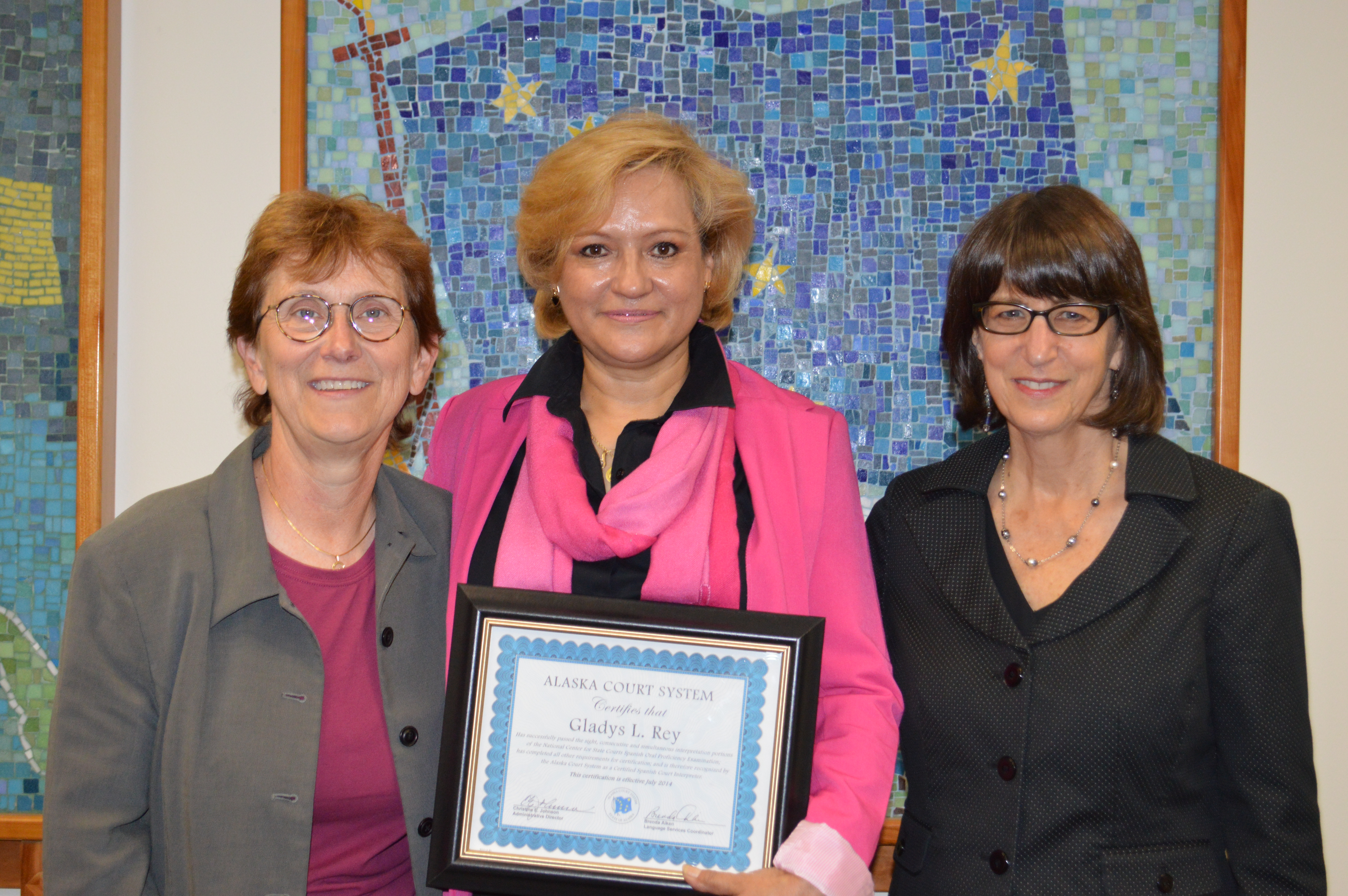
LIC court-certified Spanish interpreter Liliana Rey and Barb Jacobs, director of AIJ’s Language interpreter Center from 2007-2020.

By Christian Hartley Now You Know If you have ever wondered what the borough attorney actually does, you are not

By Katie Stavick Frontiersman.com In a direct response to public outrage over a horrific animal neglect case, the Matanuska-
By Frank Murkowski Opinion Is the threat to Alaska real? I believe it is. The continuing conflict involving Iran is

Farmers markets set to open June marks the beginning of freshly grown Alaska produce showing up around the Mat-Su