Retiring teacher, coach urges Colony grads to ‘find their 68’
By Jeremiah Bartz Frontiersman.com A football coach using a hockey reference as the centerpiece for his keynote address may


PALMER — One advantage in a state with Alaska’s relative youth is that a few of the folks selected to participate in the State Constitutional Convention are still alive to shed light on the process.
Still with us are John B. “Jack” Coghill, Seaborn J. Buckalew Jr. and Victor Fischer, who were in their 30s when elected among the 55 delegates to Alaska’s Constitutional Convention in the winter of 1955-56.
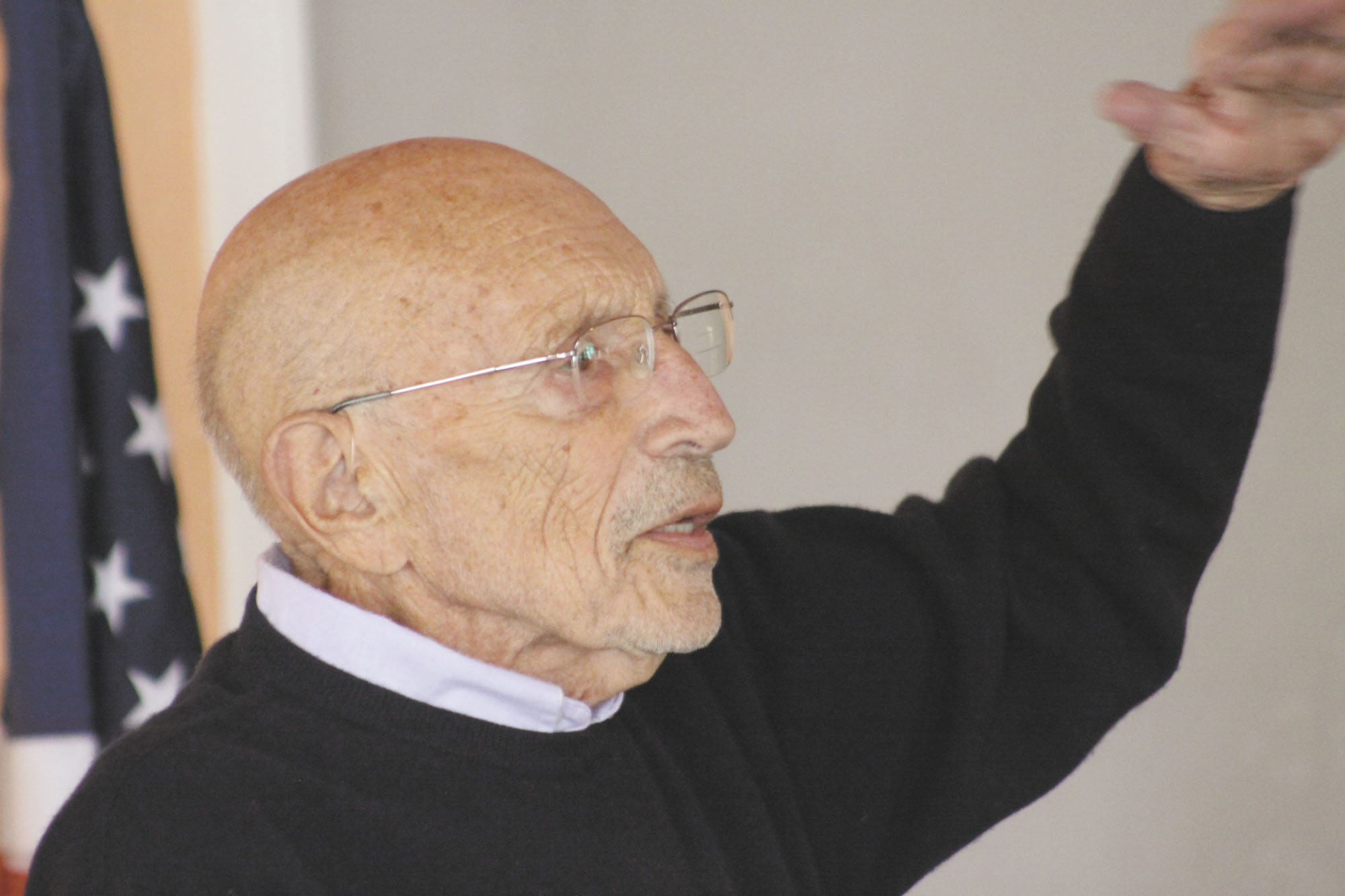
Fischer was the guest speaker at the Palmer Rotary Club luncheon, which meets at noon, Thursdays at the Eagle Hotel in Palmer. After the luncheon he was headed to Fireside Books to sign copies of his 2012 autobiography, “To Russia With Love.”
Fischer was born in Berlin, Germany, in 1924 to American journalist Louis Fischer and the Russian writer Markoosha Fischer, who left Czarist Russia for the United States during World War I.
He said his parents were very sympathetic to the 1917 revolution and traveled there to help rebuild a new world where everyone was equal.
“They went there with love and hope and, of course, then came Stalin with tremendous terror,” Fischer said.
Eleanor Roosevelt personally engineered the Fischer family’s escape from Russia, according to Fischer’s autobiography. Eventually, Fischer enlisted in the U.S. Army in World War II. He had earned a bachelor’s degree from the University of Wisconsin in 1948 and a master’s from the Massachusetts Institute of Technology in 1950.
After coming to Alaska in 1950, Fischer worked as the Anchorage planning director, served in the territorial House of Representatives 1957-59; in the Alaska State Senate 1981-87; as a faculty of the University of Alaska Fairbanks and of the University of Alaska Anchorage; and as director of the Institute for Social and Economic Research for 10 years.
In 1955, Fischer decided to resign his position with the city of Anchorage and file to run as one of 55 delegates to the Alaska Constitutional Convention in 1955. The decision was an extension of his work with other veterans in the territory forming a group called Operation Statehood to help forge the fight for Alaska’s entrance to the union.
“The Constitutional Convention was the most important thing I’ve done in my life,” he said Thursday.
Fischer was a delegate to the State Constitutional Convention, but he told the Palmer crowd it was the Valley’s own Katie Alexander Hurley who really ran the show.
“She was not just the chief clerk,” Fischer said. “The people who made things happen were Katie and her staff.”
He said the final document would have been less robust without Hurley’s influence.
“Without the heavy lifting Katie did the constitution wouldn’t be as good as it has been,” Fischer said.
He said the atmosphere at the convention was one of unity, of Alaskans coming together to do the best possible job for future generations of Alaskans.
“Alaskans were united. Alaskans worked together. There wasn’t the divisiveness we have today,” Fischer said.
As Hurley has said in past interviews, Fischer was quick to praise the leadership of convention chairman Bill Egan. He said the constitution is truly the creation of a collective group and the hallmark of Egan’s style of leadership.
“Bill Egan made sure every single person had a chance to participate,” Fischer said.
He said the same sort of behind-the-scenes vote trading that happens year-to-year during the legislative session is going on now, except some of the bills in play propose constitutional amendments, such as one that would permit spending tax dollars on private schools.
“My concern right now is they are talking about constitutional amendments,” Fischer said. “They are talking about constitutional amendments just like it is any other bill.”
He said legislators’ actions are particularly disturbing in light of a 2012 ballot question that asked Alaskans whether to convene a constitutional convention. The question failed badly at the ballot box, Fischer said.
That vote doesn’t seem to inform Alaska’s current crop of legislators or the bills they’ve introduced to amend the constitution, he said.
“Senate Joint Resolution 9 pretends it’s not going to cost anything,” Fischer said. “But it would cost the state about $100 million a year.”
Contact Heather A. Resz at 352-2268 or heather.resz@frontiersman.com.


By Jeremiah Bartz Frontiersman.com A football coach using a hockey reference as the centerpiece for his keynote address may

Frontiersman.com With its headquarters in Wasilla, the Frontiersman has been a primary source of news for the Matanuska-Susitna

By Katie Stavick Frontiersman.com The next generation of leaders took flight this week as the Houston High School Class

By Kyle Wilkinson For the Frontiersman Keynote speaker and Carry the Cure President Bill Pagaran’s words boomed through the