Retiring teacher, coach urges Colony grads to ‘find their 68’
By Jeremiah Bartz Frontiersman.com A football coach using a hockey reference as the centerpiece for his keynote address may


PALMER — “Every aspect of us is related to the things we don’t need anymore,” says Mollie Boyer, the Executive Director of Valley Community Recycling Solutions.
Landfills are some of the largest man-made structures on earth. They belch out toxic methane into the atmosphere and potentially leak toxic leachate into groundwater.
Most waste can be saved from landfill and given another life in as another product.
This perspective led Boyer, one of the founders of VCRS, to start a Mat-Su recycling group from scratch, nearly 20 years ago.
The group has a memorable history. They held their ‘first one-stop recycling event’ in April 1998 standing at the Walmart parking lot in Wasilla. More one-stop events were held in parking lots and waste transfer sites across the Valley.
Slowly the group added more regular recycling events and year-by-year, the tonnage of material the VCRS processed increased.
In 2010, they built their own facility right next to the Mat-Su Central Landfill.
The building is enormous. Two huge warehouse spaces are filled with cardboard, paper and plastics and giant baling machines process material. The building is LEED gold certified, meaning that it has been independently verified by a Washington based non-profit to be environmentally friendly.
The building has in-floor heating, solar panels and cellulose based insulation used for upper-level interior and exterior walls.
Boyer explained that theirs is the “first commercial industrial building, designed, constructed and certified at the gold level here in Alaska. And the third recycling center in the nation at the gold level.”
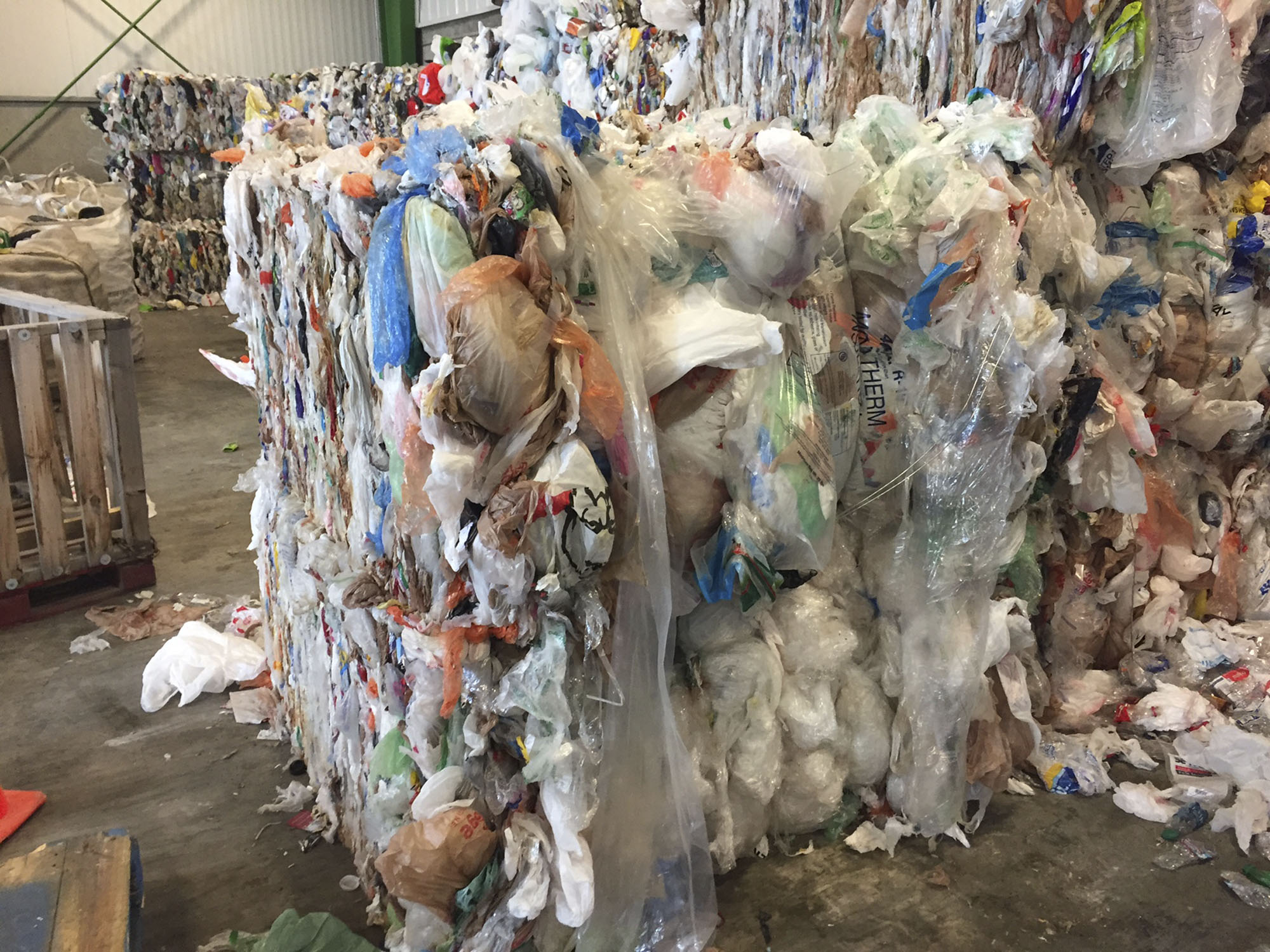
The center has also been able to increase its processing capabilities as its operations have expanded. From a small vertical baler that’s now only used to bale clothes they then expanded to a larger baler that’s now only used to bundle stretchy plastics.
Now, the pride and joy of VCRS is the enormous 2-stroke horizontal auto-tie baler. A massive machine that has an in-floor conveyer belt, taking material up to an enormous unit that compacts it into huge blocks that weigh upward of a thousand pounds.
“Now we can handle five times the material with the same staff,” said Boyer.
Last year the center was able to process 1962 tons.
Businesses around the Valley such as Town and Country and All Seasons Clothing already drop off waste.
The expansion though is just getting started, Boyer is going to go business to business to get more companies involved and VCRS is hoping to secure a district-wide agreement with the Mat-Su Borough school district.
Boyer explained, “Schools are the largest generators of waste in any community.”
Schools also have a role to play in the educational aspect of the VCRS.
Field trips cost $25 and Boyer reiterates, as a non-profit, one of the focuses of the VCRS is to educate. Anyone can come into the purpose built classroom that gives visitors a birds-eye view of the warehouse in action.
For VCRS one of their goals is changing perceptions on recycling, waste and resources generally.
People think plastics take thousands of years to biodegrade, but the truth is plastics never biodegrade, they only break down into smaller and smaller pieces.
Another misconception is that the cost of recycling an aluminum can is more expensive than creating a can from scratch. Recycling is in fact much cheaper than mining new material. The difference is in the region “of a nickel to a dollar,” said Boyer.
And the biggest misconception about taking your waste to a recycling center?
“One of the rumors people love to throw out there is that we just throw it away. It’s not practical to throw it away,” said Boyer.
Recycled waste is a worldwide commodity.
At first, it seems like a bizarre idea. Who would want used aluminum cans? Who would want tons of old paper bundled and baled? Who could possibly find a use for hundreds of tons of stretchy plastic?
It turns out, a lot of businesses across the world.
Aluminum can be recycled endlessly, paper can have hundreds of new potential lives and you could end up this 4th of July having a BBQ on some reconstituted plastic bags.
For paper and cardboard, VCRS works with a Wasilla based company called Thermo-Kool that takes the material and turns it into cellulose based insulation.
Dick Divelbiss, the owner of Thermo-Kool says the company processes between “4000 and 5000 tons” of paper and cardboard a year from all over Alaska.
He said his insulation is warmer than fiberglass insulation as it’s able to fill air pockets that a fiberglass bat couldn’t.
The insulation is even sprayed with boric acid to make it fire retardant.
Therma-Kool also takes cardboard during construction season to create astro-mulch, a mixture of cardboard and grass seed that is then sprayed onto the side of highways.
The company employs eight people locally and distributes their products wholesale across Alaska.
For stretchy plastics, such as plastic bags, VCRS has started exporting to a company in Nevada called Trex to create an environmentally friendly extruded lumber.
Boyer explained, “That category is hard to find a manufacturer who actually wants it” but because of VCRS’ rigorous standards they’ve met Trex’ criteria for their last two loads.
The process of selling the material is a business in itself.
VCRS tries to sell directly to manufacturer but on a lot of occasions they need to deal with a middleman, or middlemen.
Boyer described that recycling is a “huge broker business,” there could be “three buyers in between” VCRS receiving the material and a manufacturer turning it into a finished product.
The important thing for VCRS though is to make sure there is an end user for the waste they accept.
The chief concern is to make sure the material is clean and free from contaminants.
“If you don’t have good stuff, people don’t want it. Or, you’re the last in the queue when they’re absolutely desperate,” said Boyer.
As they expand VCRS is on the lookout for more ways to be sustainable, they are currently engaged in a research project to turn plastics into oil.
They have acquired a small demonstration machine that takes cut-up plastics, superheats them and turns them to gas. The gas then runs through cold water, turning back into liquid oil.
“Basically, you can use it as a diesel, without refining it,” said Boyer.
In the future, a larger Connex-sized ‘plastics to oil machine’ could be used to take waste and turn it into valuable fuel.
“Distributors claim these Connexes can operate off a generator and use 35% of what you generate to run the generator. So you would gain 65% fuel that you could use in a loader or a home. If it’s a rural community, maybe it could go in your stove oil,” said Boyer.
Exciting implications for villages that have long struggled with the high cost of diesel.
For people who don’t recycle, the hassle of sorting through your trash and separating plastics from cardboards is a big deterrent. It’s easy to imagine that you’ll spend hour after confusing hour trying to work out what the ‘#1’ symbol on the bottom of the bottle means.
That image couldn’t be further from the truth.
After a quick visit to the center’s website to learn what you can and can’t recycle, you’ll quickly remember that paper goes in one tub, plastic bags into another, aluminum cans into a third.
And once you do start recycling, the economic and environmental advantages become obvious.
Firstly, on the environmental side, every pound sent to the recycling center is a pound saved from the landfill.
Secondly, and most importantly for people on a budget, recycling with VCRS is free.
You can take as much sorted trash to the center, pull up to the drive-thru area drop off the waste and drive off.
But again, it does need to be clean and there is a suggested donation of $2.
You can then visit the reuse store to buy cheap egg cartons, pallets and packing peanuts.
If you live far away from Palmer, transfer sites now offer recycling options across the Valley in Big Lake, Sutton, Talkeetna and Willow - all operate intermittently.
Denali National Park and its concessionaire Aramark have even been using VCRS’ services for the last two summers.
For people who really want to avoid the hassle of driving to the recycling center there are companies that will take your waste from your curb, sort it and bring it to the center.
Raven Refuse and Recycling operates all across the Valley and does both residential and commercial work.
And Ready Recycles does both commercial and residential work closer to Palmer and Wasilla.
Kendra Johnson and her husband Hudson operate Ready Recycles. They have roughly 300 residential customers and on the commercial side, they service 8 – 10 schools and the Borough’s government offices.
Johnson said the majority of their customer base is from people moving into the area from Anchorage or the lower 48 asking what recycling services are available.
She is still passionate in the belief that recycling “has a huge potential to explode” in the Mat-Su. It will just take a business or a public campaign to spark the interest in the community, she said.
For Mollie Boyer that change will take just a little understanding that when we get rid of waste it doesn’t disappear, it simply becomes someone else’s problem.
“People keep throwing trash away, but where’s away? There is no away!”

By Jeremiah Bartz Frontiersman.com A football coach using a hockey reference as the centerpiece for his keynote address may

Frontiersman.com With its headquarters in Wasilla, the Frontiersman has been a primary source of news for the Matanuska-Susitna

By Katie Stavick Frontiersman.com The next generation of leaders took flight this week as the Houston High School Class

By Kyle Wilkinson For the Frontiersman Keynote speaker and Carry the Cure President Bill Pagaran’s words boomed through the