Retiring teacher, coach urges Colony grads to ‘find their 68’
By Jeremiah Bartz Frontiersman.com A football coach using a hockey reference as the centerpiece for his keynote address may


WASILLA —Roger Pike’s epiphany ended a few minutes before a Russian man approached him holding up a painting of St. Basil’s Cathedral.
“He walked right up to me and went like this,” Pike said, holding an imaginary painting in front of him with two hands. “You know, trying to sell it. And I thought ‘What in the world’s going on here?’”
At that moment, Pike was especially susceptible to a sales pitch for a painting. He worked with Russian businessmen moving various products back and forth between the U.S. and Russia, and once sold 15 containers of pork shoulder to the Vladivostok military base housing Russia’s nuclear submarines. For 25 years before that, Pike sold ivory and Alaska Native-manufactured arts and crafts to a network of 160 gift shops. He flew around to a lot of rural villages buying up items for resale. Whenever he landed in a village, the first thing he would see in almost every instance was the distinctive onion-shaped dome of an Orthodox church.
“It’s the focal point of life,” he said. “It’s the baptism, the marriage and the death. It all happens in that little church in the community.”
Years later, working with the Russians in the post-Communist 1990s, he was sitting and watching artists paint St. Basil’s in Red Square.
“I had just a day to myself, and I was sitting in Red Square,” he recalled. “The Kremlin was here (on the right), St. Basil’s was here (on the left), and I thought to myself ‘How in the world did an old farm kid from Minnesota end up here?’”
St. Basil’s — an iconic former Russian Orthodox cathedral renowned for brightly colored fairy tale domes — was beautiful, but it also presented a riddle.
“I was thinking ‘How could a church withstand some of the most brutal dictatorships the world has ever known?’” he said.
Then inspiration struck.
“It was just like — and I don’t know how to explain this — a light went off in my head,” he said. “’Paint the Orthodox churches in Alaska.’ And I thought ‘Yeah, right.’”
As he walked out of the square a minute later, Pike spotted the man, holding the painting of St. Basil’s out in front of him. For Pike, that was all the confirmation he needed for what would become one part spiritual odyssey and one part passion art project.
He bought the painting, took it back to Kodiak and gave it to some friends, who hung it on a wall. The painting of St. Basil’s — a precursor to a 110-painting collection of Alaska’s Orthodox churches — still hangs on a wall in Kodiak about 20 years later.
“That never left me,” he said.
Pike had divine inspiration, but he also had to work for a living. The idea of painting the churches languished unfulfilled for about a decade.
Pike — who is not Orthodox — left Alaska and moved to Arkansas, where he used contacts established during his Russian years to establish a wholesale salvage business. About seven years after the business opened, he had to close it when doctors diagnosed him with a heart condition. Heavy physical activity — like the salvage business — was out, Pike said.
“I couldn’t work physical anymore,” he said.
So Pike bought a small truck with a sleeping compartment and started delivering packages. He hit the open road, working on the painting project in his spare time.
“Eight years I was in that truck,” he said. “Eleven nights I did not sleep in it.”
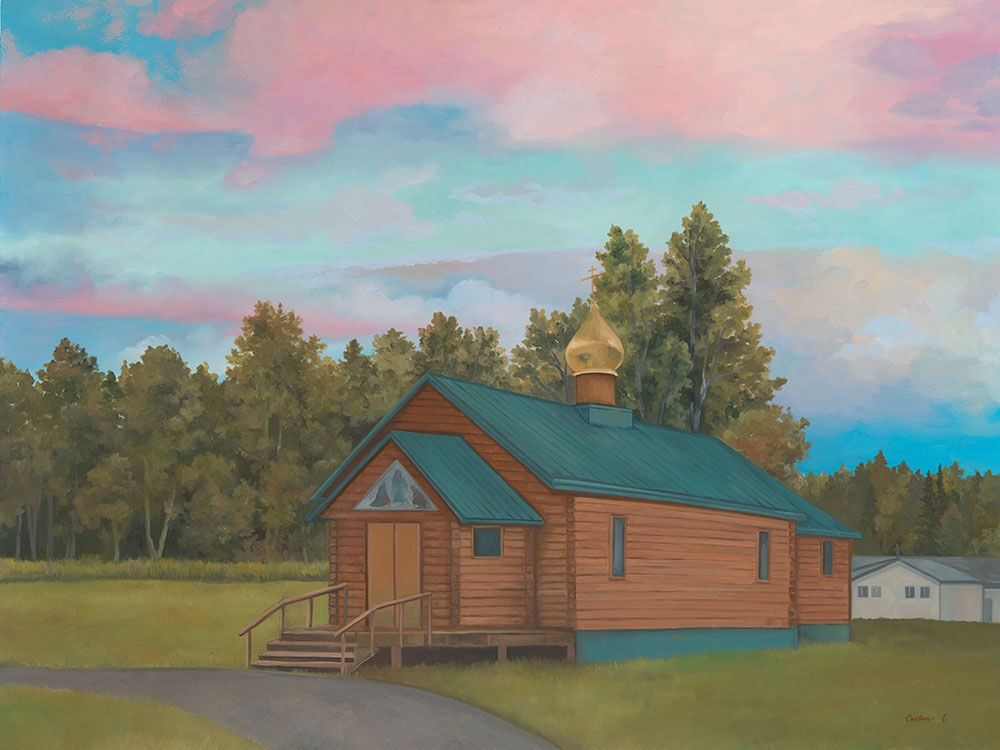
The first thing Pike had to do was find an artist. So he went online and started looking for someone who knew artists. The first person he talked to referred him to Geanina Cantemir, a Romanian painter and follower of the Orthodox faith. Cantemir ultimately agreed to paint the 105 Orthodox churches of Alaska and five Alaskan saints: St. Herman, St. Juvenaly, St. Peter the Aleut, St. Innocent, and St. Jacob.
“Up until the painting of the Orthodox churches in Alaska, my way in life was filled with studies and work,” she wrote as part of a press release for what would eventually come to be called the Kupol Collection. Kupol is the Russian word for dome. Pike put any disposable income toward Cantemir’s commission and other expenses — about $304,000 total over eight years.
“Every dime went to the artist,” he said.
Pike and Cantemir worked out a system. Pike would research photographs of Orthodox Russian Churches in the University of Alaska’s photo archives online, then send them to Cantemir, who would paint them and send them back. Where they could find Orthodox priests in traditional vestments, Pike asked Cantemir to add them into the paintings. They had attorneys check the photographs to ensure no copyrights were violated, Pike said.
“They’re all historically correct,” he said. “There’s not even a tree that’s not there that wasn’t in the photographs that we found.”
Cantemir finished the last painting about two years ago. When Pike reached out to talk to contacts in Alaska, he struck gold. The Natives of Kodiak (NOK) organization asked to see the paintings.
“They bought the entire collection for a quarter of a million dollars,” he said. “This collection is appraised right now for somewhere just over a million.”
He used some of the money to buy a house in Oregon, where he now lives, and the Natives of Kodiak group hired him as an ambassador for the collection. Pike is nonchalant about the financial windfall. For him, the collection is still about that epiphany. Natives of Kodiak unveiled the completed collection in Kodiak, on Nov. 16, 2015, when it was blessed by a local Russian Orthodox priest.
“It turned out to be the greatest spiritual experience of my life,” he said.
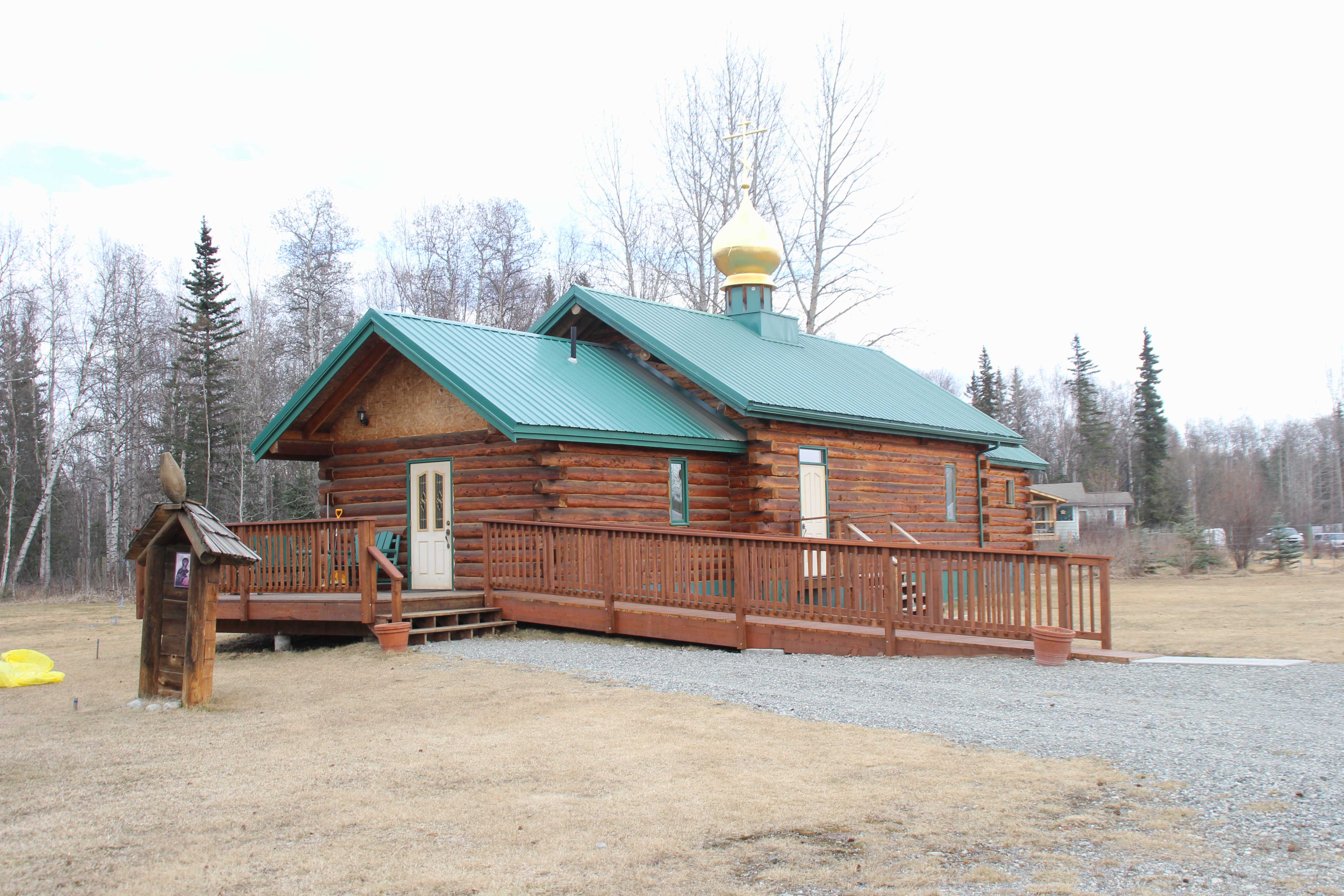
The only church in the Mat-Su Borough to be included in the collection isn’t particularly old or historic, especially compared to other churches, some of which predate American ownership of Alaska. They also didn’t know about the collection until a Frontiersman reporter called to ask about it.
St. Herman’s Antiochan Orthodox Church is along a winding gravel road in the Fishhook community. The parish was founded in 1994. Construction of the present building, which is the only formal worship building the parish has ever had, ended in 1996, said Father Matthew Howell, who has led the congregation since 2013. Antiochan and Russian Orthodoxy share a spiritual heritage. The overwhelming majority (101) of the Orthodox churches in Alaska are Russian Orthodox, because of the early settlement of Alaska by Russians, who brought their religion with them. Only three are Antiochan.
The first St. Herman’s Parishioners were from St. John’s, an Antiochan Orthodox church in Eagle River. Like the Eagle River parish, St. Herman’s has an unusual founding story.
“Our founding pastor bought an 80-acre farm that he then subdivided and sold off parcels from,” Howell said.
Congregants bought the parcels. This created a de facto religious enclave within the surrounding community — which is by design.
“It harkens back to the idea of village life overseas, where the church is the center of the village,” Howell said.
Over time, property changed hands, and most congregants, like Howell himself, now commute. Only about a third of the church’s worshippers reside in the surrounding area.
The log-cabin building was designed to be timeless, Howell said.
“If I had told you it’s been there since 1940, you might believe me,” he said. “It’s quaint and charming and it fits within the Orthodox architectural ethos.”
That ethos involves using local materials while retaining a distinct identity. The simplest expression of this is the onion-shaped dome, which in most cases houses expansive icons on the inside designed to mimic Heaven.
“It’s very traditional,” Howell said. “You look at Orthodox churches around the world, they all have that dome.”
The dome represents a spiritual aspiration, Howell said.
“It symbolizes a meeting of heaven and earth, so to speak,” he said. “It’s a reminder that we’re not called to be bound to this earth.”
It’s an aspiration Pike shares. For his next project, he plans to travel to the holy land with Cantemir, to work on a series of paintings based around the Life of Christ.
Kupol Collection-themed merchandise is available from an online store at kupolcollection.com. A portion of the proceeds goes to a restoration fund for Orthodox churches in Alaska.
Contact reporter Brian O’Connor at 352-2270, brian.oconnor@frontiersman.com, or on Twitter @reporterbriano.
Correction: An earlier version of this story gave the wrong name of the Eagle River Antiochan Orthodox Church.

By Jeremiah Bartz Frontiersman.com A football coach using a hockey reference as the centerpiece for his keynote address may

Frontiersman.com With its headquarters in Wasilla, the Frontiersman has been a primary source of news for the Matanuska-Susitna

By Katie Stavick Frontiersman.com The next generation of leaders took flight this week as the Houston High School Class

By Kyle Wilkinson For the Frontiersman Keynote speaker and Carry the Cure President Bill Pagaran’s words boomed through the