Retiring teacher, coach urges Colony grads to ‘find their 68’
By Jeremiah Bartz Frontiersman.com A football coach using a hockey reference as the centerpiece for his keynote address may


WASILLA — It’s a pleasing irony that a guy who works a buttoned-up job in a bank doing risk management spends all his spare time — and money — taking risks.
Chris Longacre’s family and friends tease that he can’t go on vacation without climbing a mountain. But for the last four years at least, their joke has been the truth, he said.
Longacre was 17 when he caught the mountain climbing bug. After taking a wilderness class at his Anchorage high school, and with no real mountaineering training, he joined a team climbing North America’s highest peak in 1999.
“I just kind of signed up to climb McKinley,” Longacre said from his second-floor office at First National Bank Alaska in Wasilla.
Longacre, 31, is a fourth-generation Alaskan who grew up in Anchorage and has always been passionate about the outdoors. He also loves to ski, snowmachine and whitewater kayak. He completed the Iron Dog recreation class as a 15-year-old and has snowmachined across more than 30 of Alaska’s glaciers since.
“If I’m on a glacier, I’m happy,” he said.
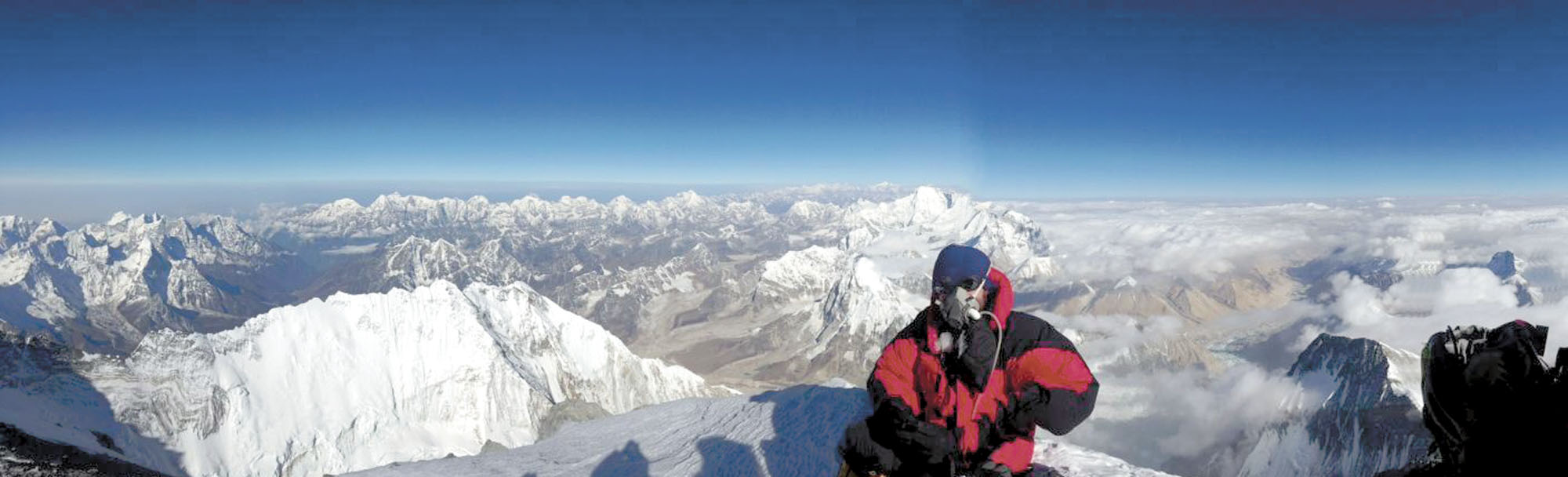
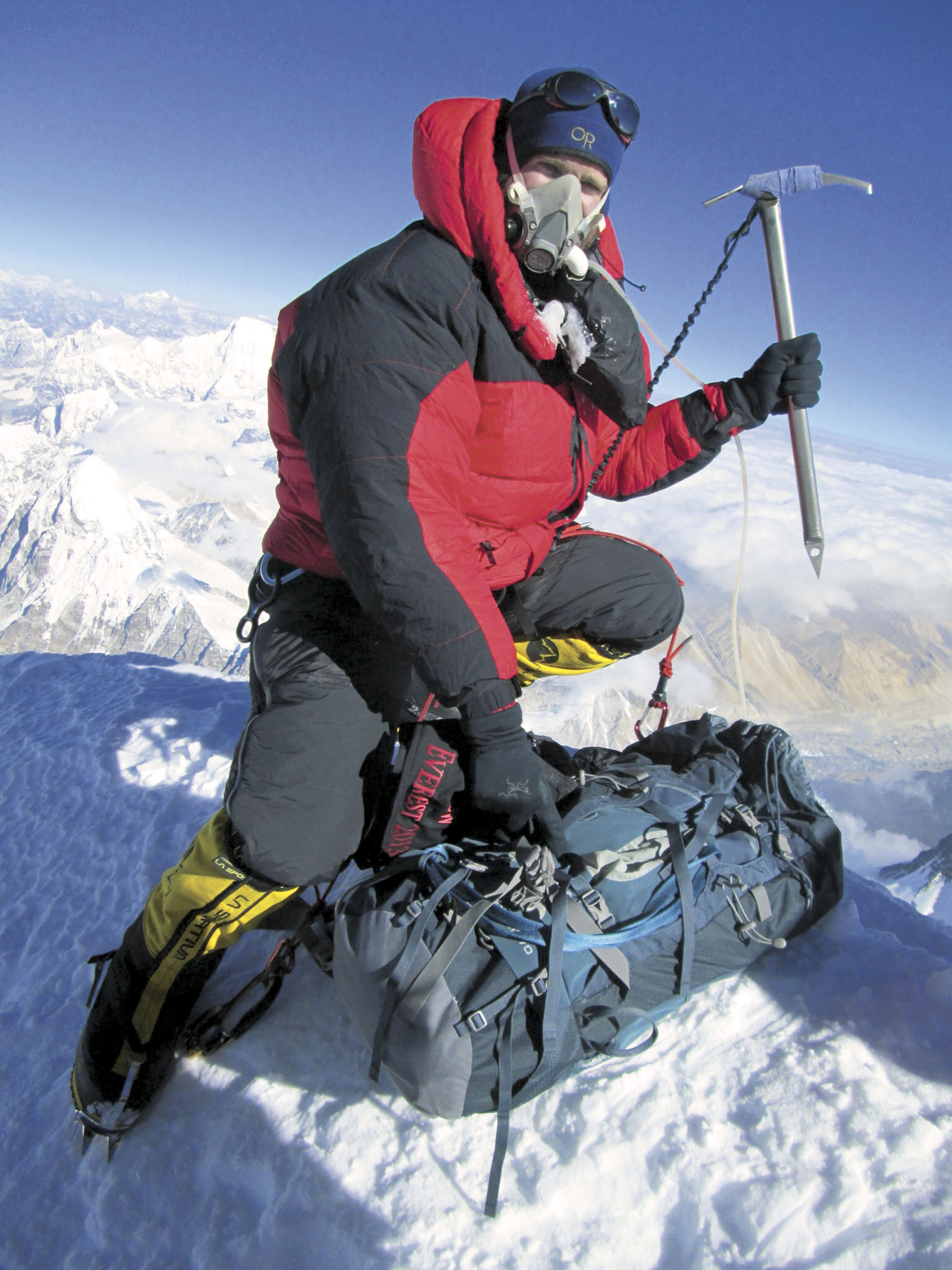
Longacre returned recently from a two-month trip and a successful summit of Mount Everest — the world’s tallest peak — on May 19, 2013.
Richard Bass became the first mountaineer to summit the tallest peak on each of the Earth’s seven continents on April 30, 1985. Longacre aims to repeat that feat, and has thus far reached the summit on five of the seven peaks, he said.
How’s it feel?
“I’m still kind of dumbfounded,” Longacre said.
After that first climb up McKinley, the hook was set. “That’s where I fell in love with it.”
But it would be another decade before he made it to the highest point on Earth.
Mountaineering might seem physically challenging in the extreme, but Longacre said it’s more of a cerebral contest.
“Throughout all of them, I’ve learned 90 percent of it is mental,” he said.
Each trip requires months of research, planning, preparation and physical training, but he said he doesn’t think of it as work. It’s what he loves to do, Longacre said.
It’s a bit like childbirth the way climbers forget the tedious, painful, arduous parts of the adventure, like weeks of waiting at base camp while the human body acclimatizes to the scant oxygen available at 17,400 feet.
“A lot of people give up in that time, with all the waiting,” he said of the 45-day period required to acclimatize at base camp.
After climbing Denali in 1999, Longacre said he returned to the top in 2004 and since then has reached the top of Mount Kilimanjaro in 2010; Mount Aconcagua in 2011; Mount Elbrus in 2012; and Mount Everest in 2013. Still to climb are Australasia’s Castensz Pyramid and Mount Vinson Massif in Antarctica.
Notching these last two peaks would ink Longacre’s name among an elite group of 275 or so climbers worldwide to best the seven-summit challenge.
He said local sponsors — including McVitty Insurance, Diversified Tire, High Performance Auto Supply, Mat-Su Plastic Surgery, The Vortex Group and Weldin Construction — helped him pay the more than $45,000 in costs for the climb. He said the Everest climb was the first time he’s had financial support.
“It’s very expensive,” he said, adding that he would appreciate sponsors for the two remaining treks.
To Longacre, each mountain is its own unique challenge. Comparing climbing Denali to Everest is apples and oranges, he said.
“The challenge on Denali is the weather. But on Everest it’s the altitude,” Longacre said. “Everest is more about what your body is conditioned to endure. It’s about altitude.”
By comparison, his office near Wasilla Lake is about 400 feet above sea level and the summit of McKinley is 20,320 feet, but Everest is 29,035 feet.
Longacre said the guide service he hired provided logistical support such as cooks, Sherpas and high mountain oxygen. Longacre said his team of climbers used oxygen from 23,000 feet on up.
Next on his list is Castensz Pyramid in Indonesia. But on every continent it is more than the mountains he travels to see, he said. “It’s just a cool way to see the world. I love seeing other places and their cultures.”
It’s also a way to meet new people and build new friendships, Longacre said. That’s why he often travels on his own instead of as part of a team of climbers he knows.
“That’s part of the wonder,” he said of the challenge of meeting new climbers and working as a team toward a common goal. “I really like the social aspect — figuring out a person’s strengths.”
Longtime girlfriend, Rachel Spicer, has been part of the team that helps support his dreams. She said the seven summits is just one of Longacre’s big ambitions. Among other things, she updated their blog with his progress on the mountain during the Everest climb in May.
“He has a lot of dreams and I just do my best to support him,” Spicer said.
With each climb, she said the technology has improved and she has more contact with Longacre during the expedition. This time he called her on a satellite phone from the summit of Everest and talked for seven or eight minutes.
“The energy from him coming through the phone was just incredible,” Spicer said. “He was literally on top of the world — physically and emotionally.”
For photos and blogs from all five climbs, visit bit.ly/110IXl1.
Contact Heather A. Resz at 352-2268 or heather.resz@frontiersman.com.
The Seven Summits are the highest points on all seven continents. Richard Bass was the first mountaineer to summit all seven on April 30, 1985. Here’s a list of the five peaks Chris Longacre has climbed, the continent where they are located, height, and the year he reached the summit.
• Mount McKinley, North America, 20,320 feet —1999
• Mount Kilimanjaro, Africa, 19,341 feet — 2010
• Mount Aconcagua, South America, 22,838 feet —2011
• Mount Elbrus, Europe, 18,510 feet — 2012
• Mount Everest, Asia, 29,035 — May 2013
• Castensz Pyramid, Australasia, 16,024 feet — still to come
• Mount Vinson Massif, Antarctica, 16,050 — still to come

By Jeremiah Bartz Frontiersman.com A football coach using a hockey reference as the centerpiece for his keynote address may

Frontiersman.com With its headquarters in Wasilla, the Frontiersman has been a primary source of news for the Matanuska-Susitna

By Katie Stavick Frontiersman.com The next generation of leaders took flight this week as the Houston High School Class

By Kyle Wilkinson For the Frontiersman Keynote speaker and Carry the Cure President Bill Pagaran’s words boomed through the