Retiring teacher, coach urges Colony grads to ‘find their 68’
By Jeremiah Bartz Frontiersman.com A football coach using a hockey reference as the centerpiece for his keynote address may


MAT-SU — As we celebrate the Fourth of July today, many of us will be thinking about the veterans we have known, people who served their country to insure the freedom we celebrate each summer.
For Raymond Lee, the veteran he’s likely to think about most this weekend was his sixth grade teacher, John D. “Bud” Hawk, who died in November.
“He dedicated his life just to service above self,” Lee said.
Lee, a corrections officer with the state and a Valley resident, met Hawk in his hometown, Bremerton, Wash. Lee spent time in foster care and struck out on his own with his twin brother at age 13. He had many chances to go astray but says he credits Hawk, and people like him, who provided a strong moral foundation in his life that allowed him to grow into a productive member of society.
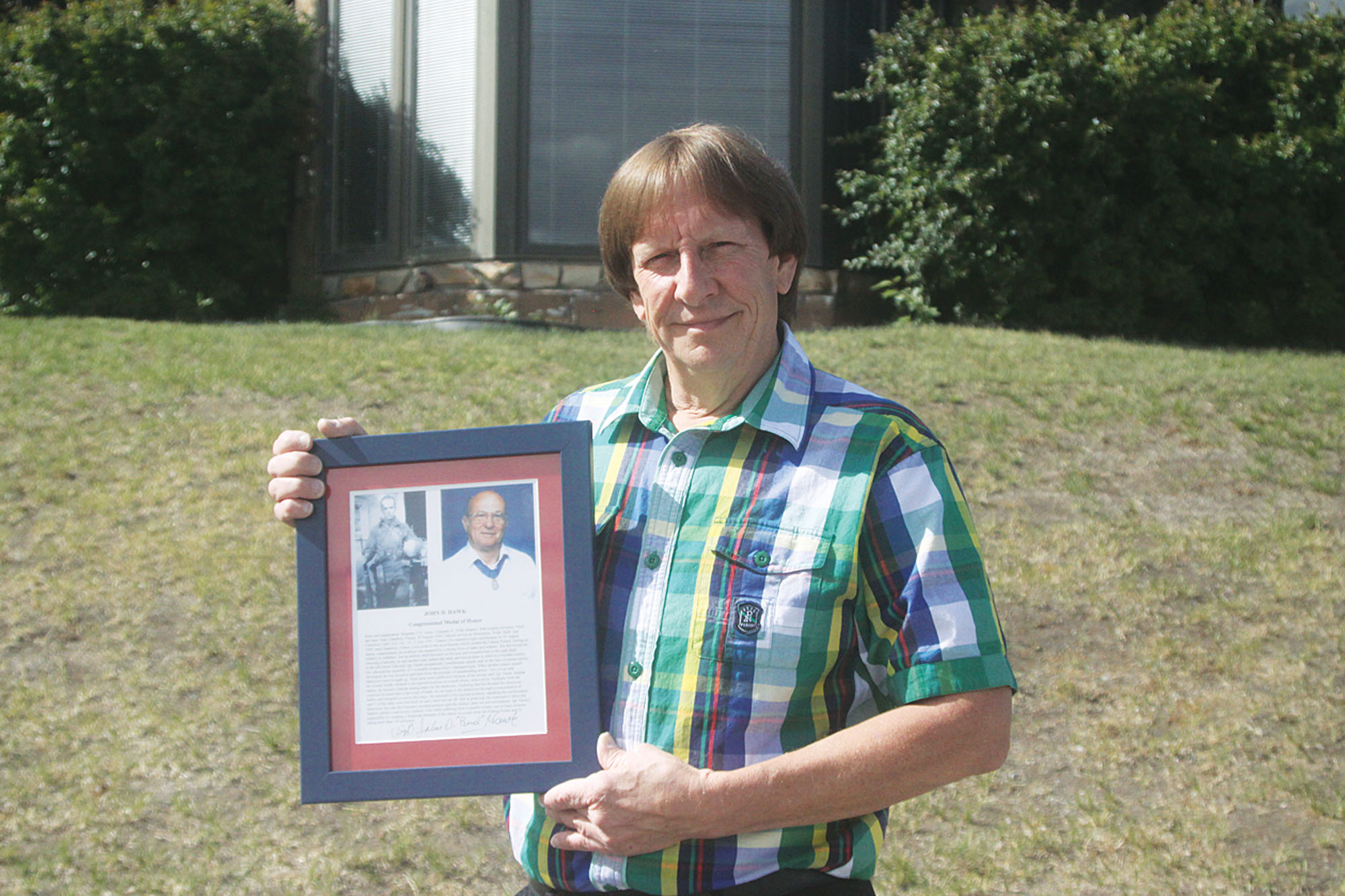
Lee keeps a framed picture of his former teacher on the wall. Hawk wasn’t just any other soldier. He was an elite soldier, honored with the highest award for valor his country could bestow. Hawk’s Medal of Honor is one of just 3,469 that have been awarded in the nation’s history.
Hawk’s story, as recounted in Tom Brokaw’s The Greatest Generation, begins when he was drafted out of high school and shipped to Normandy a few weeks after the Allied invasion. A battlefield promotion gained him the rank of sergeant and in August of 1945 he took part in the encirclement of German tanks in what came to be known as the Falaise Pocket at the edge of an apple orchard.
“With the smell of dead farm animals heavy in the air, Hawk saw a pair of German Tiger tanks lumber into his sector, followed by enemy infantry. His badly outnumbered gunners repelled the soldiers but couldn’t effectively oppose the tanks,” Brokaw writes.
An explosive round took out one of Hawk’s machine guns and a tank ran over another. He was wounded in the melee and limped to a drainage ditch where he helped a soldier with a bazooka load his weapon and fire on the tanks until they withdrew. He reorganized his squad and cobbled a working gun from two damaged ones.
Later in the same battle, Hawk stood in the open to direct fire from American tank destroyers that took out German tanks.
“As a result, two enemy tanks were destroyed and the rest were driven off. Eventually, five thousand Germans surrendered because the battle in the apple orchard had left part of the Falaise Pocket closed,” Brokaw writes.
Lee kept in touch with Hawk after leaving school and then leaving home. Working in a shipyard in Washington, Lee put together an event during the Iranian Hostage Crisis at which Hawk spoke. Lee credits his friend and mentor with teaching him many things over the year.
“Definitely to be your own person and to be able to express yourself,” he said.
In 1985, Lee moved to Alaska after seeking and finding his biological family here. But he kept in touch with Hawk. In 1998 Brokaw published his book and, soon after, Hawk got in touch with Lee.
“He said, I have something for you,” Lee recalled.
It was a signed copy of Brokaw’s book. Lee still has it, along with press clippings and photos of his friend and mentor Bud Hawk.
Lee said he has always strived to be like Hawk, to provide service to the community. He has been involved with amateur boxing and gone with his co-workers to help out at community events like the KidSafe identification program anti-bullying campaigns. He said he also hopes to get the correctional officers’ union involved with the Cardboard City anti-homelessness event this year.
“All of this is stemming from the foundation of people who put a fingerprint on your life,” Lee said.
People, he said, like Bud Hawk.
Contact Andrew Wellner at 352-2270 or andrew.wellner@frontiersman.com.

By Jeremiah Bartz Frontiersman.com A football coach using a hockey reference as the centerpiece for his keynote address may

Frontiersman.com With its headquarters in Wasilla, the Frontiersman has been a primary source of news for the Matanuska-Susitna

By Katie Stavick Frontiersman.com The next generation of leaders took flight this week as the Houston High School Class

By Kyle Wilkinson For the Frontiersman Keynote speaker and Carry the Cure President Bill Pagaran’s words boomed through the