Retiring teacher, coach urges Colony grads to ‘find their 68’
By Jeremiah Bartz Frontiersman.com A football coach using a hockey reference as the centerpiece for his keynote address may


CHICKALOON — The energy in the Palmer classroom is already palpable.
But the vigor ratchets up a few notches when Ahtna Athabascan storyteller Patricia Wade asks the class which story they’d like to hear today.
Students thrust their arms in the air and bounce in their seats, eager to help pick the story.
“Besiin — Oh, I’ve heard that one,” says one student in Julie Real’s fifth-grade class at Academy Charter School during a 2010 visit.
“The Grizzly Bear Story — tell that one,” another student begs.
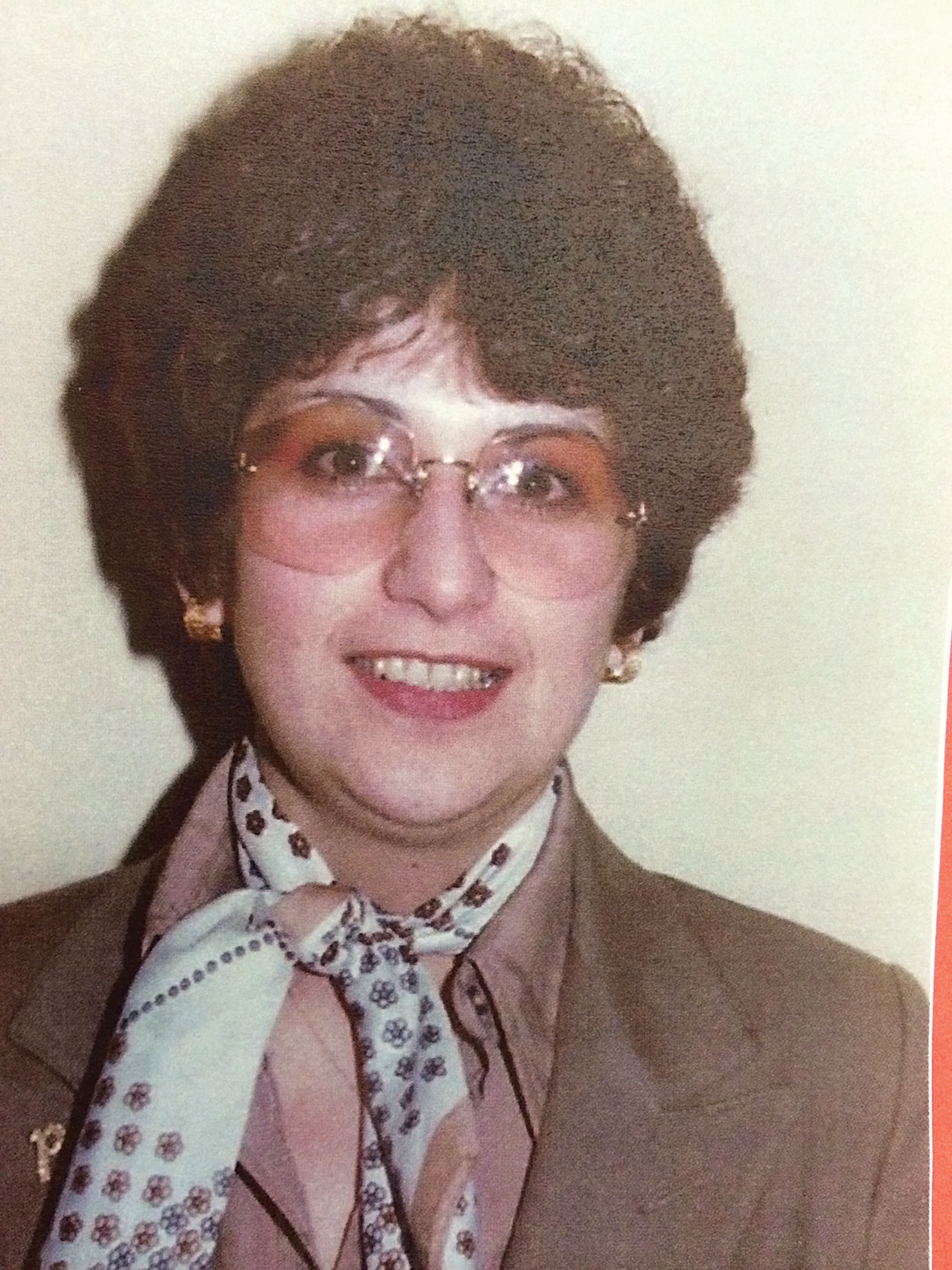
Ahtna Athabascan storyteller, mother, activist, member of the Chickaloon Tribe and writer Patricia Mae Wade, 69, died July 31, 2014, while visiting her son Dimi Macheras and adopted daughter Kelly Wooster in Seattle, Washington. She was 69.
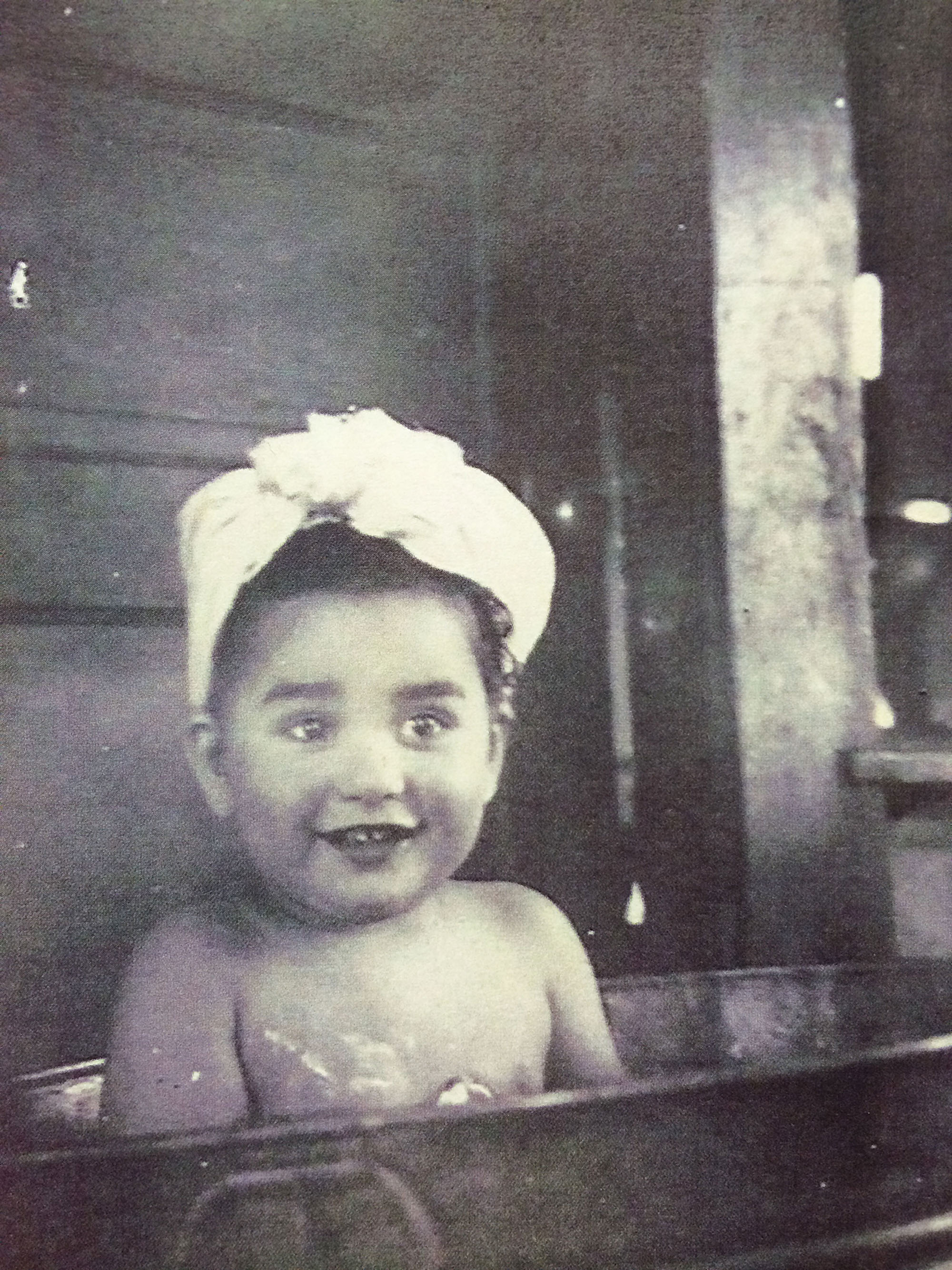
Queenie, Aunt Pat, Patricia, or Patty as friends and family knew her was born Aug. 17, 1945, in Palmer to Katie and Richard Wickersham Wade and graduated from Palmer High School in 1963.
She leaves behind sons Greg, Danny, Dimi and Alex; her sister Rain Wade; and many, many cousins, aunts, uncles, nieces, nephews and friends.
Niece Lisa Wade says Aunt Pat didn’t like the idea of people speaking or crying publically over her. So family and friends gathered Sunday at the Ya Ne Dah Ah School to share a meal and celebrate Wade’s life.
“She was an amazing woman,” her niece Lisa said. “She had such a unique way of educating people and did so much for our Tribe. She will be greatly missed by all.”
Lisa Wade is among a long list of Alaskans who count Patricia Wade as their second mother. Kelly Wooster also is on that list.
“She was like a mom to everybody,” Macheras said. “Kelly is like the daughter mom never had.”
Patricia Wade is the daughter of culture barer Katherine Wickersham Wade who, among other accomplishments, helped start the Ya Ne Dah Ah School in 1992. Wickersham Wade also wrote a book about her life and helped create the language lessons and CD-ROM that continue to help new generations of Ahtna Athabascan people learn the language.
Wickersham Wade was baptized the same year the last trainload of coal left Chickaloon. That’s the same year her uncle the Shaman shared a sweet with her that bound her to him spiritually in this life and beyond, according to Wickersham Wade’s biography.
Before the railroad and coal mines changed life here, Wickersham Wade was the last generation raised by elders and trained in subsistence ways of the Ahtna Athabascan.
In life they did not always agree, but Patricia Wade was her mother’s perfect complement. Wade was comfortable in the Western world and working alongside other members of the Chickaloon Tribe. For many years Wade’s work served as a bridge connecting the old ways and the new. She also was a patient teacher to newcomers wishing to learn the traditions of the Ahtna Athabascan people.
Friends and family remembered her Sunday as a sparkly person who shared encouraging words with everyone.
“The world is a lot less sparkly,” her niece Lisa Wade said. She was among those at the gathering adorned in bejeweled blouses and glitter-covered shoes. The top she wore Sunday is one she bought special to wear on a date with her Aunt Pat.
Sister Rain is not a glitter fan. But made an exception to honor her sister Sunday.
“I don’t do glitter normally,” Rain said, tilting out a foot to show a high-heeled shoe Patricia covered in gold glitter years ago.
She said when she and her sister would dress up to go out, Patricia always wanted her to wear something with glitter — so she could look at it.
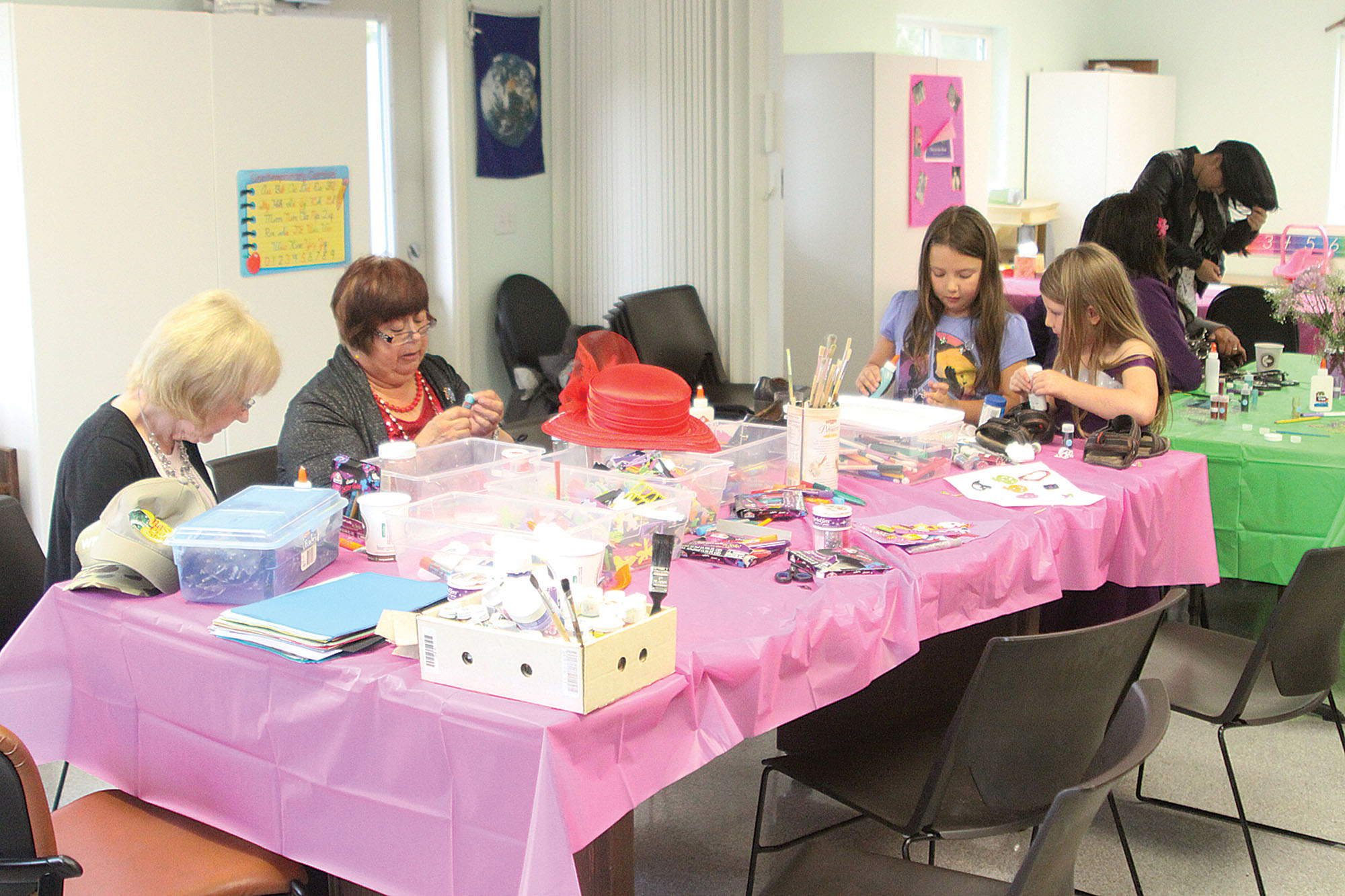
Across the back of the room two tables were set up with glitter, glue and hats, shoes and other items to bedeck with sparkles in her honor.
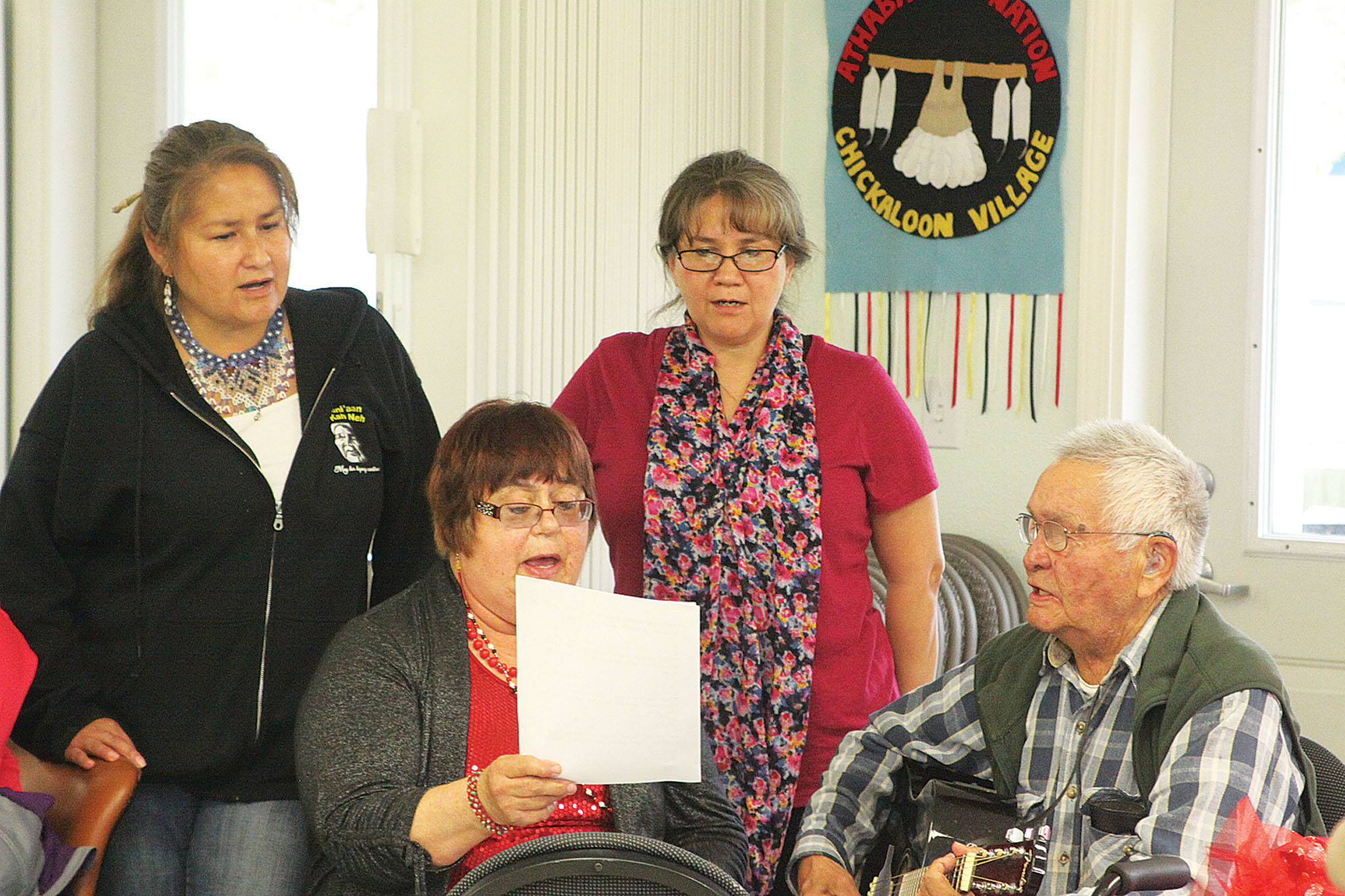
Patricia didn’t want a sad farewell, but niece Lisa Wade said she thought she’d approve of family dinner at the school with salmon filets, caribou stew and some singing led by Uncle Albert on the guitar.
“She was a champion for her community,” Lisa Wade said. “For us, us as a Tribe, we wouldn’t be here without the work she did championing us and telling our story.”
The marks Wade left on Alaska are impossible to remove. There is a generation of school children who know Ahtna Athabascan stories because she visited their classrooms and shared traditional stories. Sometimes the stories she told were Ya Ne Dah Ah stories meant to teach children traditional values and ways of living and sometimes the story Wade shared was her family’s own brutal biography.
Her grandma Annie Nicolai was born in 1905 at Old Man Lake near Chickaloon into a changing world blighted by the newcomers, Wade wrote in a 2012 biographic series she penned for the Frontiersman.
She was 11 or 12 years old, playing with her sisters in the woods when a 38-year-old Jesse Wickersham spotted her and decided to take her as his wife. She ran away to be with him at age 14. By age 20 she was pregnant with her fourth child when her husband — who was drunk at the time — told his friends he was going home to “wipe out his family,” Wade wrote.
“He had a knife, but my grandmother had a gun that he had given her when he was sober and remorseful after the last time he got drunk and beat her up. So in self-defense, she shot and killed my grandfather in 1924. …It must have been obvious that it was self-defense because in a rare occurrence they let a Native woman go for killing a white man.”
Sister Rain said telling this story again and again to groups of strangers was heavy work, but telling their story is important.
“Our family is not the only family that has had tragedy,” Rain said. “She had the kind of strength that she could stand up and do that. She was pretty fearless.”
“Fearless and sparkly,” niece Lisa Wade added.
The ripples of Patricia Wade’s life will continue to reach the shore for years to come as understanding grows between newcomers and Alaska Native people.
In many ways, these are ripples of self-esteem that Wade set in motion.
“She made it OK to be Alaska Native in the school system,” Lisa Wade said.
Rain said when she and her sister were school-aged, being Alaska Native was not a source of pride.
She recalled how students would reluctantly raise their hands only part way when the teacher asked who in class is Alaska Native. That was never Pat, Rain said.
Rather, Pat would enthusiastically thrust her hand in the air, as if to be first to claim a treasured prize. She was always proud of being Alaska Native, Rain said.
Acceptance and understanding of Alaska Native cultures hadn’t changed too much by the time niece Lisa Wade was in school, she said. She still hid in the library rather than face her peers at recess.
When Lisa Wade began working for the Chickaloon Tribe, she said this was one of the issues she raised with her Aunt Pat. Kids need to feel safe and proud at school, she told her aunt.
So Patricia Wade traveled to classrooms around the Anchorage and Mat-Su school districts for years sharing Alaska Native culture through storytelling.
“She built us up as a people,” Lisa said, “as a tribe. She built us up with her words with her energy and with her enthusiasm and humor. She never took it too seriously.”
Patricia Wade gave pride in their heritage, in being who they are, to her whole community.
“She taught us how to do that. And now we do that for our younger generations — we build them up,” niece Lisa Wade said. “She was a champion for everyone.”
She said she saw that pride spark action when visitors came to the school a couple of weeks ago. Unbidden, students jumped to their feet and started singing and dancing in Ahtna.
“She taught them self-esteem,” Lisa Wade said. “She taught them how to speak, how to present themselves.”
Rain said even as children, Patricia saw things differently. She shared a story about a time the two walked from the Moose Creek Drive Inn, which their family owned, to Moose Creek to play in the water there. Rain recalled pointing out a nice rock she found to Patricia. “Look at that cloud,” came her reply.
“She was always looking up,” Rain said.
Dawn Brunke and Patricia Wade connected over their love of writing 18 years ago. Brunke smiles at the memory of the thick binder Wade brought along to lunch with all her writings.
“I thought that was a little quirky,” she said. “So I liked her right away.”
The two share a love of writing, bargains, spirituality and laughter.
“She was my favorite laughing buddy,” Brunke said.
During her lifetime, Patricia Wade had several careers, including being a mother to many, a secretary, business owner, writer, musician and storyteller.
Rain said their first jobs were doing whatever needed doing at the family’s Moose Creek Drive Inn, which was built in the 1950s. The inn was located along the Glenn Highway where the school is today.
A couple of years ago, Patricia recorded a CD with her son Greg. Younger son Dimi’s art also was part of her storytelling effort. He drew many of the illustrations included in the PowerPoint that accompanied Wade’s storytelling.
He said now he wishes he’d illustrated more traditional stories for her.
“I owe so much to Mom for my artwork,” Macheras said.
Thanks, in part, to his mom’s marketing efforts, the comic books they made telling traditional stories using his anime-style artwork are for sale in the Native American wing of the Smithsonian.
“She worked her butt off for each of her sons,” Wooster said.
Macheras said he wishes he had done more for his mom, but he said he doesn’t feel regret, just inspiration.
“Now I see the importance,” he said.
An elder once said that Patricia Wade “would be the voice for people who had no voice.”
She did that and more. She taught generations of people to “look up.”
Contact Heather A. Resz at 352-2268 or heather.resz@frontiersman.com.

By Jeremiah Bartz Frontiersman.com A football coach using a hockey reference as the centerpiece for his keynote address may

Frontiersman.com With its headquarters in Wasilla, the Frontiersman has been a primary source of news for the Matanuska-Susitna

By Katie Stavick Frontiersman.com The next generation of leaders took flight this week as the Houston High School Class

By Kyle Wilkinson For the Frontiersman Keynote speaker and Carry the Cure President Bill Pagaran’s words boomed through the