Retiring teacher, coach urges Colony grads to ‘find their 68’
By Jeremiah Bartz Frontiersman.com A football coach using a hockey reference as the centerpiece for his keynote address may


MAT-SU — Fresh from evacuating 25 children from a burning day care facility, Mat-Su Borough emergency responders were preparing to deal with another looming disaster.
Those who pay attention to emergency band scanners likely noticed a marked increase in activity this weekend, as the borough and state teamed up with the American Red Cross and Mat-Su Regional Medical Center for an intense emergency preparedness drill.
The scenario revolved around a significant weather event, said Casey Cook, the borough’s emergency manager. It’s based on what he calls an “omega weather system” that has temperatures at -10 with wind gusting up to 80 to 90 miles per hour creating a dangerous wind chill of -65. Enstar’s natural gas supply is at “level red,” and there’s a problem with delivery of gas to the state and Valley.
Add to that the need to relocate residents of an assisted living facility who need medical care, the range of responses needed are significant, Cook said. For that, Wasilla High School and Colony Middle School became staging areas for emergency shelters and response.
The drill also included a first for local agencies in the use of Twitter, Facebook and other social media in alerting the public to the disaster situation, Cook said.
“Since most people have cellphones and iPhones and smartphones now and get their updates electronically, we’re trying to make sure we get that information out to as many people as possible,” he said.
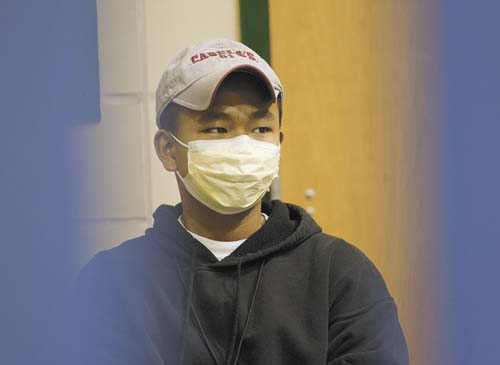
At Colony Middle School Saturday, 14-year-old Devin Houser sat patiently with his leg elevated. One of dozens of local drill volunteers, Houser was playing a 76-year-old man. And like other volunteer patients, he was provided with a scenario to present to emergency responders. In his case, he’s an injured veteran who uses a cane to get around.
“I got shot in Vietnam,” Houser said, adding he got to make up his own backstory. “We were in a convoy and our convoy was on a mission and was hit by an RPG. I came out of the wreckage and all my friends were dead, except for one. Me and him, I helped him out and got shot in the back of the leg.”
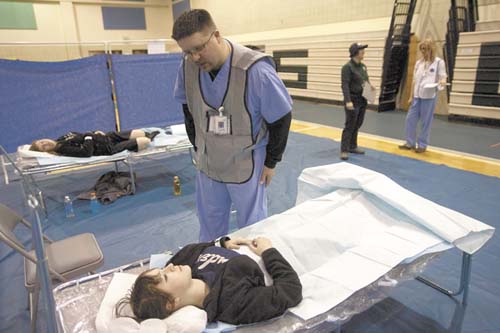
Across the gymnasium, which for the drill had become the Mat-Su Regional Medical Center Alternative Care Site, 15-year-old Mordacai Cohen was playing the part of a 68-year-old man.
“This morning, I had possibly a nut allergy,” Cohen said. “I felt severe chest pain, compression in the chest, more like someone was, like, standing on me. When I went to the shelter they sent me to this specialized care facility.”
In the next bed, 15-year-old Monique Bartolo was an 80-year-old suffering from chronic obstructed pulmonary disease.
Both were treated by Dr. Dave Gilbert, director of cardiopulmonary services for Mat-Su Regional Medical Center. Drills like this weekend’s are crucial for those who provide emergency services, he said.
“They make sure you have a plan for meeting people’s needs,” he said. “For example, they gave me these little (scenarios), where Mordecai was telling me, ‘I’m leaving. I’m out of here.’ I had to convince him he needed to stay, and I wouldn’t have though of that for a drill. I had to make sure I was aware of a methodology of actually letting him leave.”
He also can observe, from a physician’s point of view, where the hospital’s emergency supplies need help. By Saturday afternoon, he had already identified there probably should be a greater supply of oxygen and equipment with independent power supplies that don’t have to be plugged in.
That’s exactly the kind of feedback the hospital is looking for, said Sandra Porter, a MSRMC evaluator at the drill. While the hospital goes through regular trainings for potential responses at the hospital, this was the first time it has practiced setting up an off-site care center, she said.
“It’s a big learning experience,” she said. “We tried to think of what we need to bring, how we need to organize it, how we need to set it up — male, female, for service animals and care-givers.”
The hospital prepares packages of equipment and supplies enough to care for 25 patients at a time, Porter said. It’s stored in a trailer on the hospital grounds, and seeing volunteers in action to help set up the site was invaluable for future efforts.
“We thought it would take about an hour and it took right at an hour (to set up),” she said. “So, we’re happy we estimated correctly and were ready to go in that time frame.”
In addition to setting up the alternative care center, the hospital also uses its kitchen for disaster relief, Porter said. All the food for the off-site location was prepared by the MSRMC kitchen and delivered by the American Red Cross.
As with many disaster situations, the Red Cross is often the first agency called to help displaced people, said Stephanie Bass of the Valley’s Red Cross office.
“We can run a shelter, but can’t (give) medical attention,” she said. “Here, we have alongside us in the shelter, but under its own jurisdiction, the hospital. It’s fantastic, really. We get to see what everybody does in their specialized areas. Obviously, on our own, we have issues we can’t meet with special needs patients. We aren’t a medical facility. We can shelter, but need somebody to do the medical side of it.”
Part of that medical side is preparing for those little wrenches that always find themselves in the works, Dr. Gilbert said. As for convincing a cantankerous Cohen to stay at the shelter, Cohen was told he couldn’t have his medication if he left. That was convincing, the doctor said.
“Well, that, and we have Rice Krispies treats,” Gilbert said. “I think that may have had something to do with it.”
Contact reporter Greg Johnson at greg.johnson@frontiersman.com or 352-2269.

By Jeremiah Bartz Frontiersman.com A football coach using a hockey reference as the centerpiece for his keynote address may

Frontiersman.com With its headquarters in Wasilla, the Frontiersman has been a primary source of news for the Matanuska-Susitna

By Katie Stavick Frontiersman.com The next generation of leaders took flight this week as the Houston High School Class

By Kyle Wilkinson For the Frontiersman Keynote speaker and Carry the Cure President Bill Pagaran’s words boomed through the