Retiring teacher, coach urges Colony grads to ‘find their 68’
By Jeremiah Bartz Frontiersman.com A football coach using a hockey reference as the centerpiece for his keynote address may


WASILLA — Gene Horner began playing trumpet in fourth grade in El Paso, Texas. His father served as a career officer, who also played trumpet. Horner continued playing through junior high and high school.
“I joined the Army a little early, at 17,” he said. “It was go in the Army, or get into trouble; one or the other.”
He enlisted in 1967 in central California and did basic training in Fort Gordon, Ga. There he lucked out and was recruited to play trumpet for a training brigade. He said the group practiced three times a week and performed in a parade every Saturday, but it had its upside.
“It was a good gig,” Horner said. “It got me out of KP and guard duty.”
Eventually, Horner was assigned a regular duty station in Alabama, and again found an opportunity to play with the post band.
“It was just total luck of the draw. They were in desperate need of a trumpet player. I was a mediocre trumpet player. I never would have made it into the Naval School of Music.”
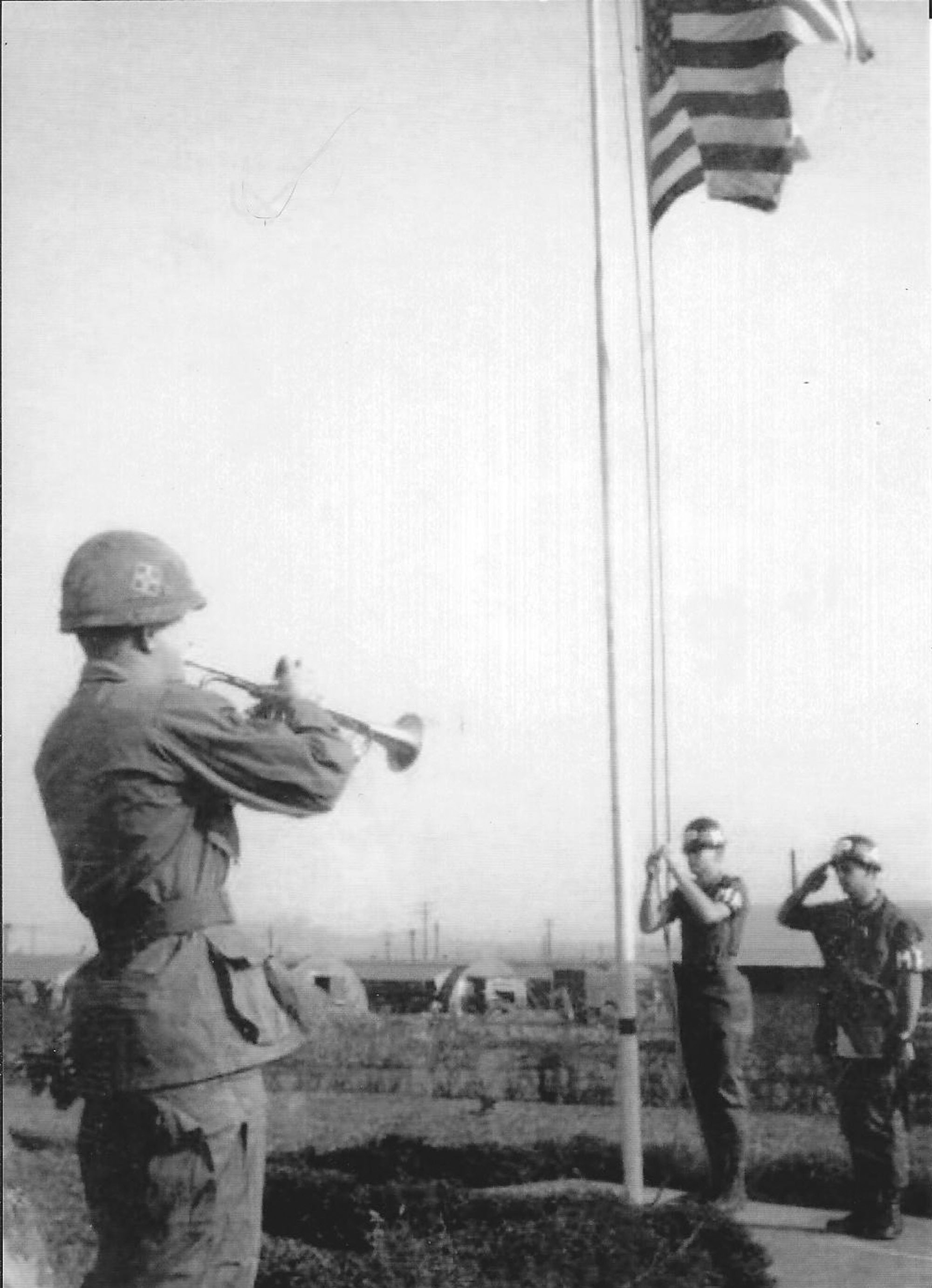
And that’s when Horner first sounded “Taps.” This was the height of the Vietnam War and he was tasked as duty bugler for Mississippi, Alabama and Florida. In three months he sounded “Taps” for 187 funerals.
“I was convinced no one came home,” Horner said solemnly.
Horner received orders for Vietnam in 1968. En route, the plane made a stop in Anchorage due to hydraulic problems.
“It was a beautiful sunny day, just like this one,” remembered Horner. “I could see McKinley.”
Totally convinced he wouldn’t return home either, Horner pledged to himself, “If I make it through this year, I am coming back here.”
Horner said at that time, a U.S. Army band in a combat zone was “32 bodies that can be used for anything. We were just the odd guys. If the infantry unit came up short, they’d grab three guys out of the band and off they’d go. If transportation needed men, three guys out of the band would be with them for a week. We were just a slush fund of bodies. Plus, we did our fair share of sweeps and patrols, too.”
During his 15 months in Vietnam, when there was a casualty in a unit, Horner and a chaplain would fly by helicopter to the unit’s location and perform a memorial service. The job was split between six buglers. Horner flew out at least two times a month. The memorial service served as closure for the men in the unit, Horner said.
When his time of duty ended, he returned to California and attended college. He married his sweetheart and moved to Alaska in 1977. After working as a carpenter’s apprentice in Anchorage briefly, Horner joined the Pile Drivers Union, where he worked for 40 years. The couple moved to the Valley in 1996.
He was at a funeral in 1999 for a fellow pile driver who served in World War II and had no family when he struck up a conversation with the Army Honor Guard.
When he asked where’s the bugler, Horner said he was directed to a boom box. But as fate would have it, Horner had just picked up his trumpet from the Horn Doctor in Anchorage that day. He asked if he could sound “Taps” for his friend. When he finished, the director asked if he would help out. An Air Force first sergeant told Horner that he had performed 300 funerals and would appreciate any help he could get.
Soon Horner was performing at other veterans’ funerals and recruiting other trumpet players to join the ranks. When the Air Force buglers could not attend a funeral at the National Cemetery on Fort Richardson, they called on Horner.
“I played ‘Taps’ most of my life, but didn’t know its history,” said Horner. “I began to research ‘Taps’ on the Internet and found out about a fellow bugler named Tom Day.”
Day put out a call to buglers to musicians in all 50 states in 2000 after learning that due to a shortage of musicians available to perform at veterans’ funerals, pre-recorded performances of “Taps” or digital trumpets were used instead. Horner gave Day a call and helped the organization establish as a nonprofit and became Alaska’s director of Bugles Across America. In 2002, 300 buglers volunteered. Today, 6,000 buglers answer the call.
Bugles Across America also closes out the Memorial Day Ceremony at the National Cemetery. Buglers from throughout Alaska are spaced equal distances around the cemetery. As the first bugler hits the third note of “Taps,” the next bugler begins. And so on and so on around the perimeter. Horner says the notes resound in a wonderful B flat echo at the end.
The first time Horner sounded “Taps” as a soldier, his 1st sergeant told him he had a funeral detail.
“What do I do?” asked Horner. “He threw me a field manual and said, ‘Hey, it’s in there somewhere, read about it!’
“Later as I stood there on the field and heard the third volley from the honor guard, I got this lump in my chest,” he said. “It’s such a solemn moment. I still get it today. It’s never changed in 45 years. You are giving a family closure. You only have one chance to get it right and you don’t want to mess up.”
Horner said that 2002 was the height of funerals for World War II veterans. These days he plays for veterans of Korea and Vietnam mostly. He played “Taps” at 186 funerals in 2013.
Horner said he has a list of about nine trumpet players from all walks of life he calls on to play at veterans’ funerals. He said there is more pressure on this small band of volunteer buglers since the Air Force Band of the Pacific became nonoperational in June 2013.
Horner said he’d like to work with the Legislature and the University of Alaska to create a program similar to one at the University of Wisconsin that allows students who play “Taps” with Bugles Across America to earn college credit with the university.
He quoted Jari Villanueva, former Chief Bugler for the United States Air Force, who says playing the solemn song “is the hardest 24 notes you’ll ever play.”
“Playing at Carnegie Hall would be nice,” Horner said. “But for a trumpet player, I don’t think there is a greater honor than sounding ‘Taps’ for a soldier’s final farewell.”

By Jeremiah Bartz Frontiersman.com A football coach using a hockey reference as the centerpiece for his keynote address may

Frontiersman.com With its headquarters in Wasilla, the Frontiersman has been a primary source of news for the Matanuska-Susitna

By Katie Stavick Frontiersman.com The next generation of leaders took flight this week as the Houston High School Class

By Kyle Wilkinson For the Frontiersman Keynote speaker and Carry the Cure President Bill Pagaran’s words boomed through the