Retiring teacher, coach urges Colony grads to ‘find their 68’
By Jeremiah Bartz Frontiersman.com A football coach using a hockey reference as the centerpiece for his keynote address may


As the weather warms and the sun shines over the Alaskan skies a little longer each day, the Division of Forestry wants to remind residents to keep an eye on the thermometers, because spruce bark beetles will start flying each year when it gets around 60 degrees.
From April to August, they're actively seeking trees to attack and are attracted to freshly cut, broken or fallen spruce trees.
According to alaskasprucebettle.org, a website maintained by the University of Alaska Fairbanks, the UAF Cooperative Extension, and Alaska Department of Natural Resources, spruce beetle activity has decreased dramatically. Only 48,800 acres of damage were recorded during aerial detection surveys, the least reported since 2015.
Almost all of the active mortality occurred in Southcentral Alaska, where the current outbreak has impacted more than 1.86 million cumulative acres. The outbreak remains most active in the northern Matanuska-Susitna Borough, the lower Denali Borough, in and around the Chugach National Forest, and near Soldotna and Kasilof on the Kenai Peninsula.
Spruce beetles spend most of their lives under the bark of trees, so too often people don’t see the insects before their damage has been done.
Knowing how to identify spruce beetle damage to trees is an important first step. The most noticeable symptom of a spruce beetle infestation is the change in needle color of impacted spruce, a symptom must Alaskans have noticed in trees the past few years.
Following a successful spruce beetle attack, needles will change from healthy green, to faded yellow, and finally to red before the needles eventually drop. This process occurs at varying rates and may take over a year to occur.
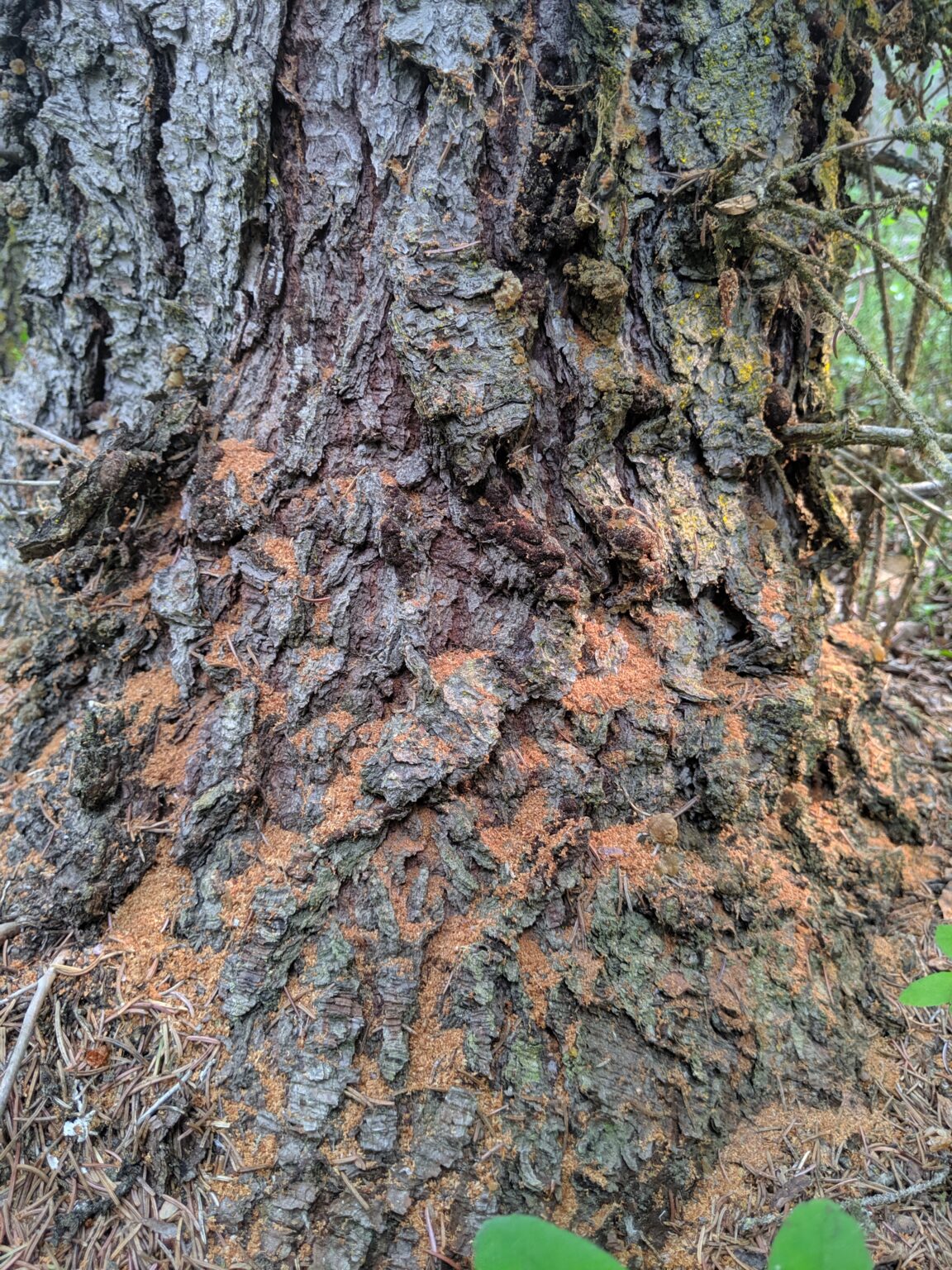
Another symptom is boring dust. Boring dust is a brown sawdust-like material that accumulates at the base of a tree, as well as in bark crevices. It is pushed out of beetle entrance holes as adults dig and clear their tunnels beneath the bark. Spruce beetles are not the only insects that produce boring dust, such as engraver beetles, so further investigation is needed to determine if this is spruce beetle.
The reddish globules that appear on trees are another indication of a beetle attack. These globules are called pitch tubes and appear on the bark’s surface and are the tree’s attempt to push out invaders. Stressed trees may not be able to produce enough resin, so pitch tubes may be small or absent. The success or failure of this defense can be assessed by examining pitch tubes closely. Large amounts of boring dust in the pitch and an unobstructed entrance hole may indicate beetle success.
A few other things to keep in mind when identifying a spruce beetle attack is loose bark and woodpecker attacks. Woodpeckers are attracted to the beetle attacked trees and will peck and scrape at the bark to find the beetles beneath it. Woodpeckers remove bark and leave behind flakes of wood at the tree’s base. This may be most noticeable in the winter when the bark accumulates on top of the snow.
The Alaska Division of Forestry asks residents to please avoid cutting live spruce or creating fresh spruce slash during late spring and summer when possible.
Keeping trees and forest stands healthy during increased spruce beetle activity is an important 1st step for management. Healthy trees are resilient trees, but a healthy tree is not immune to spruce beetle.
Using the same practices that keep spruce trees resilient against spruce beetle will be the same things to keep trees healthy in general. But as a refresher, remember to provide supplemental water during dry periods, especially in the spring when trees are breaking winter dormancy.
Avoid activities that compact the soil around the root zone of trees, such as driving or parking motorized vehicles, stacking firewood, or piling snow. Compacted soil limits root access to water, nutrients, and oxygen passing through the soil. If there is ongoing construction, extra precautions for priority trees should also be considered, such as fencing off the bulk of the tree’s root zone.
And avoid activities that could damage the trunk of trees, such as mowing and using string trimmers near the base of trees. It is beneficial to provide mulch for the tree but keep it away from the bark to prevent trapping moisture and contributing to rot. If people are planning clearing or logging operations, minimize damage to standing trees from equipment by providing sufficient room for staging equipment and clear paths for moving material.
Additionally, people can apply pesticides, but need to remember that pesticide applications for spruce beetle are preventive only and should be used only on trees that are uninfested at the time of application. Once a tree has been attacked, there is very little that can be done for the tree because of the nature and location of the damage.
To learn more about spruce beetle infestations and what is being done, visit www.alaskasprucebeetle.org

By Jeremiah Bartz Frontiersman.com A football coach using a hockey reference as the centerpiece for his keynote address may

Frontiersman.com With its headquarters in Wasilla, the Frontiersman has been a primary source of news for the Matanuska-Susitna

By Katie Stavick Frontiersman.com The next generation of leaders took flight this week as the Houston High School Class

By Kyle Wilkinson For the Frontiersman Keynote speaker and Carry the Cure President Bill Pagaran’s words boomed through the