Retiring teacher, coach urges Colony grads to ‘find their 68’
By Jeremiah Bartz Frontiersman.com A football coach using a hockey reference as the centerpiece for his keynote address may


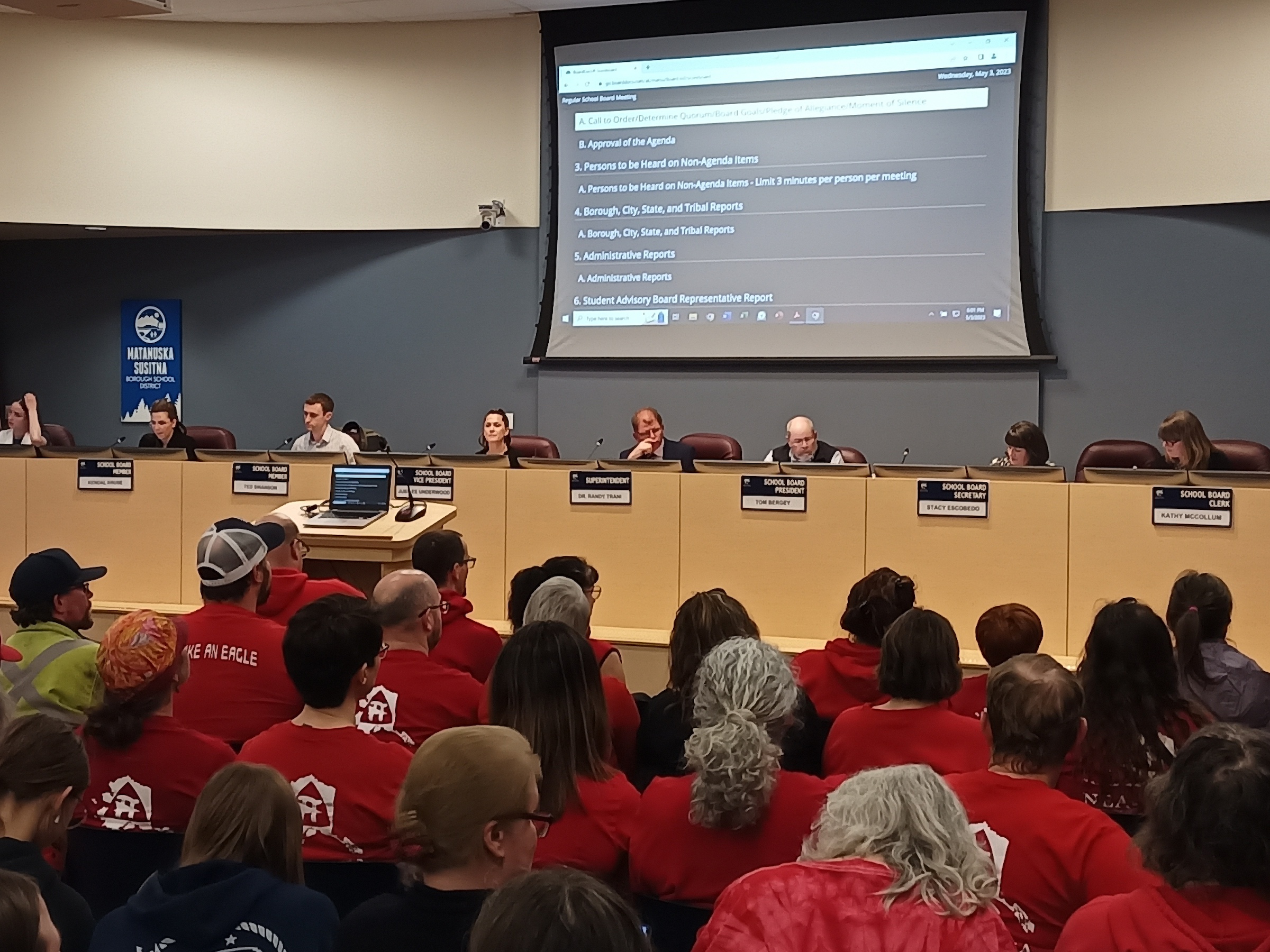
A sea of red shirts worn by members and supporters of the Mat-Su Education Employment Association (MSEA) and the Classified Employees Association (CEA) packed the room as the 2 two groups met at the Mat-Su School Board School District (MSBSD) building Wednesday to give public testimony pushing for new contracts, something they have been working without since June 2022.
Negotiations have been ongoing behind closed doors during Executive Sessions, but have been unable to reach an agreement with the MSBSD on employment contracts.
Sarah Ellis, a teacher at Finger Lake Elementary with 32 years of experience and is getting ready to retires, worries that many of her fellow teachers may not be able to say the same in the future.
“Too often during those years, contract negotiations between the teachers union and the school district have not gone well. Once again, we the teachers stand before you because we want and deserve a contract that is fair,” Ellis told the board members.
At issue is fair pay and health insurance. The MSEA and CEA say they oppose what the MSBSD is proposing due to the district’s chosen insurance providers’ high deductibles and stagnant pay.
CEA President Rick Morgan, who represents over 900 members, addressed the school board:
“All of us have experienced the record inflation that has hit Alaska for the last 3 years, and have watched with dismay at how disrespectfully we have been treated in bargaining. It is a sad day when our members can get paid better at Wal-Mart and McDonald’s than here, educating our children, and it’s heartbreaking to see those trained professionals leave our schools,” he said, before telling the board members that he had recently been told that if educators could get paid better elsewhere, then they should go.
“I’m here to say they have, but at what cost to our students?”
Morgan and many of the others who took time to speak at the meeting are upset that the MSBSD is looking to change the current health care providers from PEHT (Public Education Health Trust) to Premera.
“Now on top of stagnant and inadequate wages, the district wants to take away our health insurance provider,” said Morgan, who was frustrated that people were making decisions regarding
“It is hard to stomach that people…are dictating that we should simply accept a high deductible, high premium plan that could bankrupt the families of many Mat-Su educators.”
“You want to switch us to a high deductible health insurance plan. Absolutely not. We want a livable way to keep our health insurance,” said Ellis, who expressed frustration that so many, including principals, and the superintendent have to rally and come before a school board to argue for a fair contract.
The unions argued that the school district will not settle on a contract until both organizations give up their current health insurance provider for one that the district chooses for them.
“We have tentatively agreed to all the items except for health, salary, personal leave, and minimum working conditions,” said MSBSD attorney John Sedor while briefing the board on the status of contract negotiations. “With regards to CEA, we have tentatively agreed with every item except for health and wages.”
Sedor then addressed the catalyst item, that being the health insurance provider. He told the board that PEHT has been a source of friction for years specifically due to a lack of transparency and accountability
“PEHT is not an appropriate health insurance provider for the Mat-Su school district. PEHT is not transparent. Neither the district nor the association know if the money the employees pay into PEHT goes to cover Mat-Su employee claims.” Secor said.
In a negotiations document posted on the MSBSD website, the district lays out its proposed health plan, which says there are 2 options for members to choose from, a "mimic" plan which closely mirrors PEHT plans available, and a high deductible health plan with Premera. According to the document, the District's proposal would reduce employee health insurance premiums to $220 per pay period for the "mimic" plan and $126 per pay period for the high deductible health plan, and that these rates will not increase for FY 2025. There would also be included $8,500 HSA contributions to employees who elect the high deductible health plan option.
However, Morgan says that the plan is not saving employees money.
“When the District talks about “savings” they’re referring to the comparison in actual cost per paycheck, per employee. In their presentation last night, and during bargaining, the District has rebranded these “savings” as raises, or increased take-home pay for our members. However, what continues to be glossed over is that those dollars in many cases would need to be invested into a Health Savings Account (HSA), which has legal parameters about annual contributions and usage.”
Morgan also said that, while HSA may sound like a wonderful benefit, offering $1500 in HSA contributions to those in high deductible plans, those contributions are prorated per paycheck leaving people extremely vulnerable to out-of-pocket expenses early in the school year without access to the full balance of their HSA.
“Even common expenses like prescription drugs (which HSAs are frequently used for) may be out of reach for many employees due to low balances in their HSAs. Under their current proposal, the only local prescription providers are extremely limited and through online vendors, which could cause considerable accessibility issues for many of our members.”
He also said that the proposed insurance plan would not allow for employees to use and HSA and secondary insurance, whereas PEHT does.
“If you qualify for Medicaid, as many CEA members do due to low salaries, are a disabled veteran, or participate in Tricare, you can’t gain access to the District’s proposed HSA. Right now, members can be covered by their PEHT plan and a secondary insurer and walk out of a medical appointment with zero dollars out of pocket. That would all go away under the district's high deductible plan.”
Another issue the District has with PEHT is a lack of transparency, making the argument that District spends $41,000,000 each year for health insurance but cannot audit and effectively evaluate any information, such as claims, and therefore the District has no way to go to market for alternative coverage or know if the current program is cost effective.
“It is abundantly clear, as John Sedor, the District’s Attorney, said last night, that the goal of the District’s proposal is control over our health insurance. Given the significant trust issues our members have with the District as a whole, it’s no surprise that we are reluctant to accept their proposal without further negotiations.”
After the public testimony ended, most of the audience left, something MSBSD board member Ole Larson took exception to, saying during the meeting, “I’ve never seen that in the 15 years I’ve been on this board, and the teachers are educators and should be willing to listen to the education that we have, at least on the proposed side without turning their backs and walking out of this room. That is absolutely unacceptable.”
Meanwhile, Morgan said that it wasn’t out of lack of desire to listen to the board, but rather frustration.
“It was insinuated by Member Larson and others last night that our members were unwilling to listen to the District’s presentation. This couldn’t be further from the truth, and we’ve been listening for over a year during bargaining. What we didn’t anticipate was that the District would be given over an hour of unrestricted time to lay out their proposal while their employees were given 3 minutes.”
Negotiations are continuing.

By Jeremiah Bartz Frontiersman.com A football coach using a hockey reference as the centerpiece for his keynote address may

Frontiersman.com With its headquarters in Wasilla, the Frontiersman has been a primary source of news for the Matanuska-Susitna

By Katie Stavick Frontiersman.com The next generation of leaders took flight this week as the Houston High School Class

By Kyle Wilkinson For the Frontiersman Keynote speaker and Carry the Cure President Bill Pagaran’s words boomed through the