Retiring teacher, coach urges Colony grads to ‘find their 68’
By Jeremiah Bartz Frontiersman.com A football coach using a hockey reference as the centerpiece for his keynote address may


A few months ago, I was selected to serve as a jury foreman. After the verdict was reached, a fellow juror asked, “Why on earth did you become a P.E. teacher? You could be a lawyer.” I’m sure it was intended as a compliment, but I didn’t see it that way.
A year ago, an administrator told a group of physical educators that she would like to be a P.E. teacher because she “could go to work in sweatpants every day.”
A retired teacher I know likes to tease that my lesson plans read, “Roll balls out. Roll balls in.”
There seems to be a general lack of understanding about what takes place in physical education classes these days.
Physical education is where our kids learn how their bodies work, and how to work their bodies. It is where students set goals, and strive to achieve them. They discover how to harness their competitive urge in order to realize great accomplishment. They develop strategies for success, challenge themselves to improve, and practice winning graciously and losing respectfully. In physical education, students acquire the movement, fitness, and interpersonal skills to successfully participate in a variety of activities they will enjoy for a lifetime. They practice independently, as well as collaboratively with partners or teammates.
Learning in the gym goes far beyond throwing and kicking. Physical education students use math skills when they divide into groups, measure their vertical jump, or calculate their split times. The sciences are applied when they exercise at their target heart rate (physiology), refine their basketball shot (biomechanics), or make conscious nutritional choices (chemistry). Physical education has a vocabulary of its own, and many games and activities have an historical or cultural context. As a school subject, physical education has it all!
So why does physical education seem to hold a lower place in the hierarchy of educational importance? Recent studies have demonstrated that physical fitness levels are directly related to higher academic performance. Neuroscience research shows that daily physical activity (especially cardiovascular exercise) encourages the development of neural pathways, and even the growth of new brain cells. Activities requiring complex movements during heavy exertion (such as rock climbing, or snowboarding) have even been shown to help the concentration of students with attention disorders.
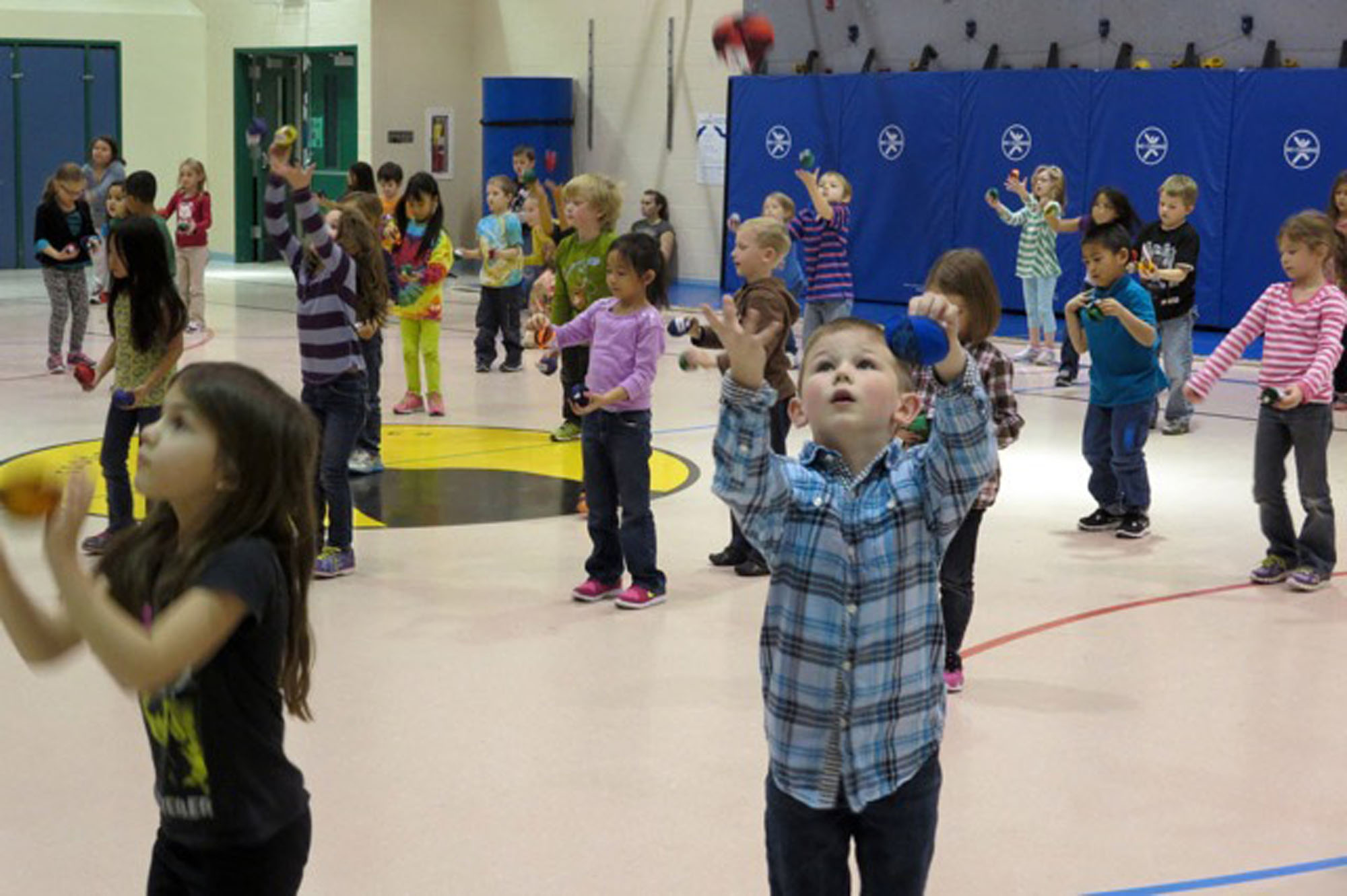
Here in the Mat-Su, students are fortunate to have rich and varied experiences in physical education. At Fronteras, students are connecting to Alaska Native culture by practicing their skills for the Junior Native Youth Olympics. At Houston High, students are building snow caves as part of their outdoor recreation and safety unit. In Talkeetna, students are exploring the local trails on their Nordic skis. At Goose Bay, students are cultivating their brain-body connection by juggling. Later this winter, Mat-Su students with disabilities will travel to Alyeska with the adapted physical education specialists for downhill ski and snowboard instruction.
Cottonwood Creek, demonstrating the importance of movement to academic learning, has recently started the “Just Move” program to bring physical activity directly into the classroom. Our students need more movement in school, and the place where kids learn to move is in P.E. When we teach them the skills, they will discover the joy, and they will be active for life.
The truth is out there: P.E. is more than just fun and games. After all, it is physical education.
Nancy Blake teaches physical education at Goose Bay Elementary School.

By Jeremiah Bartz Frontiersman.com A football coach using a hockey reference as the centerpiece for his keynote address may

By Katie Stavick Frontiersman.com The next generation of leaders took flight this week as the Houston High School Class

By Kyle Wilkinson For the Frontiersman Keynote speaker and Carry the Cure President Bill Pagaran’s words boomed through the

By Jeremiah Bartz Frontiersman.com The community of Palmer is known for a couple of things. At or near the