Retiring teacher, coach urges Colony grads to ‘find their 68’
By Jeremiah Bartz Frontiersman.com A football coach using a hockey reference as the centerpiece for his keynote address may


Some of Alaska’s sled dogs pull champion teams thousands of miles across the tundra. Some sled dogs live their lives in recreational kennels, running on local trails, getting to sleep cozily on a couch.
And some of Alaska’s sled dogs end up being victims of terrible abuse, trauma and neglect.
For those unfortunate dogs, Raven Vinter set up Sled Dog Sanctuary with the goal of providing a safe haven and the chance “to start a new life.”
To the newly rescued dogs Vinter says, “We’re going to make sure nobody hurts you and that you find your friends and you find a home.”
Where they came from and how they got there is largely irrelevant; Vinter’s mission is to build the dog back up, all with the aim of ‘allowing each dog to reach their highest potential.’
And when they are ready, there is then the chance for people to adopt these dogs, giving them a new life, either in the home of a recreational musher as a member of a dog team or in a family’s home as a beloved pet.
There is a sign at Sled Dog Sanctuary that says, ‘who rescued who?’ It refers to the way that a dog from a difficult background can give support to people in similar situations.
Vinter explained that she personally found companionship in the darkness with rescued sled dogs.
“You know what it’s like to be alone in those really hard times, and those dogs come in and you think, you’ve also been alone a long time,” she said.
Because they need to be fed and they need to get exercised, the dogs also had the benefit of forcing Vinter to go outside.
“Like it or not, you’re going to be out of bed,” said Vinter.
It proved improved impossible for Vinter to keep the healing power of the dogs to herself.
For the past four years, Sled Dog Sanctuary has been engaged in Harnessing for Hope, community outreach projects with adults and teenagers with special needs and reduced mobility, partnering with groups based out of Anchorage, such as Challenge Alaska and FOCUS Outreach.
The partnerships have led to week-by-week classes and a sense of accomplishment for the participants.
“By the end of the winter season they have been on a sled and can consider themselves mushers,” said Vinter.
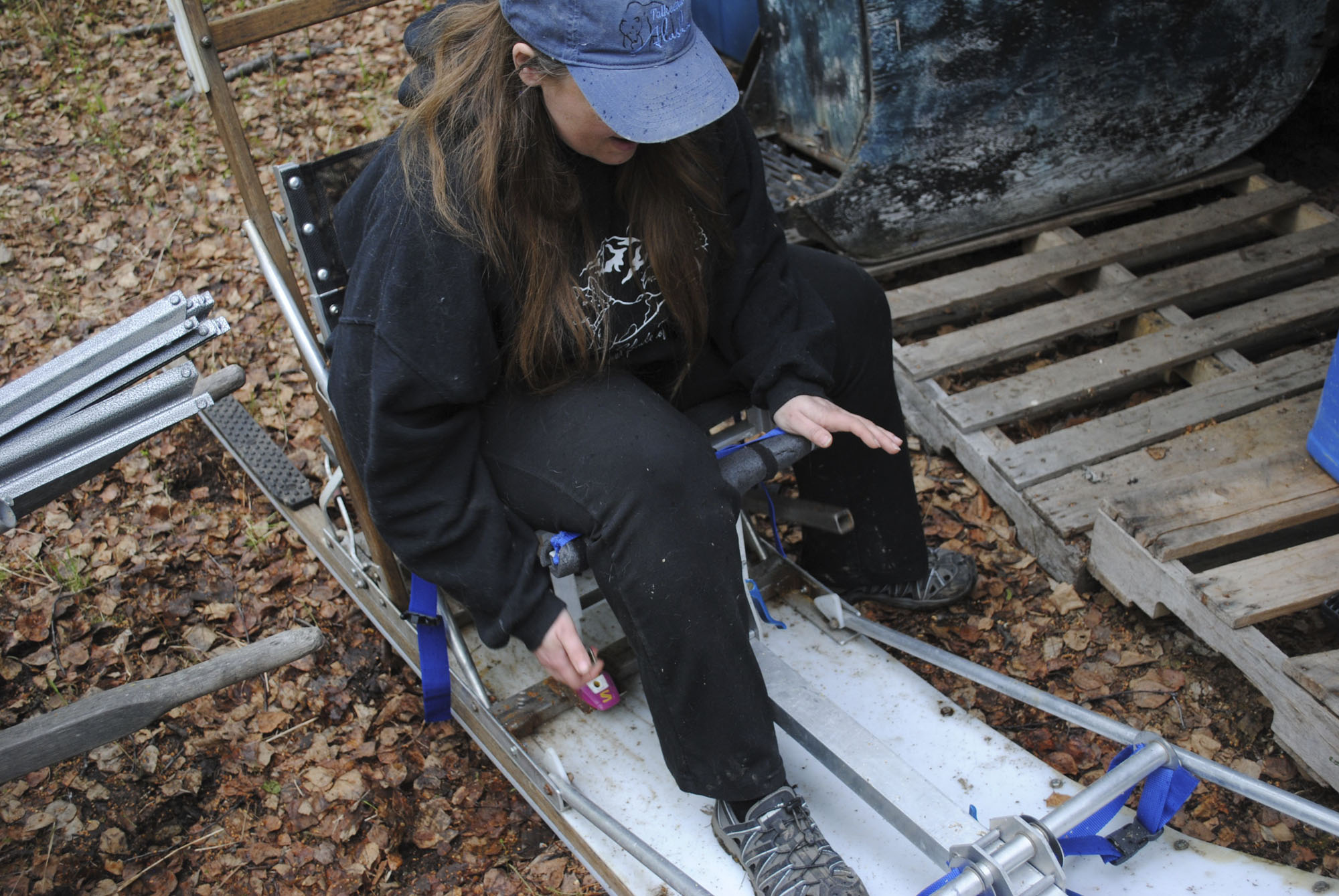
Sled Dog Sanctuary has also expanded into working with adaptive sleds that allow people paralyzed from the waist down to independently run a dog team. One sled, designed by Daniel Lee for a Graduate Project in 2015, allows a musher to brake while sitting in the sled’s basket.
Lee has returned to Alaska and the goal of the adaptive sled project has been expanded to allow reduced mobility mushers to be positioned on the runners, or as Vinter described, “The proper mushing position.”
The working theory is to build a rotational seat that would allow people to easily get on and off the sled and, at the same time, really “feel like they’re mushing,” Vinter said.
Vinter and Sled Dog Sanctuary have also been recently working with veterans and sufferers of PTSD. There have been some promising results as people with profound mental traumas meet dogs that have similar issues.
Vinter recounted one story when she was speaking to a group, a soldier quietly walked over to a dog named Strider that was under-socialized and chronically shy. He started interacting with him in a way that Vinter had never seen before.
“I look over and Strider is letting him pet him and he’s up on his house and there’s this complete connection,” she said.
For Vinter, the experience led to a realization of, “Seeing these guys come in and seeing that they have the same problems — there’s more here than just saving dogs.”
The kindness and generosity of Sled Dog Sanctuary has been partly repaid by members of the community: people are able to donate, visit the gift shop, volunteer or sponsor dogs.
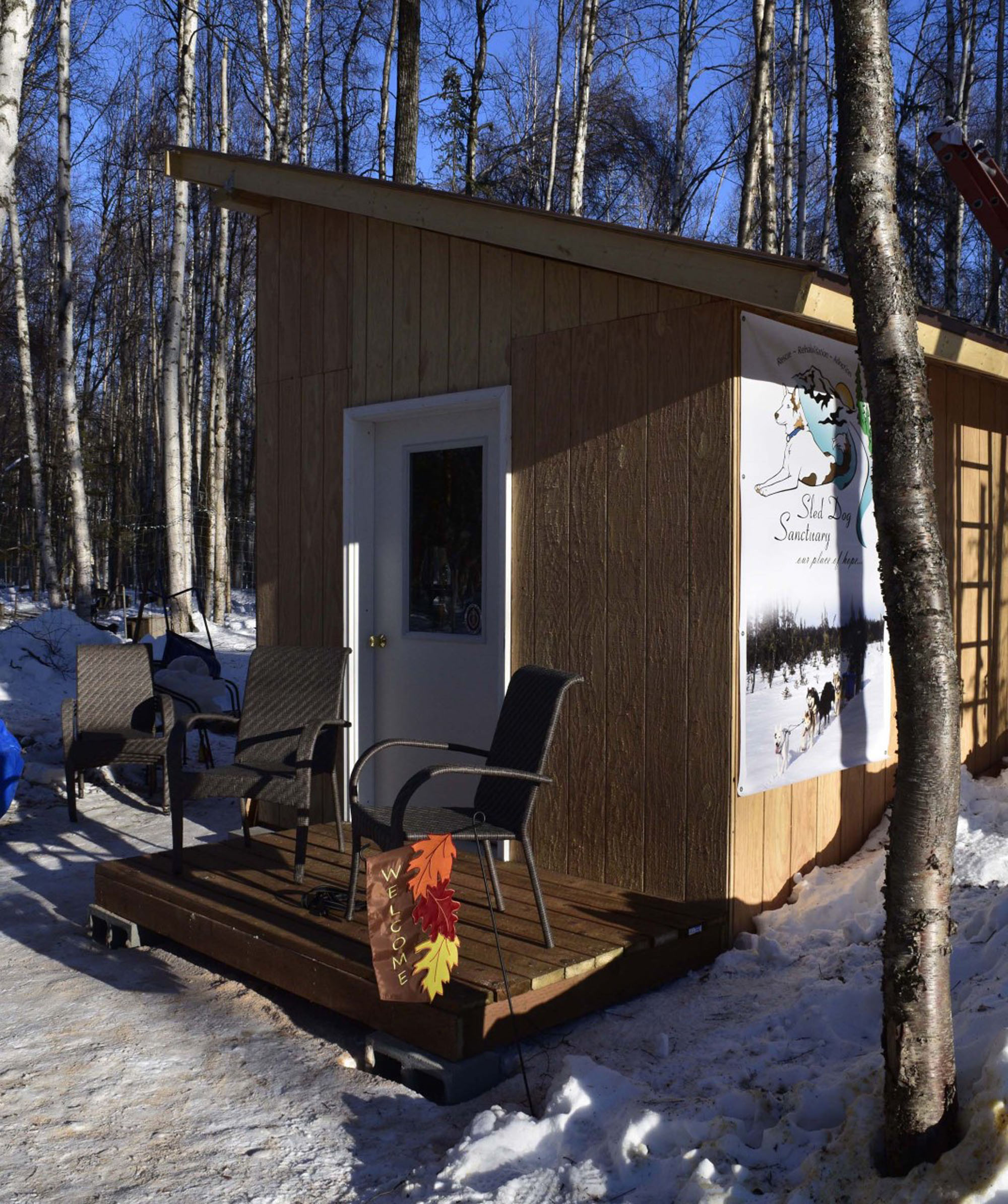
Other people, such as the Sellers family in Eagle River, have gone above and beyond. They donated a small heated cabin as part of an Eagle Scout community outreach project.
“Every piece of plywood, every nail, we didn’t pay for any of it, they donated the whole thing,” said Vinter.
The building is used to get warm, get changed and have a cup of cocoa. For people with reduced mobility it is especially important, as Vinter explained freezing people often don’t have feeling in their extremities and there is the risk of hypothermia setting in.
Sled Dog Sanctuary is still under-supplied in other areas with Vinter hoping to partner with an outerwear company that would be willing to donate some gear.
“A lot of people we’re dealing with are in the Anchorage area and they come up here and its 10 degrees colder. We had some kids show up when we first started doing this with sneakers and no socks on. If we could put a jacket on that kid, that would have been amazing.”
What better dog could be imagined for the tough terrain of Alaska than an Alaskan husky?
Their legendary endurance makes them almost unbreakable; they’re fiercely intelligent and their coats make them almost impervious to cold. It’s no coincidence that they’re perfectly suited to the environment; they’ve been purposefully designed to be Alaska-proof.
Vinter explained that mushers over generations bred large numbers of dogs in search of ever-greater speed, stamina and strength, and as a result, they have forged “their strong genetics.”
They are in short, “a dog that can sustain itself,” said Vinter.
“They’re savvy about cars even if they haven’t seen them,” she added. “They know intuitively to protect and defend themselves.”
And if they were to run into a moose on the trail, “The smart ones get out without a scratch, the other ones have a short lifespan!”
For people who are interested in adopting a sled dog, but assume that they need to run 20 or 50 miles a day, Vinter can reassure you this isn’t the case.
“We’ve had dogs adopted to hikers, even weekend hikers that have worked out really well,” she said.
While you might be active, one of the most common complaints Vinter has received from people adopting sled dogs is of the breed’s phenomenal energy. They are, especially when they’re young, extremely hyper.
People who are less active, or who just want a less energetic dog, should think about adopting a senior. A group that is often ignored at Sled Dog Sanctuary.
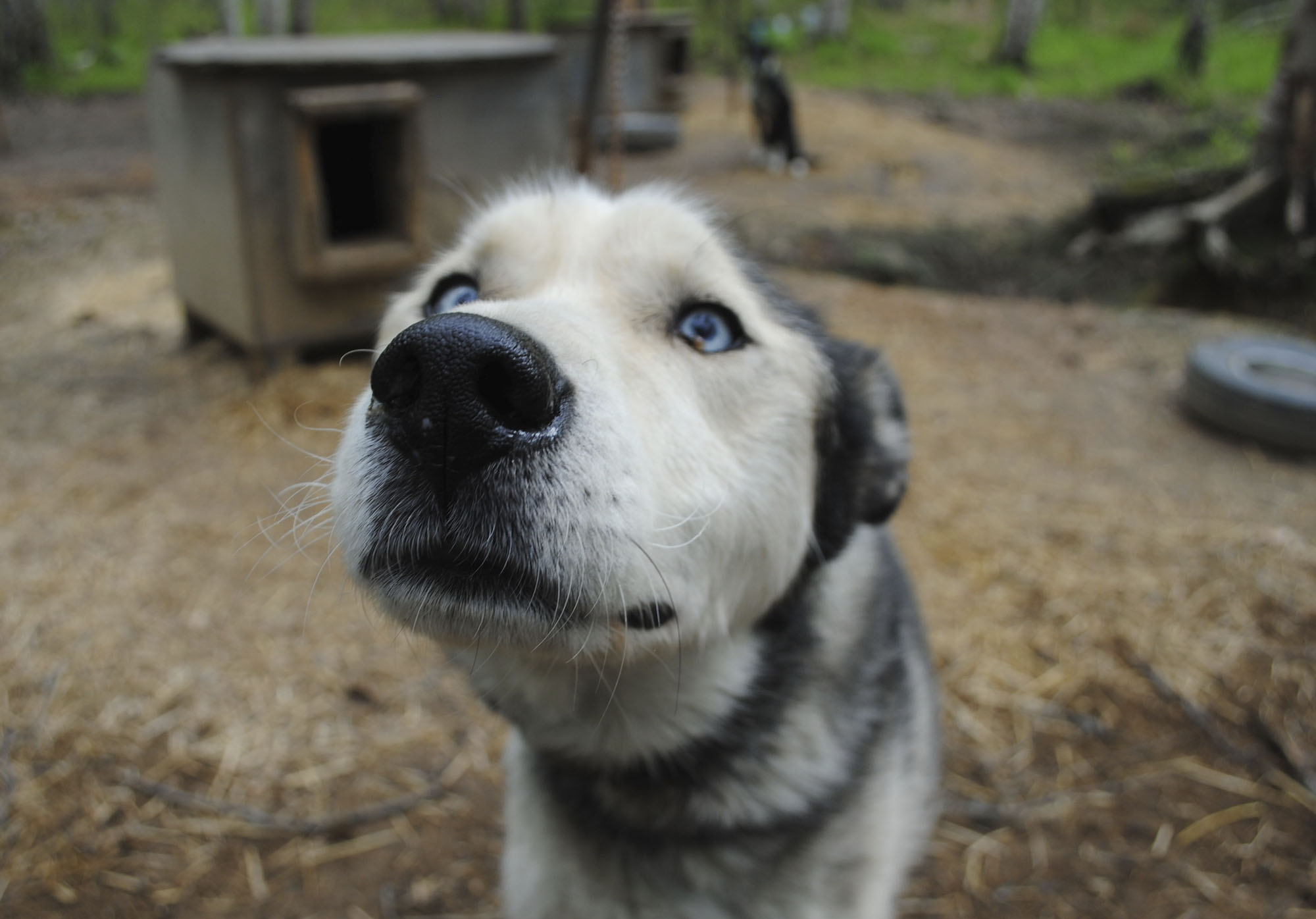
“We get a group of dogs in and the young dogs will go, the cute and blue-eyed ones, they’ll go, and then what happens is that we’re left with a lot of the seniors,” said Vinter.
And “seniors would be very happy with a mile every couple of days,” explained Vinter.
It’s also easy when visiting Sled Dog Sanctuary to be seduced by the extroverted dogs that jump up and slobber all of you. There can be real benefits however to spending some time and meeting the dogs that might be more reserved.
“Some of the shyest ones have been my best dogs, on the trail, at home. They’ve been the most intuitive and intelligent,” explained Vinter.
Odin, a big dark brown extrovert proves the point. While he’s sensitive, sweet and great at meeting kids he’s also notorious for not working.
“He’ll go along and he’ll love it (but) he won’t pull a pound,” laughed Vinter.
The process of adoption at Sled Dog Sanctuary isn’t as simple as other kennels. There are dogs available to be viewed online but then, if the person is in-state, they are highly encouraged to come out and meet the dog and see whether a connection can be forged.
This is a point reiterated repeatedly by Vinter. They are looking for ‘a compatible match of a sled dog's personality with those of their adopters.’
It’s not enough to want a dog. They need to want you back.
And if one does, it’s almost certain that you’ll be asking, who rescued who?

By Jeremiah Bartz Frontiersman.com A football coach using a hockey reference as the centerpiece for his keynote address may

Frontiersman.com With its headquarters in Wasilla, the Frontiersman has been a primary source of news for the Matanuska-Susitna

By Katie Stavick Frontiersman.com The next generation of leaders took flight this week as the Houston High School Class

By Kyle Wilkinson For the Frontiersman Keynote speaker and Carry the Cure President Bill Pagaran’s words boomed through the