Retiring teacher, coach urges Colony grads to ‘find their 68’
By Jeremiah Bartz Frontiersman.com A football coach using a hockey reference as the centerpiece for his keynote address may


PHOENIX, ARIZONA — Willow’s running man is back in world-record fashion.
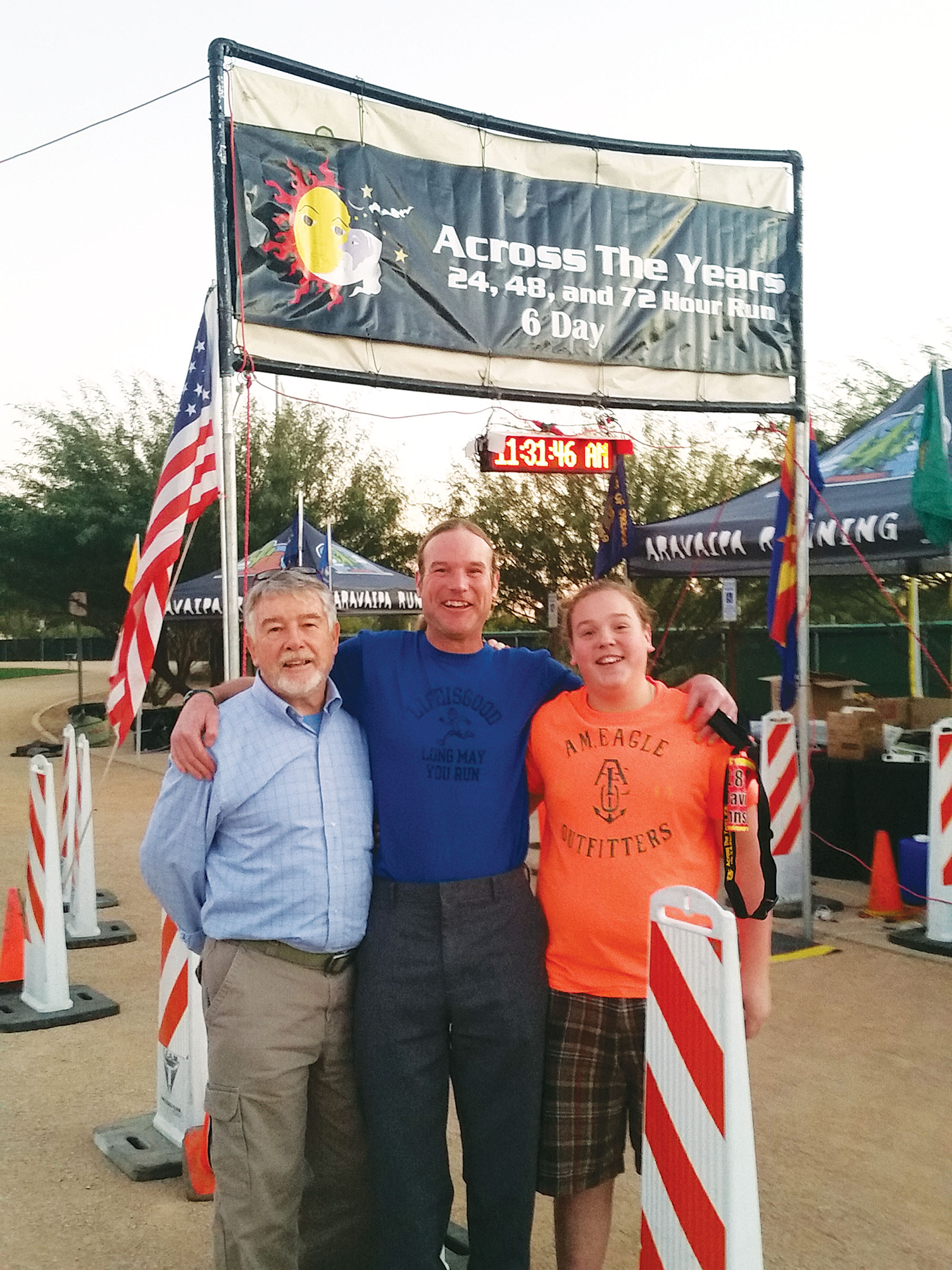
On Dec. 28, 2014 David Johnston began his second 6-day race effort — his first was Anchorage’s Six Days in the Dome — in Aravaipa Running’s “Across the Years” footrace in Arizona. At the end of those 144 hours, Johnston had finished 551.15 miles for a 10.8-mile lead over the runner-up, a world record for men age 40 to 44, according to Aravaipa’s Facebook page.
And Johnston is at the top of that age bracket.
Although many people think of running as a “young man’s” sport, this year’s 6-day Arizona event saw more competitors in the 40- to 50-year-old age range than anything else. In fact, of the 52 male and female competitors in the 6-day division (there were 3-, 2-, and 1-day divisions as well), only 10 were under 40. The youngest runner was 18, the oldest 84, and each completed around 120 miles.
Patience, Johnston said, is probably what brings in the older runners.
“This sport, it takes 6 days before you get the glory. When you’re younger, you wanna get the glory quicker,” he said.
Last year’s winner of Across the Years was 49-year-old Joe Fejes of Georgia, who finished with just more than 555 miles, and took the American men’s indoor track record of 580 miles during Six Days in the Dome last August.
So even though Johnston’s record has rather narrow parameters, it’s no secret that his accomplishments — among other things — have made him a unique competitor.
“We knew that Dave was gonna be one of the contenders, probably the favorite for sure,” said Aravaipa Running owner and race director Jamil Coury by phone Monday.
Coury has been watching Johnston’s performances for a while, and was particularly impressed by his finishes in the Iditarod Trail Invitational and other Alaska races.
Coury said Johnston was fairly consistent throughout the race, sticking with French competitor Christian Mauduit, who came in second.
“They went back and forth a little bit early on, but pretty soon Dave built up a lead and he kept that 10-20 mile buffer for several days,” Coury said.
Johnston said Mauduit was, to put it lightly, not a very charitable opponent, which made each of them add “beat him” to their list of goals.
“I had to stay ahead of him and stay smarter than him,” Johnston said.
So when Mauduit passed him on day 3 and built up a 1-2-mile lead, he got a little nervous.
“That was very humbling,” Johnston said. “He has a lot more experience than I do.”
Nevertheless, small-town Alaska came out on top.
Even without the Frenchman’s level of experience, Johnston’s training made his race a success. His run from Anchorage to Fairbanks for the Equinox Marathon last fall, for example, proved to be “the perfect training run” for Across the Years.
“There couldn't have been a better thing to toughen me up,” he said.
Johnston said temperatures dropped to the low 20s in the desert at night, and the pounding around each gravelly lap worked hard on runners’ joints, but Alaska had prepared him.
“Eventually your legs just hurt so bad, whoever cries ‘uncle’ first loses,” he said.
However, pain was hardly the only barrier to overcome in almost a full week of running.
“Seventy-five percent of the battle is showing up,” Johnston said.
Then he had to resign himself to the fact that he would be running for 6 days straight.
“It takes mental fortitude, so many other things than just athleticism,” he said.
One of those things is simply the ability to literally stay sane. After several days of running 18 to 24 hours a day through heat and cold — obviously with very few hours of sleep in between — Johnston said he started to hallucinate.
It wasn’t just seeing what wasn’t there, however. After waking up from a nap, Johnston had to receive clarification from his father on where he was, what he was doing and “how do I score points?”
He even tried to “barter” with his dad, asking if he could nap again after one more lap.
“I think you literally just fry your brain,” Johnston said.
He might be right. A recent article in BMC Medicine’s online journal — which can be found at bit.ly/1ItbzTO — describes the study of 15 ultramarathon runners who participated in a roughly 2,800-mile 2009 race in Europe. The researchers found that the average volume of a runner’s global gray matter — nerve tissue, mainly that of the brain and spinal cord — decreased by 6 percent during the race. Only 8 months later did that volume return to baseline.
Needless to say, without someone camped out on the racecourse to watch over him, Johnston would’ve been toast.
And he was able to have “a neat bonding experience” with his dad, Johnston said.
But he’s not finished running races of, by most people’s standards, scarcely imaginable caliber.
That’s right — the Susitna 100, Iditarod Trail Invitational and the Boston Marathon are still on the table. Johnston is back at his day job and intends to start running again in a couple days, once it is determined he has no lasting injuries from the Arizona race.
And he’s already thinking about next year’s 6-day Phoenix adventure.
“I think this is an event where, the more experience you get, the better you’re gonna do,” he said.
“It’s really a top-notch event, and it’s really competitive, and that's what I look for,” he added.
Contact Caitlin Skvorc at 352-2266 or caitlin.skvorc@frontiersman.com.

By Kyle Wilkinson Kyle in the outside Our spring bear hunt was bittersweet this year. We’re heading home without

Frontiersman.com Valley athletes earned titles during the Region III Championships track and field meet last week at Colony High

Leila Petersen Palmer Moose Leila Petersen, a member of the Palmer track and field team, has been named a Frontiersman

By Jeremiah Bartz J’s World August would have been the start of my 25th year as an editor at