Retiring teacher, coach urges Colony grads to ‘find their 68’
By Jeremiah Bartz Frontiersman.com A football coach using a hockey reference as the centerpiece for his keynote address may


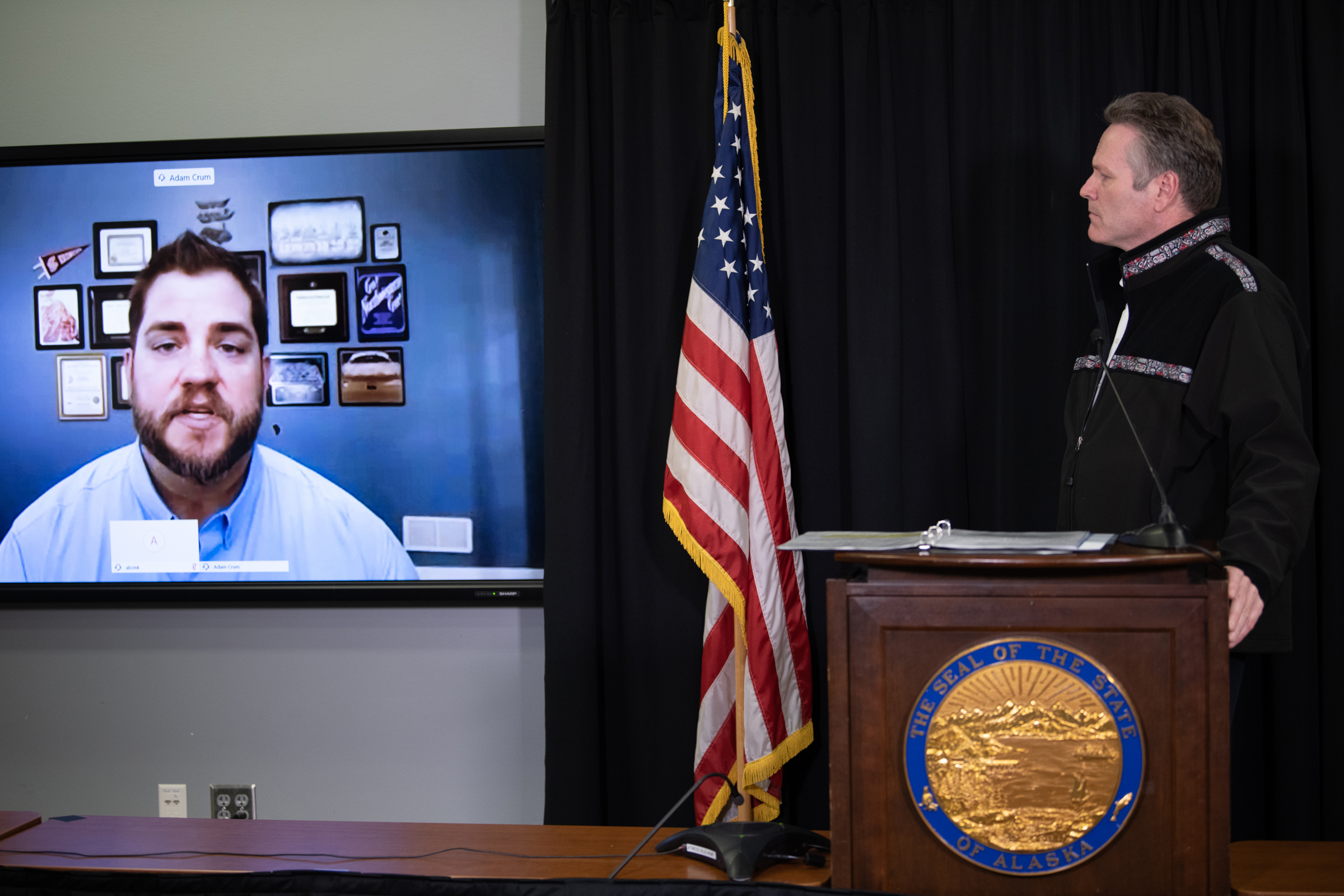
ANCHORAGE — More than a month into the coronavirus pandemic’s spread into Alaska, Gov. Mike Dunleavy has repeated that Alaska’s numbers are looking good, and on Monday detailed what his administration will keep their eye on as more Dunleavy rolls out his plan to reopen sectors of the economy later this week.
Dunleavy was joined at his daily press conference by Alaska’s Chief Medical Officer Dr. Anne Zink and Department of Health and Social Services Commissioner Adam Crum. Dunleavy announced two more cases of COVID-19 on Monday and nine total over the weekend. No more Alaskans have been hospitalized or died as a result of infection with the coronavirus, 10,024 Alaskans have been tested and only 3.1 percent of those tested have tested positive.
“I that we have real hope in Alaska. I think that we have really been able to not just flatten that curve, but really significantly push it down and what Alaskans have done has just been absolutely phenomenal,” said Zink.
While the Mat-Su had four consecutive days without positive cases last week, four more people in the Mat-Su have tested positive since Friday. According to new data on the state’s data hub, there are 12 active cases of COVID 19 in the Mat-Su, and only 702 tests accounting for 0.66 percent of the population have been tested. As the low number of new cases allows for sectors of the economy to gradually reopen, news of a dramatic drop in oil prices concerned Dunleavy.
“We obviously have to keep an eye on the oil price and the ability to ship oil and move oil because it forms the backbone of Alaska’s revenue sources and our economy, so certainly I’m concerned about it,” said Dunleavy.
Health care facilities were permitted to begin operation on Monday with safety precautions in place. Crum answered a question about what response the state would have if a spike in cases developed after sectors of the economy are reopened by saying they would investigate case contacts.
“We are not anticipating large spikes in increase in cases, perhaps that can come with this but we believe we can have the bandwidth to actually withstand that now,” said Crum.
Dunleavy released no specifics on when or how these economic sectors would be reopened, but said that he will continue having conversations with mayors and leaders of Alaskan communities as part of phase one. Dunleavy said that within two weeks, Alaskans can expect to see barbershops, nail salons and restaurants reopen to customers that maintain a social distance within the business and do not have more than 1o people. Dunleavy said that more information about which parts of the economy would reopen will be available Tuesday.
“It’s our hope, it’s our plan not to have to go back to where we were where a lot of things were suspended,” said Dunleavy. “We’re going to try to do everything we can to move Alaska back and get Alaskans back to working and get Alaskans back to participating in these activities in these businesses and their services and their products, but again we’re going to ask you to do everything you can. No shaking hands, please washing your hands, w wiping things down, staying away from folks, wearing masks when possible.”
Without any new Health Mandates, the only major change in COVID 19 protocol around the state was announced when Dr. Zink said that anyone with any symptoms consistent with COVID can now be tested as the criteria have again broadened. Zink detailed how different data is more useful later on in the progression of the spread of coronavirus. Where the total case counts were useful in March, Zink redirected focus to the graph of active cases in the state. Zink used an analogy of sailing in rough waters, and said that measures like hand washing, social distancing and face covering have become Alaska’s lifejacket. Zink then detailed the four categories to move forward as a state. Zink said that she is closely monitoring hospital capacity, monitoring and containment of those who have tested positive, testing and determining if the disease burden is decreasing.
“You can see that there’s just been a really progressive downward trend that we’ve had a consistent greater than 14 day downward trend in our cases and that’s absolutely critical,” said Zink. “No community is on their own. We are in this together and we as a state are thinking broadly about every single community and what it takes to support you if you do have cases.”
Zink noted that unlike 1918, Alaskans can be tested for coronavirus. While the state lab has a test capacity of 7,000 tests per week, less tests than the maximum are being conducted. Zink said that additional staff would be hired to help monitor close contacts of positive cases. Currently, Zink said that 100 people work on contacting people who have tested positive and that each employee can handle up to five cases at a time. Zink also used a stoplight graphic to illustrate how and when officials will lift restrictions. With downward trends that exist currently, the green light has been given to begin risking restrictions. A yellow light of slow or stable increase in cases would result in voluntary measures to flatten the curve and a red light of constant rapid increased cases or drastic decrease in hospital capacity would result in reimplementing restrictions.
“The more we can keep our face covered when we’re out in public, the better off we’re all going to be and the quicker we can open more things up together, so the more we can keep this virus controlled, the more we can get back to our daily lives as we knew it prior to this epidemic,” said Zink.
Crum discussed the ongoing conversations with members of the fishing industry around Alaska’s many fishing communities. While no announcement was made on Monday, both Crum and Dunleavy hinted at an announcement later this week of additional Personal Protective Equipment arriving from the Federal stockpiles. Crum said that Abbott rapid testing machines and medical equipment are being pre staged at fishing communities to ensure the capability for testing.
“We are hoping that Alaskans would wear a face covering when they’re going into a store for example,” said Dunleavy. “We are one of those states where folks will stay six feet away in order to help you.”
Support local journalism. By subscribing you help local journalism continue to thrive. For our latest digital subscription information, see frontiersman.com/site/forms/subscription_services/

By Jeremiah Bartz Frontiersman.com A football coach using a hockey reference as the centerpiece for his keynote address may

Frontiersman.com With its headquarters in Wasilla, the Frontiersman has been a primary source of news for the Matanuska-Susitna

By Katie Stavick Frontiersman.com The next generation of leaders took flight this week as the Houston High School Class

By Kyle Wilkinson For the Frontiersman Keynote speaker and Carry the Cure President Bill Pagaran’s words boomed through the