Retiring teacher, coach urges Colony grads to ‘find their 68’
By Jeremiah Bartz Frontiersman.com A football coach using a hockey reference as the centerpiece for his keynote address may


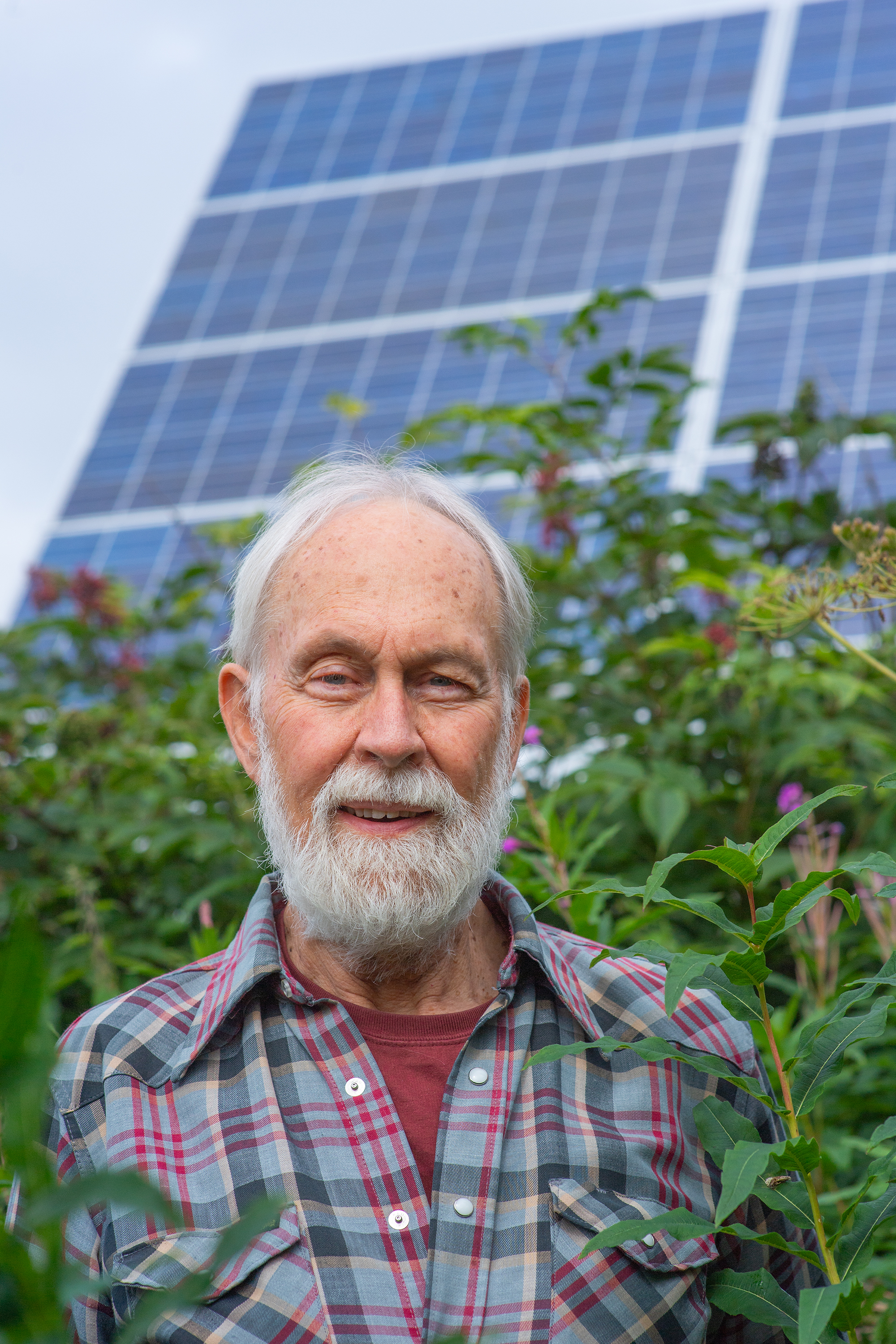
Kevin McCabe and Jim Sykes. You couldn’t find two people so different politically – McCabe, now in the state House, leans right; Sykes, a former borough assemblyman, leans left.
They live far apart in the Mat-Su Borough, too: McCabe lives near Big Lake, while Sykes is near Butte.
They have different professional backgrounds: McCabe is a commercial pilot; Sykes spent his career in broadcast.
But here’s what they have in common. Both like living “off the grid,” being self-sufficient with solar-powered electricity and, in McCabe’s case, wood heat through the winter for the 1,000-square-foot cabin he shares with his wife, Linn.
Both like the idea of being self-sufficient, and being prepared, although McCabe said that it is a lot of work splitting wood for the winter. He owns 40 acres, however, and has a plentiful supply of wood between blow-downs and beetle-killed spruce.
Sykes enjoys being self-reliant, too. He is an energy conservation buff who built his unconventional house with straw insulation.
“There’s a little Boy Scout in all of us,” McCabe says. He acknowledges that he is a tinkerer and technology buff, and has long been interested in solar. He installed all of his solar by himself.
On the cabin, McCabe has 10 solar panels including six 185-watt panels and four 350-watt panels. He also has six 185-watt panels on his shop, which is a separate structure.
“I started first with the 185-watt panels which then cost $500 a panel. The price dropped to $200 panel, so when I added on we installed the more powerful panels,” he said. Battery packs were also installed for backup, with a both 2 volt and 6 volt batteries. All in, McCabe believes the combined solar panels and batteries could be put in for between $10,000 and $12,000.
Sykes and McCabe both admit their decision to be self-reliant, while deeply felt, was also forced by circumstances: When McCabe was told by Matanuska Electric Association, or MEA, that it would cost him $875,000 to hook up, the decision made itself. But that involved five miles of installation with poles and new wire. For Sykes, the price was also prohibitive for MEA to extend its wires.
This is a common problem for people living in rural areas. MEA, the regional electric cooperative, is gradually building out its system but it can’t economically serve all parts of the sprawling service territory, which is as big many states, at least until there is enough population in an area to make it affordable.
McCabe and Sykes aren’t alone in going off the grid. McCabe says he has eight neighbors on the road where he lives, all on solar. Sykes has neighbors who are 100 percent on solar, too.
Because they’re not hooked up to MEA McCabe, Sykes and their neighbors can’t participate in MEA’s net metering program, where the electric co-op buys surplus solar from a property owner’s installation. There has to be a wired connection to do that.
But on the other hand, during power outages the unconnected, stand-alone solar kept the power flowing while buildings even with solar connected by wire to MEA went down. The relatively brief region-wide outage in early August turned off the lights at thousands of homes and businesses in Southcentral Alaska. But not for McCabe, Sykes and their neighbors who were on their own.
McCabe says, however, that buildings with solar who remain connected to the local utility can still have backup batteries to keep this running during an outage. Getting batteries raises costs, but they’re needed. McCabe runs the house and shop off the batteries and then recharges the batteries with the solar.
There are other solar enthusiasts in the Mat-Su, including Gov. Mike Dunleavy, who recently had solar installed at his home. Another is Chris Rose, who lives in Sutton. Rose is on the MEA system but has solar panels that generate about half of his needs. Because he is connected to MEA Rose sells his surplus solar power to the co-op under net metering, which required of all electric utilities under a state law enacted a decade ago.
The surplus power is deducted from Rose’s monthly electric bill, and in that way he can also see how much electricity his solar is generating in a month.
It’s commonly thought that solar doesn’t work so well in Alaska because of our dark winter months. Ninety five percent of solar power is captured between February and October. But Alaska actually has a solar resource similar to Germany, which generates about 12 percent of its electricity from the sun and has the fourth highest installed solar capacity in the world.
There is less light from Thanksgiving to February, McCabe agrees, so he runs a generator to up charge his batteries but also gets enough sun during the winter weeks to provide about half the electricity his house and cabin need.
What’s interesting, however, is that winter snow cover provides what’s called a “snow bounce,” of light reflected off the snow, that supplements the dim daylight. There is a type of bifacial solar panel that receives sunlight from the front as well as light reflected off the snow in the back. Bifacial panels add about 5% to 10% more electricity.
The snow “bounce” gets more intense as the days lengthen in February and March and there’s still snow. By mid-spring McCabe is back to getting almost all the power he needs from solar.
Jenn Miller, CEO of Renewable IPP, a small Alaska-based private company, operates the larger commercial solar installations at Houston and Willow that provides power to MEA, and also reports good performance of her company’s solar plants through the winter, which also have bifacial panels. Miller’s company is also engaged in planning commercial-scale solar plants on the Kenai Peninsula and in Nenana, which is north of Healy in Interior Alaska.
These are larger solar installations than those installed on home or commercial building rooftops but Miller believes solar could make a dent in natural gas now being used to generate electricity in Alaska. Seven to 12 solar farms of about 30 Megawatts each, not much bigger than those being planned, could reduce gas consumption by 10 percent to 20 percent in Southcentral Alaska. This is important because Cook Inlet gas fields are being depleted and not enough new gas is being found.
“There are lots of south-facing rooftops,” in the region with opportunities for solar, Rose said. The 40% federal tax credits available for a few more years will pay part of the installation cost. “We need to do everything we can to displace the use of natural gas for power because that will push out the time by which imported liquefied natural gas will be needed,” to replace declining gas from Cook Inlet.
Smaller solar installations can play a role in this, too. McCabe, Sykes and their neighbors have installed stand-alone solar units on structures on their property but a new state law signed by Gov. Mike Dunleavy in mid-August encourages “community” solar projects that could be a larger installation serving several buildings like condominiums or apartments. These could also support clusters of homes in a rural neighborhood, lowering the cost with a centralized facility.
Senate Bill 152, establishing the new community solar law, also allows community projects powered by other renewable energy sources like wind and small hydro. Twenty four states have laws encouraging community solar but Alaska is the firt state to incorporate other forms of renewable energy.
The federal government is also offering tax incentives to encourage home solar including a 30% tax credit. Two state agencies, the Alaska Housing Finance Corp. and the Alaska Energy Authority, are also gearing up to implement the federal government’s “Solar for All” program, which will help establish home and community solar projects across the state.
Being off the grid has long been a necessity in Alaska but it’s becoming fashionable in the Lower 48, too. There’s an active movement to disconnect from contemporary comforts in many parts of the nation and many enthusiasts are promoting their new lifestyles on social media. For many, the one necessity of life they can’t live without is an Internet connection, but solar power and Low Earth Orbit satellites can provide that.

By Jeremiah Bartz Frontiersman.com A football coach using a hockey reference as the centerpiece for his keynote address may

Frontiersman.com With its headquarters in Wasilla, the Frontiersman has been a primary source of news for the Matanuska-Susitna

By Katie Stavick Frontiersman.com The next generation of leaders took flight this week as the Houston High School Class

By Kyle Wilkinson For the Frontiersman Keynote speaker and Carry the Cure President Bill Pagaran’s words boomed through the