Retiring teacher, coach urges Colony grads to ‘find their 68’
By Jeremiah Bartz Frontiersman.com A football coach using a hockey reference as the centerpiece for his keynote address may


PALMER— The Pioneer Peak Interagency Hotshot and Gannett Glacier type II Initial Attack Fire crews are midway in their ‘critical training,’ the intensive pre-summer exercises and drills designed to prepare them for the coming fire season.
“If anyone is going to make a mistake, we hope it’s on a day like today — training day,” said Bryan Quimby, Superintendent of the Gannett Glacier Crew.
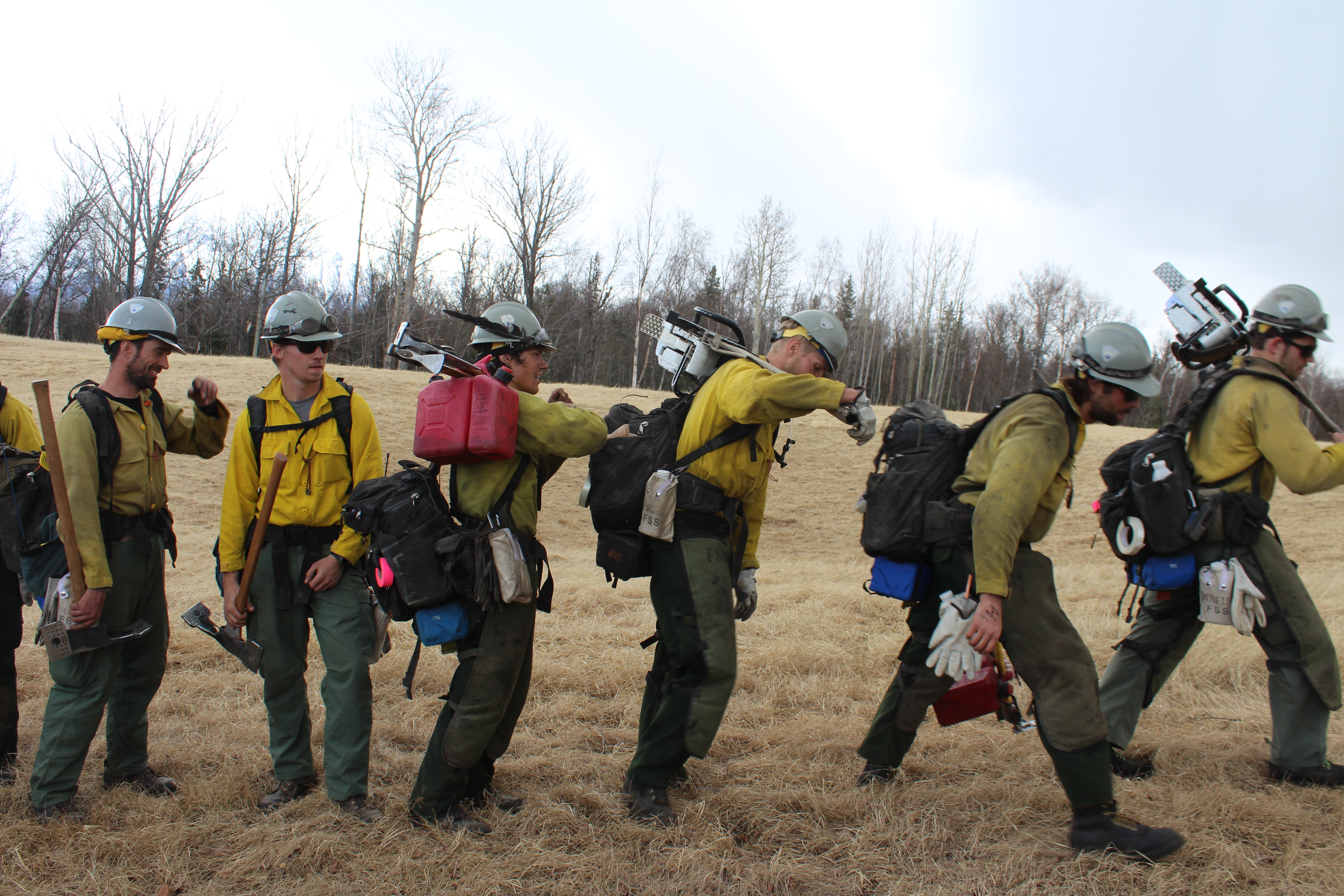
Pioneer Peak and Gannett Glacier share a building off Trunk road, near Mat-Su Regional Medical Center. On April 26, the two crews went down the road to the experimental farm after vehicle drills in Palmer. They scurried through fields and trails and wooden glens, practicing various drills to emulate real life scenarios. In the event of a fire, cutting off the supply, or fuel for the flame is essential. When going into a fire, a team will plan everything out, several steps ahead to ensure a safe way out. They scout out the perimeter of the fire and its course and after mapping that out, they establish an exit route. Both crews operate under the Alaska Division of Forestry.
“It’s pretty exciting to see them in action,” said Norm McDonald, Fire Management Officer for the Alaska Division of forestry.
Firefighters usually spend a majority of the winter months keeping in shape, according to Quimby. They often keep active work out regiments so they are ready year-round. These two weeks are a chance to take stock of where everyone is at and to sharpen up with team building exercises.
“We can’t just get into shape in two weeks,” Quimby said.
Most people that do this are pretty active, on and off the clock, Baumgartner said. A majority of these Alaskan firefighters enjoy the nature they protect, often fishing, hiking and enjoying other staples of the outdoors. The job does demand arduous and physical work though.
“We do get older every year,” laughed Kris Baumgartner, Superintendent of the Pioneer Peak Interagency Hotshot Crew.
He said that like most firefighters, he trains for durability, strengthening his core and preparing the rest of his body for the physically demanding and injury prone line of duty. After doing it for so long, he’s developed a custom-fit routine. Between the hazardous environment and all the moving around, he’s put some miles on his body.
“I use foam rollers pretty much every day, a lot of physical therapy,” Baumgartner said.
Like most worthwhile careers, one finds themselves working many hours off the clock Quimby said. To him, Baumgartner and their crews, it’s a lifestyle fueled by camaraderie, purpose and the rush of running into the line of fire to secure a ‘fire line.’
Baumgartner compared it to pre-season training in football. Windy days provide opportunity to practice in a realistic scenario. When it comes to wildfires, wind is one of the strongest enemies in the battle over the land.
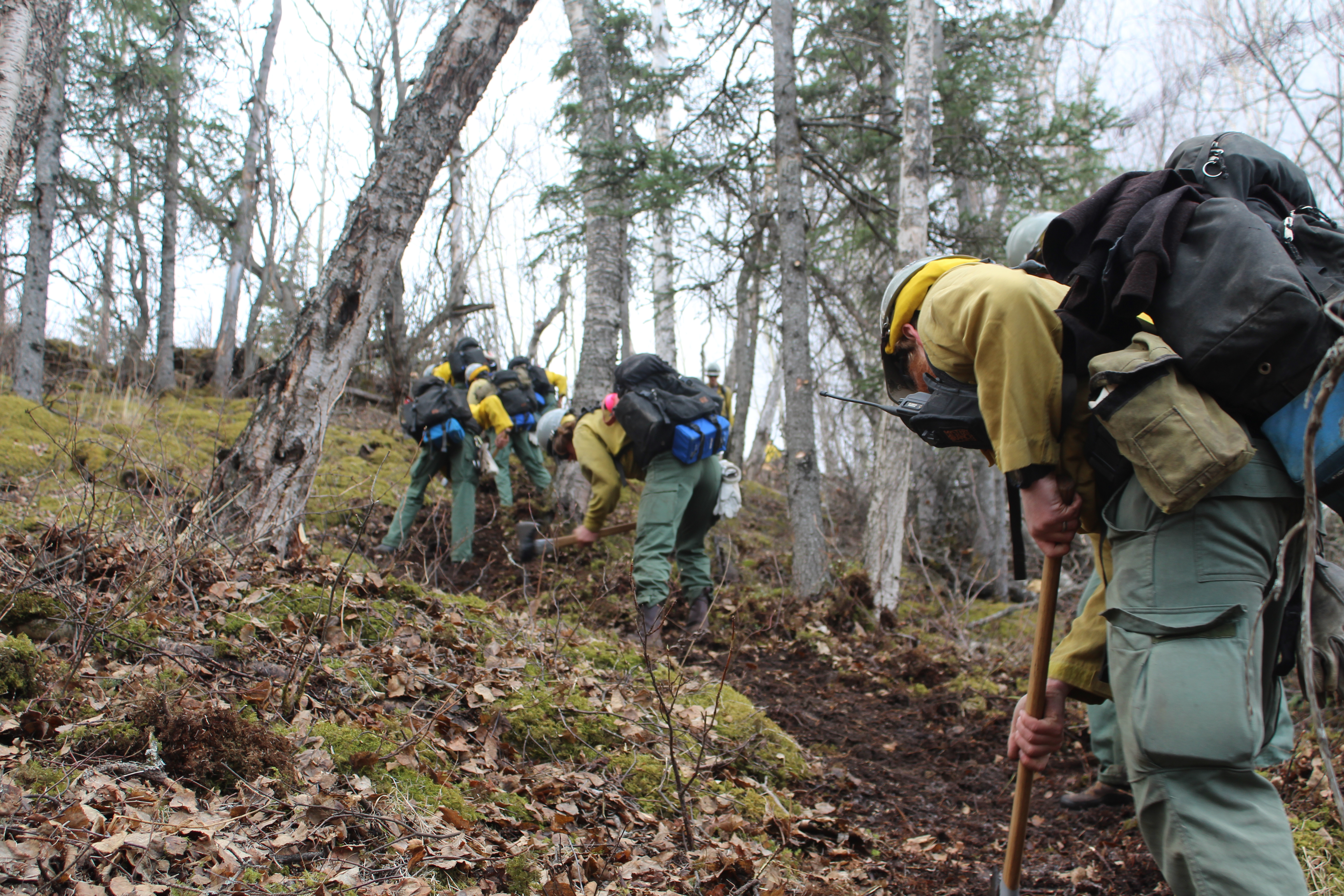
A line of people formed at the base of a hill. In a single-file line, they worked their way up the hill, succeeding a line labor. Chainsaws cut their way through the front of the line and hand tools chopped, chipped and dug their way in behind them, forming a 2 foot wide trail of soil known as a ‘fire line’ in their wake.
“Imagine if you had them on house project,” McDonald laughed.
They progressed with vigorous speed, like a military squadron, shouting directions down the line like a game of telephone. Between line-ups and calls to action, they would sometimes joke and chat with each other, like cogs in a well-oiled machine. Communication is essential in this line of work.
“Swipe and move!” down the line, “swipe and move!” to the very end,” swipe and move!”
Fire lines are an attempt to block a fire path, removing flammable materials or ‘fuel.’ Firefighters clear shrubbery, trees, and so on, leaving bare, flame resistant soil in their wake.
Alaska has its own set of environmental factors that make firefighting its own beast in the Last Frontier. Places like the Interior tend to have more organic material, sometimes hosting shelter for a sneaky flame. Historically, there have been incidents where a smolder prevails through the winter under the ice and emerges in the spring as a roaring flame.
Alaska is one of the leading states in regards to drone firefighting efforts, according to Baumgartner. Sending a drone to scout a fire can protect lives on the field and also can also save money by replacing more traditional helicopter missions. While helicopters will remain a prominent asset against fires, drones can do a number of similar missions at a fraction of the price. Even with recent technological advancements like drones in the mix, humans will always have a place on the field, Baumgartner said.
“It’s very primal. You’re always going to need boots on the ground. You get a hotshot crew together, we can do anything very fast,” Baumgartner said.
“It’s amazing; as the summer goes on, they get more dialed in,” said Sara Saarloos, Public Information Officer for the Alaska Division of Forestry.
Towards the end of the day’s training, the sky cracked. Rain and hail fell down. Nature’s damper may keep some flames at bay but when it comes to stopping a huge fire, it takes a village.
“Rain doesn’t put out fires — crews do,” Quimby said.
Since this was a training exercise and it took place on borrowed lands, they cut to the ground but save the trees.
“This is the first real taste of the season,” Baumgartner said.
Before each exercise, the group of firefighters gathered in a circle for a simulated briefing. With notepads in hand, they jotted down the mission. One person would take a swig of his water while another wiped the sweat from her brow like a scene from boot camp.
The hot show crews tend to interchange between Alaska, California, Oregon and other states in the Lower 48 as the need arises, according to Jared Kemp, assistant superintendent of the Gannett Glacier crew. He was excited to see familiar faces get back into form for the blockbuster months.
“There’s definitely a sense of camaraderie,” Kemp said. “It’s a like a family reunion.”

By Jeremiah Bartz Frontiersman.com A football coach using a hockey reference as the centerpiece for his keynote address may

Frontiersman.com With its headquarters in Wasilla, the Frontiersman has been a primary source of news for the Matanuska-Susitna

By Katie Stavick Frontiersman.com The next generation of leaders took flight this week as the Houston High School Class

By Kyle Wilkinson For the Frontiersman Keynote speaker and Carry the Cure President Bill Pagaran’s words boomed through the