Retiring teacher, coach urges Colony grads to ‘find their 68’
By Jeremiah Bartz Frontiersman.com A football coach using a hockey reference as the centerpiece for his keynote address may


During the Matanuska Susitna Borough School District (MSBSD) school board meeting on Wednesday, Wyatt Perkins a senior at Career and Technical High School (CHTS), wearing a yellow t-shirt, took to the podium to address the board:
“I and multiple members of my student government were investigated a month ago, and while I do appreciate the concern, I would like to say that we organized this ourselves.”
The very brief comment was in response to reports that students and some staff had been questioned as part of an investigation, sparked after the school board meeting on September 6, where members voted 5-2 to change Board Policy 9110, regarding the Student Advisory Representative Role (SABR), under the guise of board membership.
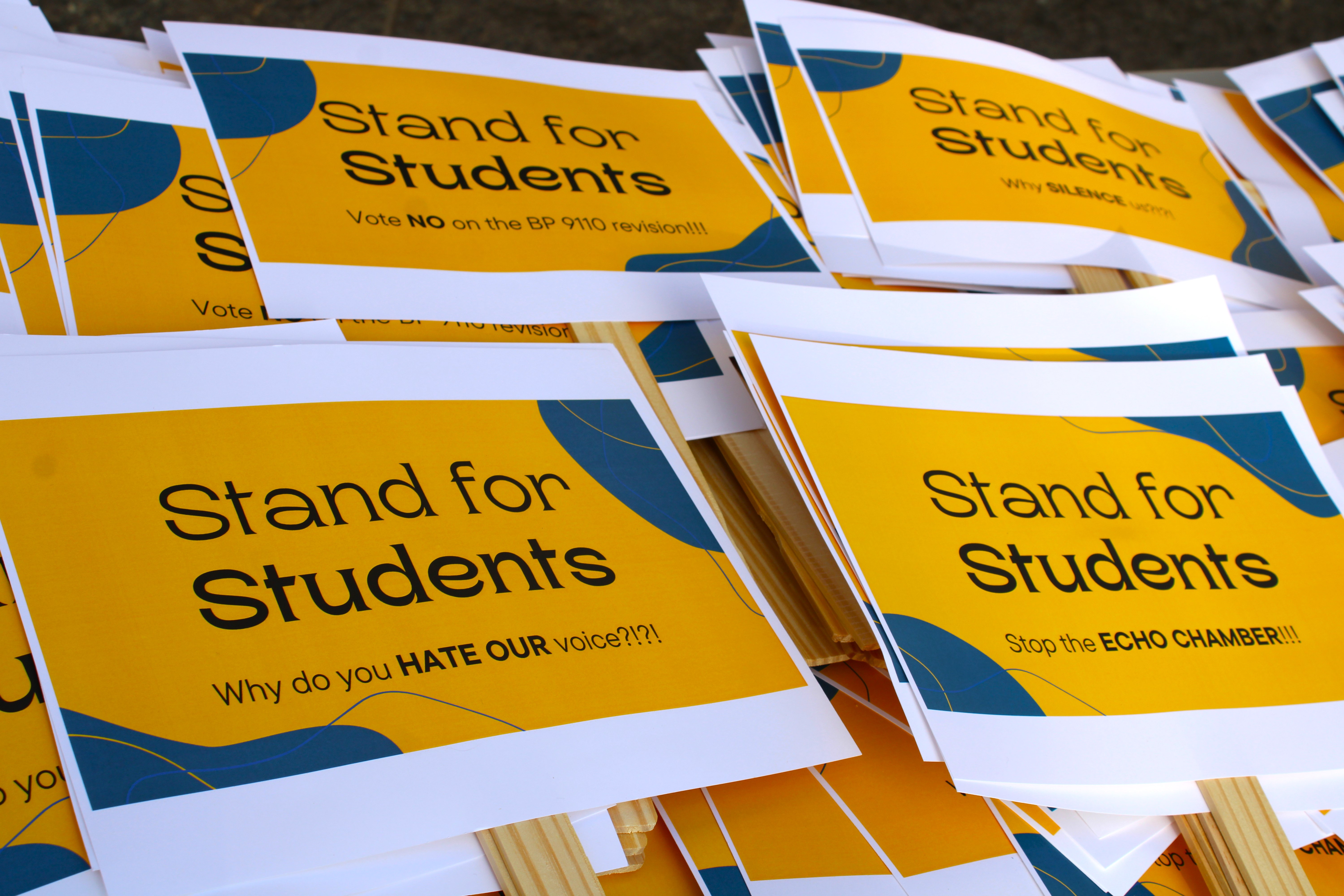
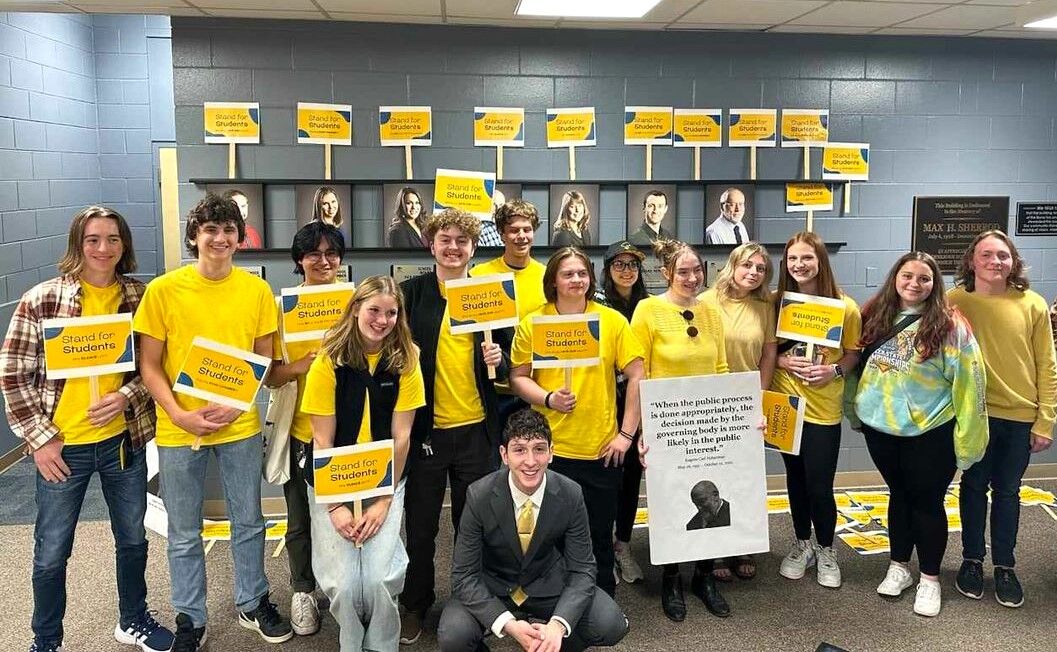
Just before and during the September meeting, students came out to rally in protest to BP 9110, and show support of the SABR, senior Ben Kolendo, by wearing yellow and waving signs in support of the Student Advisory Board.
In the hours leading up to the meeting, a group, calling themselves Alaska Student Voice, made up of students from several local high schools, could be seen putting finishing touches on, and handing out signs to attendees.
“We believe the changes being made to BP 9110 are overall wrong, and they’re stripping the voices of the student to the point that it is objectively reducing the students’ input on all of the policies,” said Perkins before the meeting in September.
The students, who are not all members of the Student Advisory Board, said that it was important to them to show up and be present.
Finn Gannon, a junior at Colony High School and president of his school’s chapter of the Tri-M Music Honor Society, said that he was there to show his support for the same people who had shown up when the board proposed a logical fallacies curriculum last year.
“Students were shocked and hurt. To see something like that happen again, it was important to give back. Student voices are important, so we’re here representing.” Gannon later told the board that he heard about the meeting from a fellow student and came to protest, despite having an AP Physics test to prepare for.
“We can’t keep showing up here putting out fires. That’s why we have our representative, Ben Kolendo,” Gannon told the board that night.
“We still showed that we are listening and that we care what they’re doing,” said Samantha Holler, a senior at CTHS, who also serves as parliamentarian for the student government.
The group listened and spoke at the meeting, hoping to sway the board to reject the changes not just to BP 9110, but also to the ‘lottery system’ change. The board instead voted to change both policies.
“I think they are once again trying to silence voices and they don’t want to hear things they don’t agree with. They can explain away why they are making these changes, say they are redefining the mechanics and venues student input is received and not silence student voices, but they are,” said Perkins in September.
“The need to make the commitment to support the students’ voices, protect our voices, because that’s their job. We are supposed to be their biggest priority over anything else, and I feel like they’ve not been doing that lately.”
“During this meeting, and after the meeting, several talented, bright, articulate, determined, and responsible students organized and fought against the change,” said Jamin Burton, a teacher in the MSBSD who wrote a letter to the editor recently, expressing dismay about the investigation.
Within days of the meeting, several parents and community members called or spoke off the record to the Frontiersman, stating that their students and/or staff were receiving requests to be interviewed for possible violations of Board Policy 4055, which deals with Political Activities of Employees.
According to one parent, who asked to not be named so as to avoid bringing more negative attention to their student, questions were asked in relation to signs the students made, specifically, if they were made during school time.
“The kids did this on their own times without outside influence,” the parent said.
The investigation has not deterred the students from continuing to attend school board and Mat-Su Borough Assembly meetings, wearing yellow t-shirts, the color representing the Student Advisory Board. Still, questions linger about the reasons behind the district inquiry.
“This feels like a backdoor way to block kids’ rights to free speech and political activity. Feels like intimidation so they will not attend meetings without facing punishment or reprisals.”
Others say that the process infringed on the students’ rights.
“They launched an inquisition against the very students they are supposed to be serving,” said Burton. “They (the students) did not have representation. They did not have the option to say no. Their parents were not notified. There was no due process.” Burton said that instead of receiving lessons or instruction, the students instead experienced a lesson on what happens if someone pushes back or steps out of line.
“The school board engaged in the persecution of political adversaries, and their target was the very students they were sworn in and elected to serve.”
Kolendo was one of the students who was called to answer questions, but he exercised his right to notify his parents.
“I was the only student whose parents knew their kid was going to be investigated. I wasn’t going to answer questions until I had the opportunity to talk to my parents.”
He also said that when asked, that no staff members, not his principal, advisors, or teachers, helped with the planning of the protest during class time, and that it was only talked about with his peers outside of school.
In response to the reports, the MSBSD released a statement denying that any students’ rights were violated, and that in the end, there was no violation of policies:
“Concerns are routinely brought to the attention of School Board members by members of the public. In this case community members raised concerns with School Board Members that both school resources and staff time had been used in creation of political materials. As is best practice, the School Board Members passed the concerns onto district office administration. Administration has an obligation to follow up with these types of concerns because they are directly connected to Board Policy. In this instance, BP 4055. Standard operating procedure is for district office administration to then ask school administrators to address school level concerns.
In our district, like school districts around the nation, school administrators, teachers, and other personnel routinely ask students questions about concerns others have raised. Typically, administrators gather information from students first and if no evidence of wrongdoing is discovered, the matter is considered resolved and administrators may not contact parents.
Statements implying that school level administrators somehow violated protocols or student’s rights by asking them questions without calling parents are simply false. In this case, most of the follow up questions administrators asked students occurred in a very informal manner outside of regular class time. To broadly characterize these informal questions by school personnel as “investigations,” or that they wasted considerable class time is inaccurate. If the follow up with a student took more time than a brief conversation, this reflected the Administrator's best judgment in working with the student and their family’s needs.
After the follow up was complete at the schools and school administrators had reported back to district administration, it was clear that the concerns raised by community members were resolved and no violation of board policy had occurred. School administrators acted with integrity and followed best practice during these brief conversations with students.”
Contact Mat-Su Valley Frontiersman reporter Katie Stavick at katie.stavick@frontiersman.com.


By Jeremiah Bartz Frontiersman.com A football coach using a hockey reference as the centerpiece for his keynote address may

Frontiersman.com With its headquarters in Wasilla, the Frontiersman has been a primary source of news for the Matanuska-Susitna

By Katie Stavick Frontiersman.com The next generation of leaders took flight this week as the Houston High School Class

By Kyle Wilkinson For the Frontiersman Keynote speaker and Carry the Cure President Bill Pagaran’s words boomed through the